
Most dog parents find out about separation anxiety after the fact - from a chewed door frame, a note from a neighbor, a puddle in the middle of the living room. You get home, take stock of the damage, and try to guess what happened.
Meanwhile, behaviorists have been saying the same thing for years: separation anxiety is hard to diagnose without a recording. Without video, you're guessing whether your dog went through real distress in the first 15 minutes, or was simply bored for 6 hours. Those are two different diagnoses and two different support strategies.
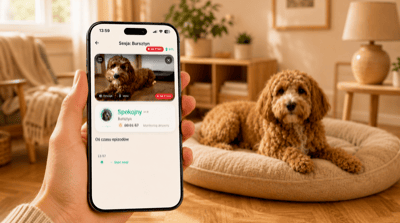
The good news: a dog camera no longer requires a separate investment in dedicated hardware. An old phone in a drawer is enough. In this article I'll show you exactly what you'll see thanks to a recording, how it fits the approach recommended by veterinary organizations (AAHA, ASPCA, RSPCA), and how to use this tool on your own, without needing a behaviorist visit right at the start.
Do you really need a dog camera?
The short answer: yes, if you've ever wondered "how's he doing in there." The longer answer is more interesting.
Without a camera, you have three sources of information about how your dog experiences your absence:
- What you find when you get home - damage, puddles, fur on the furniture. Signals that are 4-8 hours late.
- What the neighbors say - if they say anything at all. Most keep it to themselves until it starts to bother them.
- Your gut feeling - what you sense when you close the door. Valuable, but not scientific.
None of these three sources will show you one crucial thing: exactly when the behavior appears. And that's the question every behavioral assessment starts with.
Separation anxiety has a clear timing pattern: distress peaks in the first 15-30 minutes after you leave, then eases off (unless the stress turns into exhaustion). Boredom works the opposite way, building up slowly across the whole day. Compulsive behaviors (paw licking, tail chasing) show up in cycles every so often. Without a recording, these situations are easy to confuse - each one leaves behind the same chewed door frame.
Dr. Karen Overall, author of "Manual of Clinical Behavioral Medicine for Dogs and Cats" - one of the foundational texts in veterinary behavior - emphasizes that behavioral observation in a dog's natural environment (that is, with a camera rather than in a clinic) is key to telling separation-related difficulties apart from other anxiety disorders. Without the right diagnosis, it's easy to pick the wrong form of support.
5 things you'll see through a camera (that you'd otherwise miss)
The first time you turn on the camera and leave the house, you'll almost certainly see something you didn't expect. Here are the things that surprise pet parents most often:
1. The first 15-30 minutes after you leave
This is the window you never see. Keys in the door, footsteps in the hallway, the sound of the elevator - and then what? Some dogs head straight to their bed and fall asleep. Some start pacing, whimpering, scratching at the door. Some stand still at the window for 20 minutes. Each of these reactions is a different signal and a different strategy.
2. Reactions to pre-departure cues
If your dog gets up and starts panting when you pick up your keys, that's already a sign the anxiety began before you left. A camera set up in the morning captures the whole sequence: how your dog reacts to the alarm, the shower, the hair dryer, putting on shoes. This knowledge opens the door to desensitizing to departure cues, one of the most effective support techniques.
3. Subtle stress signals
Yawning when not sleepy. Lip-licking every few seconds. Brief panting when it isn't hot. Pacing back and forth between the window and the door. These are the classic calming signals that Turid Rugaas describes in dog body language. Many pet parents miss them, because they happen quietly and with no witnesses - according to the RSPCA, as many as half of dogs who struggle with being alone show no obvious symptoms. A camera records what you can't spot after the fact.
4. Reactions to outside triggers
A neighbor comes home at 11:00 and the stairwell echoes. The mail carrier knocks on the door across the hall. The garbage truck stops under the window at 14:30. Your dog reacts, sometimes with a bark, sometimes by standing tense for 5 minutes. These are triggers that can raise stress and arousal. You can't eliminate them, but once you know them, you can plan a food-stuffed toy at specific times, put on calm music, or draw the curtains.
5. Sleep and recovery patterns
An adult dog sleeps 12-14 hours a day. A dog with separation anxiety sleeps 2-3 hours during an 8-hour absence - the rest is time spent on alert with an elevated heart rate. A camera (especially one with sound analysis) shows you whether your dog is recovering during the day or staying on alert until you get home. This matters, because dogs who regularly don't rest enough can have a weakened immune system and a greater tendency toward compulsive behaviors.
Practical tip
For the first 3 days with the camera, just watch, without conclusions and without changes. Give yourself time to notice the pattern. A dog behaves differently on Monday (after a weekend with you) and on Friday (after 4 days of routine). Only after a week do you have a baseline you can work from.
Why a recording helps diagnose separation anxiety
Organizations dedicated to dog health and welfare emphasize the importance of careful behavioral observation, distinguishing between the causes of a problem, and working from concrete data. A recording fits right into this approach:
- AAHA (American Animal Hospital Association) in its "Canine and Feline Behavior Management Guidelines" (2015) recommends a standardized behavioral assessment of the dog, for which observation in the natural environment is a valuable source of information.
- ASPCA (American Society for the Prevention of Cruelty to Animals) describes the typical symptoms of separation anxiety and stresses the need to tell it apart from other behaviors, such as boredom, incomplete house training, or destructiveness in young dogs.
- RSPCA (UK) in its guide to separation-related behavior advises: it's worth recording your dog when they're left alone, because many signals (pacing, panting, whimpering) leave no trace that you see when you get home.
Why? Because without video, each of the situations below looks the same:
| What you see when you get home | Possible cause | What can help |
|---|---|---|
| Chewed door frame | Separation anxiety | Desensitization, a consultation with a behaviorist, and in more severe cases medication prescribed by a specialist |
| Chewed door frame | Boredom | More activity, interactive toys, an extra walk during the day |
| Chewed door frame | A reaction to a trigger, e.g. a cat outside the window | Covering the window, redirecting your dog's attention |
| Chewed door frame | Teething in a puppy | Safe chew toys and patience |
Four different causes, four different strategies, and one and the same trace when you get home. Without video, it's easy to pick the wrong strategy, and then you waste weeks, sometimes months of work.
The classic study by Lund and Jorgensen (1999) in Applied Animal Behaviour Science was one of the first to observe filmed dog behavior in the dogs' own homes. The authors identified four categories of separation-related behavior (exploration, play with elements of hunting behavior, destructive behavior, vocalization) and showed how their intensity changes over time. It's exactly this "what and when" perspective that's only possible thanks to a recording, not from inspecting the home after you get back.
If you're considering a visit to a behaviorist, come with a week's worth of footage. The specialist won't start from a questionnaire and guesswork, but from concrete images. This shortens the assessment and lets you move to a working plan faster.
The camera as a therapy tool - 4 training phases
Diagnosis is just the beginning. The camera gives you the most during systematic alone-time training, that is gradually extending your absence and desensitizing to departure cues. Here's what a four-week plan with a camera looks like:
Phase 1: Baseline (week 1)
Goal: understand how your dog behaves when left home alone. No interventions, no changes to the routine. You simply record every day for 5-7 days and observe. Note down:
- Time from your departure to the first signal of distress
- How long the distress lasts (whether it settled after 20 minutes, or went on for an hour)
- Outside triggers that provoke reactions
- Total sleep time versus time on alert
Phase 2: Desensitizing to departure cues (week 2)
Goal: weaken the association between departure cues and the anxiety response. Pick up your keys 10 times a day and don't leave. Put on your shoes and sit back down on the couch. In this phase, the camera confirms that the reaction to these cues is fading, in other words whether your dog stops getting up and panting at the mere sound of the keys.
Phase 3: Gradually extending your absence (weeks 3-4)
Goal: gradually lengthen the time you're away. Start with 30 seconds, then 2 minutes, 5, 10, 20, 30. The key rule: always come back before your dog starts to get anxious. The camera lets you measure this precisely: you see in real time that your dog is lying calmly, so you can safely extend by another 2 minutes. Without a camera it's easy to come back too late, once your dog has already gotten stressed, and that can set training progress back by several days.
Phase 4: Tracking progress (after week 4)
Goal: maintaining progress and catching setbacks. Once a week, check a session lasting 1-2 hours. Compare it with the baseline from week 1. If the Calm Score or sleep time is rising, you're on the right track. If it's falling, you step back a phase in the plan.
Why this works
A plan based on camera observations is safer than a plan "by feel." If you extend your absence too quickly, your dog may cement the association that being alone is dangerous, and the difficulty with separation can deepen. The camera helps you judge whether it's safe to move on to the next stage.
Video camera or sound analysis? What you really need
There's one thing here that's rarely talked about: video alone isn't enough.
The problem with video alone is that nobody watches a screen for 8 hours. Even if the app records everything, who's going to scrub through 8 hours of footage looking for the 30 seconds when the dog was barking? Most traditional dog cameras have the same flaw: they record, but they don't analyze.
The problem with audio alone, without a picture, is that you hear a bark but you don't know the context - you don't know if it's excitement at the sound of a neighbor in the hallway, or anxiety at the door.
The most practical solution combines a picture with sound analysis:
- AI-powered sound recognition in real time - filters 8 hours down to 5-10 events ("barking 13:14", "whimpering 14:20"). Only those need your attention.
- Video on demand - you get a notification about barking and open the live view. You watch for 30 seconds, see the context, close it. You don't have to manually scrub through many hours of footage.
- Calm Score - a measure of how calm your dog was (from 0 to 100) that sums up the session in a single at-a-glance result. Without it, you'd have to do this by hand from your notes.
A traditional camera (live view only) leaves you with 8 hours of footage and the job of reviewing it. Sound recognition combined with video on demand leaves you with 5-10 notifications that truly matter.
How Merdilo helps you - 3 features that make the difference
Merdilo is an app we build in Toruń - we combine live video with real-time sound analysis. It runs on two of your devices (one as the camera, the other as your live view) and doesn't require buying any extra hardware.
1. Recognizing barking, whimpering and howling in real time
The app analyzes the background sounds in your home and recognizes specific vocalizations: barking, howling, whimpering, and prolonged barking over 30 seconds. Everything happens locally on the device, without sending recordings to our servers. You get a notification with the exact time and type of event: "Merdilo: whimpering detected 13:14, 1 minute after you left."
2. The Calm Score, a result that sums up the session
After each session you get a Calm Score on a scale of 0 to 100. It comes from analyzing several dimensions - among others, how long your dog vocalized and how the reactions were spread out over time. Thanks to this you can compare days without reviewing footage. Tuesday 78 points, Wednesday 64, what changed? Maybe Wednesday was hot and your dog was on edge. The Calm Score shows patterns, not single incidents.
3. Live view with two-way audio
In Premium mode you can open the live video at any moment: you see, you hear, and (if you want) you can speak. This is an option for calm dogs. For dogs with separation anxiety, during the first few weeks it's worth using the live view for observation only, because your voice without your presence can heighten distress.
See what your dog really does when you leave
Merdilo lets you turn an old phone into a dog camera - with bark recognition, a Calm Score after every session, and live view. Without buying any extra hardware.
Do you need a dedicated dog camera? Not necessarily
The market for dedicated dog cameras has grown a lot in recent years. Most of them are a separate device you set up at home, connect to Wi-Fi, and control through the manufacturer's app. They can be convenient, but they come with three costs: buying the device, often a recurring subscription for AI features, and no control over where the video from your home ends up.
Meanwhile, you probably have an old smartphone in a drawer - a phone from a few years back, a child's device that nobody uses anymore. That's enough for a dog camera, as long as it has:
- A working camera (usually a minimum of 8 MP is enough)
- Wi-Fi at home
- A modern operating system (check the requirements of the specific app)
- The ability to stay plugged in while in use (a 6-8 hour session will drain the battery, so the phone needs to be in the outlet)
The upside of the phone approach isn't just skipping a separate investment. There's also privacy: if you choose an app with local processing, sound recognition runs directly on your device, and the video stream can be sent between your two phones without passing through external servers. That matters more than 4K resolution or an electronic treat dispenser - especially in a home with a busy family life.
The second upside is mobility: you can carry the phone that acts as the camera into another room whenever you want to watch your dog in different parts of the home. With a dedicated stationary device, you mount it once and don't move it.
If you're comparing your dog's stress signals in different rooms (the bedroom versus the living room), the flexibility of a phone is hard to overstate.
How to start in 5 minutes - 3 steps
Three steps are all it takes to see, for the first time, what's happening with your dog:
Step 1: Download the app on both devices (3 min)
Download Merdilo on your main phone and on the old one that will stay with your dog. For the first 7 days you have full access to every feature - sound recognition, alerts, and the Calm Score - and you can cancel the trial at any time.
Step 2: Set up the old phone in your home (1 min)
Lay or stand the old phone somewhere with a view of your dog's bed or the entrance to your home. Plug it into the charger - a 6-8 hour session will drain the battery. Turn on "Camera" mode in the app.
Step 3: Go out for a 15-minute test (1 min)
Keep the first test short - 15 minutes is plenty. Pop out to the post office or to the store for some bread. When you get back, you'll see the Calm Score from that short session and a list of the sounds that were detected. That's your first real picture of what happens in the first minutes of your absence.
After that first test, most pet parents say the same thing: "I had no idea my dog behaved like that." A concrete picture like this helps replace guesswork with facts, and that's exactly the approach recommended by veterinary organizations that work on dog behavior.
Summary - key takeaways
- Without a recording it's very hard to tell separation anxiety apart from boredom, reactions to triggers, or compulsive behaviors: four different diagnoses, one trace when you get home.
- Veterinary organizations (AAHA, ASPCA, RSPCA) recommend careful observation of a dog's behavior and working from concrete data, and a recording fits right into this approach.
- The timing pattern of the reactions is the diagnostic key: separation anxiety peaks in the first 15-30 minutes, boredom builds up slowly, compulsive behaviors are cyclical.
- A camera alone isn't enough: without sound analysis, nobody will scrub through 8 hours of footage. Sound recognition filters it down to 5-10 events that truly matter.
- An old phone can replace a dedicated camera, and on top of that it gives you more control over privacy (local processing) and mobility.
- A four-week plan with a camera (baseline → desensitizing to departure cues → gradually extending your absence → tracking progress) is a framework you can work through on your own. The exception is situations where your dog injures themselves, in which case it's worth consulting a behaviorist.
Your dog doesn't need you to stop going out. Your dog needs you to understand how they experience your absence, and to have concrete tools to help. A camera is one of those tools. Before you change anything, it's worth seeing it first.
Sources
- Lund, J. D., & Jorgensen, M. C. (1999). "Behaviour patterns and time course of activity in dogs with separation problems." Applied Animal Behaviour Science, 63(3), 219-236.
- Sherman, B. L., & Mills, D. S. (2008). "Canine anxieties and phobias: An update on separation anxiety and noise aversions." Veterinary Clinics of North America: Small Animal Practice, 38(5), 1081-1106.
- Overall, K. L. (2013). "Manual of Clinical Behavioral Medicine for Dogs and Cats." Elsevier Mosby. Chapters on anxiety disorders and behavioral observation.
- AAHA (American Animal Hospital Association) (2015). "Canine and Feline Behavior Management Guidelines." aaha.org
- ASPCA. "Separation Anxiety." aspca.org
- RSPCA. "Separation-related behaviour in dogs." rspca.org.uk
- Rugaas, T. (1997, 2nd ed. - 2006). "On Talking Terms With Dogs: Calming Signals." Dogwise Publishing.
This article is for informational purposes and does not replace a consultation with a veterinarian or a certified behaviorist. If your dog is showing serious signs of separation anxiety - injuring themselves, howling for many hours, or refusing food - consult a specialist.