
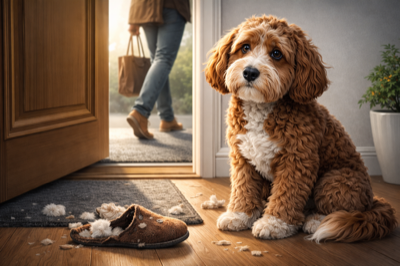
You come home and find a shredded pillow. Your neighbor mentions the barking again. And your dog greets you like you just got back from a trip to Mars, when really you were only out running errands.
Sound familiar?
If so, your dog may be dealing with separation anxiety - one of the most common behavior problems in dogs. It affects as many as one in five dogs, so you're truly not alone in this.
In this article I'll explain what separation anxiety actually is, how to recognize it, and - most importantly - how to help your dog, so you can both feel at ease again.
What is separation anxiety in dogs?
Let's start with the most important thing: separation anxiety is not spite or revenge. Your dog isn't chewing your shoes because they're mad at you for leaving. They're genuinely suffering.
Picture a panic attack - racing heart, no way to focus, overwhelming fear. That's exactly how a dog with separation anxiety feels when they're left alone.
It's a real anxiety disorder, in which the dog feels intense stress while you're away. They can't control it - they're reacting to overwhelming fear, much like a person in the middle of a panic attack.
How many dogs have this problem?
Research shows that separation anxiety affects 14-20% of all dogs. With hundreds of millions of pet dogs around the world, that adds up to an enormous number of dogs quietly struggling with this.
So if your dog has separation anxiety, they're in very good company. And just like other dogs, yours can be helped too.
How to recognize separation anxiety: the signs to watch for
Not every dog that barks while you're out has separation anxiety. The key is when the trouble starts.
The magic line: the first 30 minutes
Here's the most important clue: a dog with separation anxiety starts to panic almost immediately after you leave - usually within the first 5-10 minutes. The stress peaks during the first half hour.
A dog that's simply bored will cause trouble throughout the day, and the "mischief" tends to build up over time. That's a completely different pattern.
The most common signs of separation anxiety
Your dog barks, howls, or whimpers when left alone
This is the most common and, well, loudest sign - literally. Your dog might:
- Bark nonstop, with no clear reason
- Howl mournfully (neighbors often think the dog is hurt)
- Whimper and whine
Important: If your dog only barks when they hear neighbors in the hallway or other dogs, that's more likely reactivity to triggers, not separation anxiety. Learn more about the 7 types of barking and what causes them.
Your dog destroys the house - but in specific spots
Pay attention to where your dog does the damage:
- At the front door? - a classic sign of separation anxiety (the dog is trying to "escape" after you)
- By the windows? - same thing
- Your things - clothes, shoes, a pillow that smells like you?
- Randomly all over the place? - that's more likely boredom than anxiety
A dog with separation anxiety focuses the destruction around places tied to your leaving. It's no coincidence.
Your dog has accidents indoors (even though they're house-trained)
A house-trained dog that suddenly starts peeing or pooping indoors only when you're away may be dealing with separation anxiety. Stress literally loosens their control over their bladder.
But first: Always rule out medical issues with your vet. A urinary tract infection can cause similar signs.
Subtler stress signals
If you can record your dog while you're away, watch for:
- Pacing back and forth (repetitive circling)
- Heavy panting
- Drooling
- Trembling
- Lip-licking and frequent yawning
These are all stress signals that are easy to miss, because they don't leave "evidence" like a shredded pillow.
Separation anxiety or plain boredom? A quick test
Leave your dog a stuffed chew toy with their favorite treats and step out for 30 minutes:
- A bored dog - will dig right in
- A dog with separation anxiety - may not even touch it (too stressed to eat)
Why does my dog have separation anxiety?
You're probably wondering, "Did I do something wrong?" In most cases, no. Separation anxiety has many causes, and most of them are out of your hands.
A rough start in life
Dogs taken from their mother and littermates too early (before 8 weeks of age) are far more prone to anxiety problems. Puppies from puppy mills and backyard breeders often struggle with this.
If you adopted your dog from a shelter, their earlier experiences (being abandoned, past trauma) may have left a mark.
Genes and breed
Some breeds are more prone to separation anxiety. Labradors, Border Collies, German Shepherds, Cavalier King Charles Spaniels, and Cocker Spaniels are dogs that bond very deeply with their people. It's a beautiful trait, but it comes at a cost.
Changes in life
Separation anxiety can appear suddenly after:
- Moving to a new home
- A change in your work schedule (for example, the end of working from home)
- A family member moving out or passing away
- A frightening event while the dog was alone (a storm, an alarm going off)
Is it my fault for spoiling them too much?
No. For years, owners were told that separation anxiety comes from "over-attachment" and that they shouldn't cuddle their dog so much. Newer research shows that this simply isn't true.
The problem isn't that you love your dog too much. It's more that some dogs have an "insecure" attachment style - a bit like people who constantly need reassurance in their relationships.
How to help a dog with separation anxiety
The good news: separation anxiety can be treated. Most dogs improve significantly with the right approach. The bad news: it takes time and patience.
Method 1: Gradual desensitization (this really works!)
The most effective method is called "systematic desensitization." It sounds complicated, but it comes down to something simple: you teach your dog that your departures are OK, starting with very short absences.
How to do it:
- Start with seconds - Get up, grab your keys, step out the door for 5 seconds, and come back calmly. Repeat a few times.
- Build up slowly - 10 seconds, 30 seconds, one minute, two minutes... Only increase the time if your dog stays calm.
- Midway goal: 40 minutes - Once your dog can handle 40 minutes without stress, you can start increasing in bigger jumps (5-15 minutes).
- Final goal: 90 minutes - Dogs that can tolerate an hour and a half apart usually do fine with a full workday too.
Key rules:
- Never cross the line where your dog starts to panic
- If you see signs of stress, take a step back
- Train every day, but keep it short (a few repetitions)
- Be patient - this can take weeks or months
Method 2: Uncoupling the leaving routine
Your dog has learned that keys = you're leaving = panic. You can "unwire" that:
- Pick up your keys and don't leave - just set them back down
- Put on your shoes and sit on the couch
- Put on your jacket and go make yourself a cup of tea
Do this many times a day, at random. Your dog will stop associating these actions with you leaving.
Method 3: Calm departures and returns
This is hard, but it matters:
- Don't drag out goodbyes - no "I'll miss you, sweetie, be good." A calm "bye" is enough.
- Don't turn homecomings into a ceremony - I know your dog greets you like you're back from war, but wait until they settle down before you say hello.
Why? Because long goodbyes and ecstatic hellos reinforce your dog's belief that your comings and goings are a huge deal.
When should you see a specialist?
With moderate or severe separation anxiety, working on it at home may not be enough on its own. In that case, it's worth booking an appointment with a veterinary behaviorist - beyond training support, a specialist can assess whether other kinds of help are needed.
Reaching out to a specialist is nothing to be ashamed of. The tougher the case, the more the behavioral work benefits from being guided by someone who has already seen many dogs with similar signs.
What about extra support at home?
- Classical music or audiobooks - some dogs are soothed by the sound of a human voice in the background.
- A T-shirt that smells like you - can give a sense of closeness.
- A chew or a food-stuffed toy - keeps your dog busy at first, if they're not too stressed to eat.
These methods won't cure separation anxiety on their own, but they can be a helpful addition to the behavioral work.
What NOT to do - the most common mistakes
Don't punish your dog for the damage
I know it's tempting when you come home to a wrecked house. But punishment doesn't work and can make things worse.
Why?
- Your dog can't connect the punishment to something they did hours ago
- Anxious behaviors are panic - your dog has no control over them
- Punishment raises their overall stress level
- It damages the trust between you
That "guilty" look when you come home? It's not guilt - it's fear of how you'll react. Your dog has learned that your return + the mess = trouble.
Don't get a second dog "for company"
This is one of the most common myths. Separation anxiety is about being apart from you, not about being alone. Another dog usually doesn't help.
Worse, you can end up with two anxious dogs, because the new one "picks up" the panic from the first.
Don't shut your dog in a crate as a fix
A crate can be a safe space for dogs that have been positively introduced to it ahead of time. But for a dog with separation anxiety, being shut in a crate is extra stress.
Panicked dogs try to escape crates, which can lead to broken teeth and serious injuries.
Can it actually be cured?
Yes! Most dogs with separation anxiety improve significantly with the right approach. Research shows success rates ranging from 60% to over 80% when behavioral work is combined with medication where it's needed.
How long does it take?
Be prepared for:
- 8-12 weeks of consistent work in mild cases
- Several months in more severe cases
- Medication (if needed) reaches full effect after 4-8 weeks
This isn't a "by tomorrow" fix, but you'll see progress build up gradually. Every day without panic is a win.
When to seek specialist help?
Consider a visit to a behaviorist or a vet who specializes in behavior problems when:
- Your dog is hurting themselves (for example, scratching their paws raw at the door)
- The destruction is extreme
- You don't see improvement after 4-6 weeks of work
- You feel overwhelmed by the situation
There's no shame in asking for help. A good specialist can speed up your progress considerably.
Summary: what to remember
- Separation anxiety is a real problem - your dog isn't acting out to spite you
- It affects a lot of dogs - you're not alone in this
- The key signal: the trouble starts in the first 30 minutes after you leave
- It can be treated - it takes patience, but most dogs improve
- Punishment doesn't work - and can make things worse
- A second dog isn't the answer - the problem is about you, not being alone
- Watching over your dog helps - recording your dog lets you see what's really going on
Remember: your dog isn't trying to make your life harder. They're genuinely suffering when you're away. But with your help, they can learn that your leaving isn't the end of the world - and that you always come back.
Keep an eye on your dog with Merdilo
Recording your dog while you're away is the first step to understanding the problem. A dog monitoring app helps you see what's really going on - your phone works like a camera, with no extra gear.
This article is for educational purposes. If you suspect your dog has separation anxiety, talk to your vet to rule out any medical issues.
Read next
- 8 signs your dog has separation anxiety (and not just boredom)
- 10 dog breeds most prone to separation anxiety
- Dog barks when you leave? 7 causes and how to fix it
- How long can a dog be left alone? A chart by age
- How to read your dog's body language: 15 stress signals
- Pandemic puppies: why dogs from the COVID era struggle with being alone