
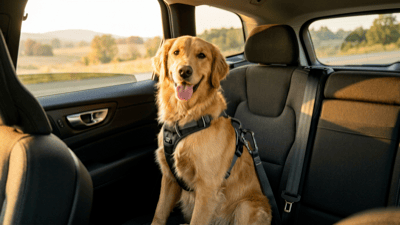
Who this article is for: you're heading out in the car with your dog and you want the trip to be safe and calm for them. Here you'll find an overview of ways to secure your dog and a practical plan for the drive. If your dog handles car rides very badly or gets motion sick, talk it over with your vet ahead of time.
A dog in the car isn't just about comfort. An unsecured dog turns into a projectile in a crash. At around 30 mph, they hit with a force many times their body weight, and for a medium-sized dog that can mean several hundred pounds of impact on the people sitting up front. On top of that there are everyday situations: a dog who climbs under the driver's feet, blocks the mirror, or leaps out of the car when the door opens at a stop.
The good news is that a safe trip with your dog comes down to a few simple decisions. Let's start with what the rules require.
What the rules say
In many places there isn't a single, dedicated law that spells out exactly how to transport a dog, so general road-safety rules apply. Road-traffic law typically prohibits using a vehicle in a way that endangers safety, and the same principles that cover carrying cargo apply to a dog too: anything you carry has to be secured so it can't shift around.
In practice, that comes down to a few simple rules:
- Your dog can't move freely around the car.
- They can't ride on the driver's lap.
- They can't block the view or get in the way of driving.
- They shouldn't be able to jump out of the car when a door opens.
An unsecured dog can earn you a ticket, but honestly, that's not the main point. What's really at stake is the safety of your dog and everyone in the car during hard braking or a collision. That's why it's worth choosing not just a legal option, but simply a good way to secure your dog.
4 ways to secure your dog
There's no single best solution for every dog and every car. The table below compares the four most popular methods, and underneath it we walk through each one.
| Method | Which dogs | Safety |
|---|---|---|
| Travel crate | Dogs of any size | Highest |
| Trunk barrier | Large dogs, wagons and SUVs | High |
| Harness with seat belt | Dogs from about 10 lb up | Medium |
| Back-seat hammock | Small and medium dogs | Low |
Travel crate
This gives the highest level of safety. A dog in a crate doesn't become a projectile in a crash, doesn't get in the driver's way, and won't leap out when a door opens. An added bonus is the sense of a familiar, personal space, which lowers stress for a lot of dogs. The downside: a crate takes up plenty of room, and a dog who has never ridden in one needs to get used to it beforehand so it doesn't become an extra source of stress.
Trunk barrier
A good option for large dogs in a wagon or SUV. Your dog has the whole trunk to themselves but can't get into the cabin. You get peace of mind, and your dog gets room to lie down. The downside: it only works in the right kind of car and usually needs to be installed.
Harness with seat belt
A tether clips into the car's seat belt buckle and connects to a special, sturdy dog harness. It's cheap, simple to set up, and your dog can see out the window, which eases tension for many dogs. The downside: safety depends on the quality. Crash tests show that only certified models truly protect your dog, so this isn't the place to buy the cheapest option.
Back-seat hammock
A mat stretched across the whole back seat, forming a kind of tub. Your dog doesn't slip down between the seats and doesn't mess up the upholstery. It's cheap and easy to wash. The downside: it offers low safety. In hard braking, your dog still gets thrown forward, so treat a hammock more as upholstery protection than as real protection in a crash, ideally paired with a harness.
Preparing your dog for a long drive
The way you secure your dog is only half the battle. The other half is the prep that helps your dog get through the drive calmly.
A light meal ahead of time. Feed your dog about 4 hours before you leave. A full stomach right before the drive raises the risk of vomiting, and a completely empty one isn't great either.
A walk before you set off. 30-40 minutes of movement so your dog gets tired and burns off some energy. A tired dog usually sleeps through most of the drive.
A break every 2 hours. A short stop for a bathroom break, 10-15 minutes of walking, and some water. It's good for your dog and for you.
Water always within reach. A collapsible silicone travel bowl doesn't spill on turns and lets you give your dog a drink at every stop.
Pleasant associations. If your dog mostly associates the car with vet visits, it's worth turning that around with short trips to fun places. We cover building calm associations in more detail in our plan for getting your dog ready for a trip.
Dogs in cars and the heat
This is the most important section in the whole article, because it's about your dog's life. There's one rule, and it has no exceptions: never leave your dog alone in a parked car on a warm day, not even for a moment.
A car heats up incredibly fast. According to the RSPCA, even at 72°F (22°C) outside, the inside of a car can reach around 117°F (47°C) within an hour, and it happens in the shade too. Just as importantly, a cracked window, a bowl of water, or a windshield shade won't protect your dog from heatstroke, and they don't make leaving them in the car safe. Heatstroke can set in within minutes, and the most at-risk are puppies, older dogs, dogs with thick coats, and flat-faced breeds.
On the road, keep things cool: run the air conditioning, offer water at stops, and avoid the hottest hours. Watch for signs of overheating, like sudden, loud panting, heavy drooling, deep-red gums, vomiting, or wobbling and disorientation. If that happens, move your dog into the shade, cool them with cool (but not ice-cold) water on the neck, belly, and paws, and get to the vet as fast as you can.
Motion sickness
Some dogs, especially young ones, handle car rides badly. Signs of motion sickness include excessive drooling, vomiting, restlessness, and panting that isn't caused by heat. The good news is you can work on it.
Gradual exposure. Start with very short rides and make them longer over the 2-3 weeks before your trip. Ideally, the ride should end with something your dog enjoys.
An empty stomach for the drive. A light meal a few hours before the drive cuts down on vomiting.
Fresh air. A slightly cracked window helps, but not enough for your dog to stick their head out or jump.
Help from your vet. If your dog struggles a lot despite the prep, talk to your vet. There are effective prescription options that ease motion sickness. Leave the dosing and the choice to your vet, and don't reach for human medications on your own.
The most common mistakes when traveling with a dog
A few habits come up especially often, and each one genuinely lowers safety. It's worth knowing them so you don't repeat them.
- Dog loose or on the driver's lap. This isn't just against the rules, it's dangerous for everyone in the car.
- Head hanging out the window. It looks adorable, but it risks eye and ear injuries from the wind and debris, and in a sudden movement your dog can fall out.
- The cheapest, uncertified restraint. A harness that hasn't passed a crash test can fail in an accident exactly when it's needed most.
- "Just for a moment" in a parked car in summer. That moment is enough for heatstroke to set in. Take your dog with you or leave them at home.
- A big meal right before the drive. The quickest route to nausea and vomiting. Feed your dog ahead of time.
- One long drive with no breaks. Regular, short stops are far gentler on your dog than hours on end without a break.
Peace of mind about your dog doesn't end when the trip does
Once you arrive and your dog is left alone in a new place, a second device (a phone, tablet, or laptop) turns into a camera with sound recognition and live view. You can check that your dog is resting calmly, and get a heads-up if they start to feel anxious.
Frequently asked questions
Can I let my dog ride in the passenger seat?
Yes, but only when they're properly secured. The most common option is a dog car harness with a seat belt tether that clips into the car's seat belt buckle. Your dog shouldn't ride loose, on the driver's lap, or in any way that blocks the view or gets in the way of driving. For extra safety, many pet parents prefer to keep their dog in the back seat or in the trunk behind a barrier.
Is it worth buying the cheapest dog harness?
It's better not to go by price alone. The cheapest harnesses often don't pass crash tests and can fail in an accident. Look for products with a confirmed crash-test certification (such as TÜV testing) and sized to your dog's weight. This is one of those things where it's not worth cutting corners on safety.
How long can a dog go without a break on a drive?
A healthy adult dog can usually handle 2-3 hours of driving without a problem. Puppies and senior dogs need breaks more often, roughly every 1.5 hours. At each stop, give your dog a chance to relieve themselves, have some water, and stretch their legs for 10-15 minutes. Shorter stretches and regular breaks are gentler on your dog than one long haul.
Can I give my dog something to calm them down before the drive?
Only after talking to your vet. Some dogs react badly to sedatives in the car, and sedation can make disorientation and vomiting worse. Gradually getting your dog used to the car usually works better, and for motion sickness there are effective prescription options your vet can recommend. Never give your dog human medications on your own.
Summary
- The rules require your dog to be secured and not to endanger safe driving. The how is left up to you.
- 4 ways: crate (highest safety), trunk barrier (high), harness with seat belt (medium), hammock (low, mainly upholstery protection).
- For a long drive: a light meal ahead of time, a walk before you set off, breaks every 2 hours, and water within reach.
- In the heat: never leave your dog alone in a parked car, not even for a moment. A cracked window and water don't protect against heatstroke.
- Motion sickness: gradual exposure, and if needed, prescription options recommended by your vet.
This article is meant as general guidance. It's best to talk with your vet about which restraint and any medications suit your dog, and to confirm current road-traffic rules with an official source. If your dog handles trips especially badly, discuss it with a professional ahead of time.
Sources and further reading
- Road traffic law. isap.sejm.gov.pl. Rules against using a vehicle in a way that endangers safety, plus the cargo-securing provisions applied to transporting a dog.
- RSPCA. "Dogs Die In Hot Cars." rspca.org.uk. How fast a car heats up and why a cracked window and water don't protect a dog from heatstroke.
- AAHA (2015). "Canine and Feline Behavior Management Guidelines." aaha.org. Building positive associations and getting a dog used to new situations.