
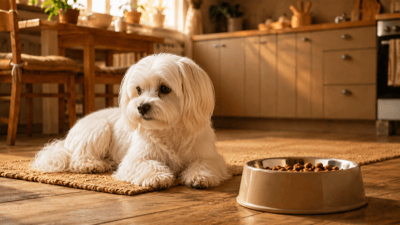
Who this article is for: your dog has stopped eating or is eating much less, and you suspect stress is behind it. This is educational and helps you keep an eye on the situation, but it isn't a diagnosis. Loss of appetite can also be a symptom of illness, so if it lasts longer or comes with other signs, talk to your vet.
A dog's appetite is a sensitive indicator of how they feel. When a dog is under stress, their body's cortisol level rises, the hormone that triggers the "fight or flight" response. In simple terms, the body then diverts its resources to dealing with the threat: blood flows away from the digestive system toward the muscles, digestion slows down, and hunger signals fade into the background. Your dog's brain focuses on the potential threat, not on food.
This is natural physiology. Briefly skipping a meal on a tough day usually isn't dangerous. It becomes more of a concern when the stress drags on and the lack of food starts to affect your dog's health. Below you'll find the 5 most common reasons for refusing food, a clear signal of when to watch and when to act, and practical ways to make eating easier for your dog.
5 reasons your dog isn't eating
Before you change anything, it helps to understand where the lack of appetite comes from. Here are five common causes. Some of them you can solve on your own, and some call for a vet visit.
Reason 1: Acute stress (after a trip or a move)
This is one of the most common causes. In a new situation, a dog withdraws on a physical level too. A move, a vacation trip, a vet visit, a new dog or a baby arriving in the home. Any big change can take away a dog's appetite for a while.
What to do: give your dog time. Most dogs return to normal within 24-48 hours. Provide calm, a safe spot and your presence. Don't build tension around food, because your dog will pick up on it.
Reason 2: Separation struggles (won't eat when left alone)
A dog who eats well when you're there but leaves a full bowl when you go out is a classic picture of separation struggles. The tension during your absence is so strong that the digestive system clearly slows down. Food then fades into the background, because your dog is focused on keeping watch and waiting by the door.
What to do: this isn't about food itself, it's about lowering the stress of being apart. Desensitization training for being alone can help. As a short-term fix, try feeding your dog right before you leave or right after you get back, when they're calmer.
Reason 3: Health (teeth, stomach, illness)
Loss of appetite doesn't always come from stress. A toothache or gum disease can make a dog afraid to chew. Stomach trouble, kidney or liver disease also take away the desire to eat. Sometimes a drop in appetite is the first, subtle sign of a more serious illness.
What to do: if your dog has no clear reason to be stressed and still won't eat, or the loss of appetite drags on, book a vet visit. Your vet will check the teeth, assess your dog's condition and decide on any tests. This cause can't be ruled out at home.
Reason 4: The food (a switch or freshness)
Sometimes the reason is completely mundane. You recently switched food brands and your dog simply doesn't like the new one. Or an open bag has been sitting around a long time and the food has lost its aroma. It also happens that a dog prefers dry food over wet, or the other way around.
What to do: if you recently changed foods, go back to the previous one as a test. Check the use-by date and how it's stored. Try warming the food slightly, since warmer food smells stronger and becomes more tempting for your dog.
Reason 5: Overstimulation (too much going on)
A dog in an excited state doesn't focus on eating. Kids running around the house, guests, noise from outside, bustle in the kitchen. In all that commotion the bowl fades into the background, because there's simply too much happening around them.
What to do: feed your dog in a calm spot, away from distractions. A dedicated corner, a closed door, no one peeking in or interrupting. Your dog should feel that eating is a safe, calm moment.
Stress-related loss of appetite vs illness - how to tell the difference
The most common question is: how do I know whether it's stress or something more serious? You can't be fully certain at home, but a few signals help narrow it down.
Stress-related loss of appetite usually has a clear trigger (a trip, a move, being left alone) and comes on suddenly. Apart from eating, the dog behaves fairly normally: drinks, responds to you, plays and passes stool as usual. Once the source of stress passes, appetite most often returns within a day or two.
Other signals may point to a health cause: no clear reason to be stressed, accompanying symptoms (vomiting, diarrhea, lethargy, sleeping more than usual), weight loss, bad breath, or careful, one-sided chewing that can point to a toothache. A lack of improvement despite calm conditions should also raise concern. In any of these situations, don't guess, contact your vet.
The 24-hour test - when to see the vet
The longer your dog goes without eating, the more serious the signal. The table below helps you judge when to calmly watch and when to act. Treat it as a guide, not a substitute for contacting your vet.
| Time without food | What to do |
|---|---|
| 0-12 hours | Normal. Your dog skipped one meal, nothing needs to be done. |
| 12-24 hours | Keep watching. Check for other signs: energy level, drinking, stool. |
| 24-48 hours | Call your vet for advice. Offer a treat and check whether your dog is drinking. |
| More than 48 hours | See your vet. |
| Drinking less and not eating | See your vet urgently, the risk of dehydration is rising. |
| Not eating with weakness or vomiting | See your vet immediately, this may be a sign of serious illness. |
Puppies, small-breed dogs and seniors are more sensitive. For them, not eating raises the risk of a dangerous drop in blood sugar faster, so respond sooner than you would with a healthy adult dog. The same goes for dogs with chronic conditions.
No matter what the clock says, certain symptoms mean an urgent visit: a hard or bloated belly, whimpering when the belly is touched, clear lethargy, pale gums, or repeated vomiting. If you see any of these, don't wait for more hours to pass.
How to make eating easier for a stressed dog
Once you know it's more likely stress than illness, you can help your dog with a few simple approaches. None of them replaces working on the source of the tension, but they can make it easier for your dog to start eating.
Warm the food. Slightly warm wet food smells stronger, so it's easier to catch your dog's interest. It should be lukewarm, close to body temperature, but not hot. Check the temperature before serving.
Serve the food in a toy instead of a bowl. A stressed dog sometimes can't eat calmly from a bowl. Food served in a stuffable toy (for example a Kong) requires licking, and rhythmic licking has a calming effect on many dogs. For some dogs, this is exactly what breaks the barrier and lets them start eating.
Feed in a calm spot. A dedicated corner, a closed door, no noise. Your dog should feel that eating is a safe activity, not just one more distraction among many.
Don't force it. Feeding by hand, piece by piece, usually doesn't help, because your dog doesn't learn to eat on their own. Leave the food out for 20-30 minutes. If your dog doesn't eat, take the bowl away and offer food again in 2-3 hours.
Don't comfort them over the bowl. A tender "poor thing" at a full bowl sounds caring, but some dogs then learn that not eating brings your attention. Behave neutrally, as if everything is fine.
Add something tempting. A spoonful of dog-safe pâté on top of the food, or a piece of plain cooked chicken breast with no seasoning, can be the first nudge that gets your dog to start the meal. Once they begin, they often finish the rest.
How to check whether your dog eats when left alone
Your dog's appetite is hardest to judge when you're the one leaving. You come home, the bowl is empty, but you don't know when your dog ate, or whether they did it calmly or only right before you got back. And that's exactly the information that says the most about whether separation stress is at play.
A second device left with your dog (a phone, tablet or laptop) lets you watch this without guessing:
- Live view. You open the video and see whether your dog went to the bowl, or paced by the door for a long time first. That's a concrete observation, not a guess.
- A notification when your dog gets anxious. If your dog starts whimpering or barking instead of eating, you get an alert. It's a hint that separation tension may be behind the loss of appetite, and that it's worth working on.
This kind of watching won't give you a diagnosis, but it helps you spot a pattern: whether your dog doesn't eat only when you're away, or not at all. The Calm Score, a supporting score in the app on a 0-100 scale after a session, makes it easier to compare days. It isn't a medical measure or a diagnosis, just a hint of whether your dog's calm is improving. It doesn't replace a consultation with a vet or a dog behaviorist.
See whether your dog eats calmly while you're away
A second device left with your dog becomes a camera with sound recognition. You'll see whether your dog goes to the bowl or starts getting anxious, and it's easier to decide whether separation stress is at play.
Frequently asked questions
My dog hasn't eaten for 36 hours but is drinking normally. Is that serious?
More than 24 hours without eating is a warning sign. It's worth calling your vet for advice. If your dog is active, drinking normally and passing stool, there's no need to panic yet, but don't ignore it. Puppies, seniors and dogs with chronic conditions need a faster response, because they're at risk of a drop in blood sugar.
My dog won't eat their food but happily eats treats. What does that mean?
Usually this means a lack of appetite for that specific food, not a wider health problem. Try switching foods, warming it up slightly, or adding a tasty topper. If your dog is picky and refuses food for a week or longer, book a vet visit to rule out a health cause.
After a trip my dog won't go back to their usual food. What should I do?
While you were away your dog may have been getting tastier things, so going back to regular food feels like a step down. Transition gradually over a week: for the first two days mix 70 percent regular food with 30 percent of the tastier food, then increase the share of regular food every few days.
Can I give my dog broth to encourage them to eat?
Usually yes, as long as it's broth without salt, onion, garlic or seasonings, or a ready-made product made for dogs. The smell can tempt your dog to eat and often works as a good first nudge to get them started. It doesn't replace complete food long-term, but as a starter incentive it usually helps.
Supplements or appetite stimulants. Are they worth it?
If your dog isn't eating because of stress, a supplement alone usually doesn't fix the root of the problem. What matters most is lowering tension and creating calm conditions to eat. If you suspect a health cause, leave the choice of any supplements or appetite stimulants to your vet. Some are prescription-only and need supervised dosing, so don't give them to your dog on your own.
Summary
- 5 reasons for not eating: acute stress, separation struggles, illness, the food and overstimulation.
- The 24-hour test: up to 12 hours is normal, 12-24 hours is time to watch, over 24 hours means calling for advice, over 48 hours means a visit. Puppies and seniors need a faster response.
- What helps: warmed food, eating from a stuffable toy, a calm spot, a tempting topper and no emotional comforting over the bowl.
- Don't delay when the loss of appetite involves a puppy or a senior, or when it comes with other symptoms such as weakness or vomiting.
This article is educational and helps you keep an eye on your dog's appetite, but it isn't a diagnosis or a treatment recommendation. Loss of appetite can be a symptom of illness. If your dog goes without eating longer than the table above indicates, or if it comes with other worrying signs, talk to your vet. Any supplements or dietary changes are also worth discussing with your vet.
Sources and further reading
- American Animal Hospital Association (2015). "AAHA Canine and Feline Behavior Management Guidelines." aaha.org. Guidelines on managing stress and anxiety in dogs and the vet's role in ruling out medical causes.
- Today's Veterinary Practice. "Dysrexia in Dogs and Cats." todaysveterinarypractice.com. A clinical overview of appetite disorders in dogs and cats and their causes.
- Overall, K. L. (2013). "Manual of Clinical Behavioral Medicine for Dogs and Cats." Elsevier Mosby. A reference on how stress and anxiety affect a dog's behavior and physiology.
Read also
- Teaching your dog to be alone - systematic desensitization step by step
- Interactive toys for a dog left alone - what really works
- Your dog is afraid of thunderstorms - what to do step by step
- Your dog licks their paws - when it's stress and when it's something more
- How much do dogs sleep a day - and when sleep signals stress