
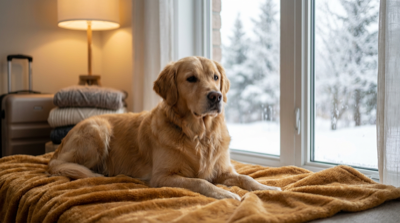
For a lot of us, a winter trip is the one real chance all year to break from the everyday - head to the mountains, visit family, or just rest. But when you have a dog, one question can take the shine off all that excitement: what do you do with your pup?
Leaving your dog while you travel is a decision that keeps plenty of pet parents up at night. The guilt, the worry about how your dog will cope, a hundred questions running through your head... Sound familiar?
Here's the good news: you can go away and not feel terrible about it. In this article, I'll show you how to prepare your dog for your time away, what care options you have, and how to make sure both you and your four-legged friend get through it calmly.
Take your dog along or leave them home? How to decide
Before you start looking for a sitter, think about whether your dog even needs to stay home. Some dogs love to travel and enjoy new places. Others - quite the opposite.
When it's worth bringing your dog along
Your pup can make a good travel companion if they:
- Are used to car rides and don't get stressed in the car
- Do well in new places - no panic, happy to explore
- Are headed somewhere dog-friendly (lodging, activities, weather)
- Don't have health issues that could flare up on the road
When it's better to leave your dog at home
Leaving your dog at home may be the better call when:
- Your pup travels poorly - throwing up, trembling, getting overly worked up
- You're traveling with a big group (kids, for example) and your dog doesn't like the crowd
- You're planning activities your dog can't join (skiing, museum visits)
- Your dog is older or has health issues
- The trip is long and the destination isn't especially pet-friendly
Remember
Deciding to leave your dog behind doesn't make you a bad pet parent. Sometimes the best care is giving your pup calm and stability in a familiar setting. See how long a dog can be left alone by age.
Care options while you're away
You have a few tried-and-true options. Each has its pros and cons - pick the one that fits your dog and your budget best.
Option 1: Family or friends
This is by far the most popular choice among pet parents - and often the best one for your dog.
Why it works:
- Your dog stays with someone they know (less stress)
- The person has an emotional bond with your pup - they genuinely care about their wellbeing
- Usually cheaper than professional services
- Easy to stay in touch (photos, updates)
What to watch out for:
- Make sure they really have the time and the space for it
- Leave detailed instructions (feeding, walks, meds)
- Pack everything your dog needs
Pro tip: If your dog is staying at someone else's place, set up a few "trial" visits beforehand so your pup can get comfortable with the new spot.
Option 2: A professional dog sitter
A dog sitter is someone who looks after your dog either in your home or in theirs. It's a fast-growing service, and it's easier than ever to find a reliable sitter near you.
Pros:
- A professional touch - experience with all kinds of dogs
- Your dog can stay in their own home (less stress)
- Regular updates with photos and videos
- Insurance and background checks on the larger platforms
Cons:
- Cost: a daily rate that varies with your area and the level of service
- Your dog spends time with someone unfamiliar
Where to find a dog sitter:
- Dedicated sitting platforms - these vet their sitters, often accepting only a small share of applicants, and offer vet and behavior support plus insurance on every booking
- Booking-protection services - platforms with built-in booking protection that operate across most cities
- Established directories - longer-running services that connect pet parents with local sitters
- International platforms - global sites offering a range of care options in your area
Option 3: Dog boarding
Boarding facilities are for those who want the reassurance of professional care.
Pros:
- Around-the-clock care
- The company of other dogs (great for social pups)
- Professional conditions, often with a live camera
Cons:
- The stress of a new place and unfamiliar dogs
- Higher cost
- Risk of illness (despite vaccinations) from contact with many dogs
- Not every dog handles this kind of environment well
Important
Boarding is a great option for social, well-socialized pups. For anxious or older dogs, it can be too stressful. If your dog has separation anxiety, consider other options.
Option 4: Shared care
An increasingly popular setup: a few people (family, neighbors, friends) split the care between them. Each one looks after your dog for part of your trip.
Pros:
- Less of a burden on any one person
- Your dog can partly stay in their own home
- Flexibility
Cons:
- Takes good coordination
- Frequent changes in caregiver can stress some dogs
How to prepare your dog for time apart
Whichever option you choose, it's worth prepping your pup properly. A few simple steps can meaningfully lower their stress.
The week before you leave
Getting comfortable with the caregiver: If your dog is staying with someone they don't know well, set up shared walks and short visits. Let your pup build a positive association with that person.
Routine is everything: Give the caregiver a detailed daily plan - when your dog eats, when they go for walks, when it's playtime. The closer you can keep to their normal routine, the better.
Check their health: A vet visit before you leave gives you peace of mind that your dog is healthy. While you're there, catch up on vaccinations and check your supply of any meds your pup takes.
What to leave with the caregiver
Put together a "starter kit" for whoever is looking after your dog:
- Food - enough for the whole stay, plus extra
- Favorite toys and a blanket - familiar smells feel like safety
- Leash, harness, poop bags
- Health records and your vet's number
- Your contact details and an emergency contact
- Written instructions - feeding and walk times, special needs, what scares your dog
The goodbye - keep it short and calm
This one's hard but really important: don't turn the goodbye into a big ceremony. A long, emotional farewell raises your dog's stress - it signals to them that something serious is happening.
A better approach:
- A calm "bye, see you soon"
- Head out confidently, without looking back
- Trust that your dog will be just fine
How to stay calm while you're away
You've left, but your mind keeps drifting back to your dog? That's completely normal. Here are a few ways to ease the worry - yours and your pup's.
Regular updates
Agree with the caregiver on how often you'll check in. For most people, one update a day is ideal - a photo, a quick note that everything's OK.
Heads up: Checking in too often can backfire. Instead of calming you, it feeds the anxious thinking. Trust the caregiver.
Technology as a helping hand
If the care happens in your own home, consider keeping an eye on things. Being able to glance at your pup any time gives you incredible peace of mind - without calling and bothering the caregiver.
Monitoring apps let you:
- See what your dog is doing in real time
- Check whether they're calm or unsettled
- Have proof that everything's fine
Keep an eye on your dog with Merdilo
Merdilo is an app that lets you watch over your dog while you're away. It tells barking, howling, and whimpering apart, reads your dog's behavior, and notifies you in real time - so you can enjoy your trip with a clear mind.
Trust the process
Dogs are far more adaptable than we give them credit for. Research shows that most dogs settle down within 30 to 60 minutes of their person leaving, and handle a temporary change in routine well.
Your dog will most likely:
- Sleep through most of your time away
- Enjoy new games with the caregiver
- Greet you wildly when you get back
Coming home - what to expect
You're back! Your dog will probably lose their mind with joy. And here's a small tip: don't lose yours right along with them.
A calm hello
Over-the-top reunions (squealing, jumping - yours and your dog's) reinforce the idea that your comings and goings are a huge deal. Better to:
- Come in calmly
- Wait until your dog settles a little
- Then give them a cuddle and say hello normally
Keep an eye on things for a few days
After you're back, your dog might be:
- Extra clingy (following you step for step)
- A little tired (all those emotions!)
- Or completely normal
All of that is OK. Give them a few days to ease back into their routine.
Take notes for next time
After each trip, ask yourself:
- What worked?
- What could be better?
- Did your dog handle the time apart well?
These observations will come in handy when you plan your next trip.
The bottom line: your dog will be fine (and so will you)
Leaving your dog while you travel doesn't have to be a source of stress. With good preparation and the right care, your pup can get through it just fine - and you can finally rest without a guilty conscience.
The key takeaways:
- Choose a care setup that fits your dog's personality
- Prepare detailed instructions for the caregiver
- Keep the routine - feeding, walk, and sleep times
- Keep goodbyes short and calm
- Trust that your dog will be just fine
Remember: needing a break is natural, and your dog won't love you any less when you get home. Quite the opposite - that reunion after time apart will be one of the warmest moments in your relationship.
Have a wonderful trip!
Scientific sources
- Parthasarathy, V., & Crowell-Davis, S. L. (2006). "Relationship between attachment to owners and separation anxiety in pet dogs." Journal of Veterinary Behavior: Clinical Applications and Research, 1(3), 109-120.
- Schwartz, S. (2003). "Separation anxiety syndrome in dogs and cats." Journal of the American Veterinary Medical Association, 222(11), 1526-1532.
- Herron, M. E., Lord, L. K., & Husseini, S. E. (2014). "Effects of preadoption counseling on the prevention of separation anxiety in newly adopted shelter dogs." Journal of Veterinary Behavior, 9(1), 13-21.
- Mariti, C., Gazzano, A., Moore, J. L., Baragli, P., Chelli, L., & Sighieri, C. (2012). "Perception of dogs' stress by their owners." Journal of Veterinary Behavior, 7(4), 213-219.
- Palestrini, C., Minero, M., Cannas, S., Rossi, E., & Frank, D. (2010). "Video analysis of dogs with separation-related behaviors." Applied Animal Behaviour Science, 124(1-2), 61-67.
- Storengen, L. M., & Lingaas, F. (2015). "Noise sensitivity in 17 dog breeds: Prevalence, breed risk and correlation with fear in other situations." Applied Animal Behaviour Science, 171, 152-160.
This article is for informational purposes and is not a substitute for advice from a dog behaviorist or vet for dogs with serious anxiety issues.