
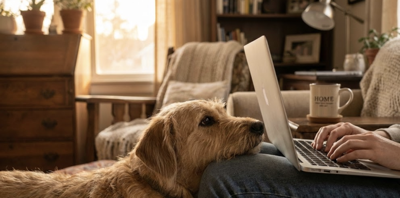
March 2020. Lockdown. The world ground to a halt, and you - like millions of people around the world - thought: "This is the perfect time to get a dog."
And you were right. You worked from home, you had loads of time, you could give a new pup your full attention. The trouble showed up later - when the world went back to normal, and your dog had no idea that people leaving the house is part of normal.
If your pandemic dog struggles with being alone today, this article is for you. We'll explain where it comes from and what you can do about it.
The adoption boom: what actually happened?
The scale of the pandemic adoption boom was unprecedented. Research confirms that global interest in dog adoption jumped by as much as 250% in the first months of the pandemic compared to the year before. In the United States alone, more than 23 million households welcomed a new four-legged family member between the start of the pandemic and January 2022.
The trend looked similar around the world. Shelters recorded record numbers of adoptions, and breeders had waiting lists for puppies. Suddenly everyone wanted a dog - and it's not hard to see why. In a time of isolation, uncertainty, and worry, having a four-legged friend around was a cure for loneliness.
But behind that lovely story lies a real behavioral challenge that many pet parents are only discovering now.
The socialization window: why timing matters
To understand why pandemic dogs have a particularly hard time, you need to know one of the most important ideas in dog psychology - the socialization period.
What is the socialization window?
It's a critical stage in a puppy's development, roughly from week 3 to week 14 of life. During this time, a young dog's brain is like a sponge - soaking up experiences, learning what's safe and what to be afraid of. Everything a puppy experiences (or doesn't experience) during this window shapes their behavior for life.
Under normal circumstances, puppies meet all kinds of people, other dogs, places, and sounds during this time. They learn that the mail carrier isn't a threat, that the dog behind the fence is just a neighbor, and that a car ride isn't the end of the world.
What happened during the pandemic?
Lockdown overlapped with the socialization period of millions of puppies. Studies found that dogs whose socialization period fell during restrictions showed significantly higher levels of fearfulness and reactivity compared to dogs socialized before the pandemic. Specifically, researchers saw a rise in personality traits linked to fear and aggression, which had a strong effect on their later behavioral development.
Picture it: for the first weeks of life, your puppy only ever saw you and your four walls. They never met guests, because guests weren't allowed to visit. They never played with other dogs, because puppy classes were closed. They never walked down a busy street, because the streets were empty.
The result? A dog that looks grown up but, emotionally, never learned how to cope with the normal world. And one of the hardest parts of that "normal world" is the fact that people leave the house.
Hyper-attachment: when closeness becomes a problem
Here's the paradox of pandemic dogs: they got more time with their people than any generation of dogs in history - and that's exactly what became the source of trouble.
Why does too much closeness backfire?
When you work from home 24/7, your dog never experiences you leaving. They never live through the moment where you close the door and disappear - and then come back. They never learn that your absence is temporary.
Research from the UK confirms this pattern. Scientists looked at the effect of changes in how much time dogs were left alone and found that dogs whose people went from working remotely back to the office showed significantly more separation-related behavior. The bigger the change in time spent with the dog, the stronger the stress response.
Research from Japan added to this, finding that three key factors linked to separation anxiety - difficulty with separation, excessive barking, and over-attachment - were tied to changes in how often people were home during the pandemic.
It's a bit like a child who never went to preschool. The first time they have to be away from a parent, the distress is far greater than for a child who learned to handle short goodbyes from an early age.
The outcome: a dog that can't be alone
A pandemic dog may have never experienced being home alone - or experienced it suddenly, with no preparation, when their person went back to the office. Instead of gradually learning to be alone, they got a shock: yesterday you were here all day, today you vanished for 8 hours.
It's a natural consequence of extraordinary circumstances - pandemic dogs simply never got the chance to learn something that earlier generations of dogs picked up automatically.
Stress contagion: does your worry rub off on your dog?
There's one more factor that rarely gets mentioned - and it matters enormously in the context of the pandemic. Your stress directly affects your dog.
What does the science say?
A landmark study published in one of the world's leading scientific journals found something fascinating: cortisol levels (the stress hormone) in dogs and their people are synchronized. People with higher levels of long-term stress had dogs with higher stress levels - and vice versa.
Interestingly, it wasn't the dog's traits that influenced the person, but the person's traits that influenced the dog. Personality traits like neuroticism turned out to be especially significant - people with higher levels of neuroticism had dogs with higher cortisol.
What does this mean in the context of the pandemic?
Think back to 2020. Stress, uncertainty, worry about health, isolation, changes at work. Millions of people were experiencing elevated stress levels - and their dogs felt it.
This phenomenon is called emotional contagion - the process by which one being's emotions "carry over" to another. It works both ways: your smile calms your dog, but your anxiety unsettles them.
Pandemic dogs not only missed out on proper socialization - they also grew up in an atmosphere of their people's heightened stress. It's a double burden, and it has real behavioral consequences.
How to tell if your pandemic dog is struggling
Not every dog adopted during the pandemic has separation anxiety. But it's worth knowing which signs to watch for.
Common behaviors that point to trouble being alone
Notice whether your dog, when left alone:
Barks, howls, or whimpers intensely - especially in the first 15-30 minutes after you leave. This is the most telling pattern of separation anxiety, and it's what sets it apart from bored barking, which builds up gradually.
Destroys things near doors or windows - a dog with separation anxiety tries to "escape" after you. Damage concentrated around exits is a classic sign.
Refuses to eat while you're gone - even favorite treats. A dog under intense stress can't bring themselves to eat, much like a person in the middle of a panic attack.
Greets you over the top when you get home - as if you were coming back from a months-long trip rather than a two-hour grocery run. Intense, frantic greetings can be a sign that your dog had a really hard time while you were away.
Follows you step by step around the house - this is called "shadowing." Your dog won't let you out of their sight, because they're afraid you'll disappear again.
A note: don't diagnose on your own
These behaviors can point to separation anxiety, but they can also have other causes - from health issues to plain boredom. If you see these signs in your dog, it's worth talking to a dog behaviorist who can help pin down the right diagnosis. Learn about 15 subtle signs of stress in dogs that are easy to miss.
What can you do? Practical steps
The good news: even if your dog's socialization window fell during lockdown, it's not too late. Dogs learn their whole lives - they just need the right support.
1. Start with small steps
Don't suddenly leave for 8 hours. Start with 5 minutes, then 10, 15, 30. Gradually stretch out the time you're away, giving your dog the chance to learn that your leaving isn't a crisis - and that you always come back.
The key is for your dog to stay below their stress threshold. If they're calm at 10 minutes but start to panic at 15, step back to 10 and build up slowly from there. Check out our guide to alone time by a dog's age.
2. Set up a departure routine
Studies show that dogs who react to separation suffer most in the first 30 minutes. That's why what you do right before you leave and right after you get back matters so much.
Leaving should be boring and quiet - no dramatic goodbyes. Coming home too - greet your dog calmly, and only give them attention after a moment. The goal is to teach your dog that your comings and goings are a normal, unexciting part of the day.
3. Provide activity before you leave
A tired dog is a calmer dog. A morning walk with plenty of sniffing (a "sniffari") is one of the best ways to prepare your pup for time on their own. Sniffing naturally lowers cortisol levels in dogs.
4. Leave your dog something to do
A stuffable toy with frozen peanut butter, a snuffle mat, a treat-dispensing toy - give your dog something to keep them busy during those critical first minutes after you leave.
5. See what's really happening
Many pet parents have no idea how their dog behaves while they're gone. Recording or keeping an eye on your dog lets you see the real picture - whether they settle down after a few minutes or stay stressed the whole time. That knowledge is invaluable, both for you and for any behaviorist you might work with.
6. Focus on progress, not perfection
Working with a pandemic dog is a marathon, not a sprint. Track the progress - even if it's just "today they held out for 12 minutes instead of 10." Every calm minute is a win you can build on. Many pandemic dogs make huge progress within a few weeks of consistent training.
When to seek professional help
Consider seeing a dog behaviorist when:
- Alone-time training isn't working after 4-6 weeks
- Your dog hurts themselves - scratching at the door until they bleed, breaking teeth trying to get out
- The destruction is serious enough to threaten your dog's safety or your home
- You feel overwhelmed by the situation and don't know where to start
A good behaviorist will help you build an individual plan tailored to your dog's history and temperament. In some cases, a vet may also recommend temporary medication support - not as a solution, but as a tool to make training easier.
In summary: a unique generation, real solutions
Pandemic dogs are a unique generation - adopted out of love, raised in extraordinary circumstances, and now facing challenges that earlier generations of dogs never had to deal with.
If your COVID-era dog struggles with being alone, remember:
- They're not the only dog facing this - millions of dogs around the world are going through the same thing
- There's a clear, scientific explanation - interrupted socialization and sudden changes in the daily routine
- Your calm and patience are your best tools - because your stress carries over to your dog, but so does your calm
- There's hope - dogs learn their whole lives, and with the right support, most pandemic dogs can learn to be alone
Your dog simply never got the chance to learn that your leaving isn't the end of the world. The good news? Now you can give them that chance.
Keep an eye on your dog with Merdilo
Not sure what your dog gets up to when you leave? Merdilo recognizes barking, howling, and whimpering, reads the behavior, and notifies you in real time - so you can see the real picture and track the progress.
Scientific sources
- Ho, J., Hussain, S., & Sparagano, O. (2021). "Did the COVID-19 pandemic spark a public interest in pet adoption?" Frontiers in Veterinary Science, 8, 647308.
- Sacchettino, L., et al. (2023). "Dogs' behavioral and physiological responses to COVID-19 lockdowns: Effects on puppies' socialization." Behavioural Processes, 205, 104823.
- Sundman, A. S., et al. (2019). "Long-term stress levels are synchronized in dogs and their owners." Scientific Reports, 9, 7391.
- Harvey, N. D., et al. (2022). "Impact of changes in time left alone on separation-related behaviour in UK pet dogs." Animals, 12(4), 482.
- Takagi, S., et al. (2025). "COVID-19 pandemic: Effect of changes in the owner's life on dog behavior." Journal of Veterinary Behavior, 82, 18-25.
- Holland, K. E., et al. (2021). "More attention than usual: A thematic analysis of dog ownership experiences in the UK during the first COVID-19 lockdown." Animals, 11(1), 240.
This article is for educational purposes. If you suspect your dog has separation anxiety, consult a vet or a certified dog behaviorist.
Read next
- Separation anxiety in dogs: the complete research-based guide
- 8 signs your dog has separation anxiety (and not just boredom)
- Dog barks when you leave? 7 causes and how to fix it
- How long can a dog be left home alone? A guide by age
- How to read your dog's body language: 15 signs of stress
- How long can a puppy be left home alone? A table by age