
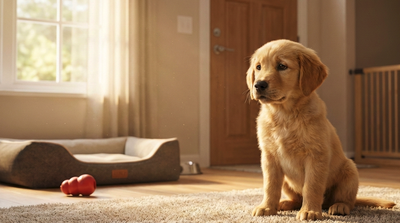
You've had your puppy for a few days and can't imagine leaving them alone. That's completely normal. This little fluffball looks up at you with big eyes and seems so helpless. But life goes on: work, errands, meetings. So the question isn't really whether to leave your puppy alone, but when and for how long you can do it safely.
In this article you'll find a rough chart with recommendations by age, a step-by-step plan for teaching your puppy to be alone, and a list of the most common mistakes worth avoiding. No scare tactics, no guilt trips: just the facts.
The short answer: as a rough guide, a puppy can handle being alone for as many hours as they are months old - up to a maximum of 6 hours. That's a safe upper limit, not a goal - you work up to those windows gradually, building alone-time skills step by step.
- 2 months - about 2 hours
- 3 months - about 3 hours
- 4 months - about 4 hours
- 6 months and up - a maximum of 6 hours (an adult dog up to 6-8 hours)
Why puppies shouldn't be left alone too long
Before we get to the chart, it helps to understand why puppies have different needs than adult dogs. It's not about spoiling them - it's biology and development.
The bladder isn't fully developed yet
A puppy can't control their bladder the way an adult dog can - their urinary system is still developing. A common rule of thumb: as a rough guide, a puppy can hold it without going outside for as many hours as they are months old, up to a maximum of 6 hours. If your pup is 2 months old, they can realistically hold it for about 2 hours. At 4 months - about 4 hours.
Leaving a puppy longer than their bladder allows isn't just about a wet floor. It's a situation that can set back house training - your pup learns that peeing indoors is OK, because there's no other option.
The socialization window
The first 3-4 months of life are the so-called socialization window - the time when a puppy shapes their view of the world. During this period, contact with people, other animals, and new experiences is incredibly important. Too much or poorly managed isolation during this window can raise the risk of behavioral challenges like fearfulness, reactivity, or later trouble being left alone (and in some cases separation anxiety).
Emotional development
A puppy who has just left their mom and littermates needs a sense of security. Their new home, new people, new smells - it's all exciting, but stressful too. A young dog needs regular contact with you to build confidence. That's the foundation their ability to calmly stay alone will rest on later.
Chart: how many hours a puppy can be alone by age
Below are rough recommendations based on the rule of thumb "age in months = maximum number of hours" and on guidance from dog behaviorists and vets. These are upper limits, not goals to reach for.
| Puppy's age | Max. time alone | Notes |
|---|---|---|
| 8-10 weeks | up to 1 hour | Short absences only. Your puppy is still getting to know their new home. |
| 10-12 weeks | up to 2 hours | Start alone-time training with just-a-few-minutes departures. |
| 3 months | up to 3 hours | Set up a safe space (a pen or a separate room). |
| 4 months | up to 4 hours | Your puppy should have access to water and toys. |
| 5 months | up to 5 hours | Still needs a break during an 8-hour workday. |
| 6 months | up to 6 hours | The maximum for a teenager. Don't exceed it regularly. |
| 7-8 months | up to 6 hours | The bladder is more mature, but still a young dog emotionally. |
| 9-12 months | up to 6 hours | Approaching adulthood. 6 hours is still a comfortable maximum. |
Rule of thumb
Age in months = a rough maximum number of hours alone. But never more than 6 hours, even for an older puppy. If you work 8 hours a day, plan for someone to drop in around midday - it's really important support for your pup's comfort and development.
Remember, these are upper limits, not goals to reach for. If your 4-month-old puppy calmly handles 2 hours alone, you don't need to push that time up to 4 hours. Let them learn at their own pace.
When can you start leaving a puppy home alone?
It's worth starting alone-time training from the first days in your home - but with really short moments. We're talking seconds and minutes, not hours. One commonly recommended method is systematic desensitization - and it's the foundation of everything I describe below.
Start with 2-5 minutes
Step into another room and close the door. Wait 2 minutes. Come back calmly. That's enough to begin with. Your puppy learns two key things: first, that your disappearing isn't the end of the world. And second, that you always come back.
Gradually stretching the time
Once your puppy handles 5-minute separations, you can start stretching the time. A schedule might look like this:
- Week 1: 2-5 minutes, a few times a day
- Week 2: 10-15 minutes
- Week 3: 20-30 minutes
- Week 4: 45-60 minutes
- Months 2-3: gradually up to 2-3 hours
The pace depends on your puppy. If your pup reacts with stress to a longer absence, step back and stretch the time more slowly. There's no rush.
The first real time out of the house
Before you leave the house for longer (say, for groceries), make sure your puppy can handle being alone in a closed room while you're in another part of the home. If your pup calmly rests in their pen for 30 minutes while you're in the kitchen - that's a good sign they're ready for a short trip out of the house.
How to prepare your puppy for being left alone
Teaching your puppy to be alone isn't about throwing them in at the deep end. It's a process that takes preparation and patience. Here's a step-by-step plan.
Step 1: Create a safe space
Your puppy shouldn't have run of the whole home when left alone. Electrical cords, shoes, potted plants, food on the counter - it's all a hazard. Set aside a safe zone:
- A crate or pen: the best option for little ones. It gives a sense of security and limits access to dangerous things.
- A separate room: a room with a safety gate, cleared of anything your puppy could destroy or that could hurt them.
- A crate: great for short absences and overnight, but not for many hours during the day - your puppy needs room to move around.
The safe zone should include: a bed, a water bowl, pee pads (for younger puppies), and toys.
Step 2: Set up a routine
Puppies love predictability. A steady daily schedule - meals, walks, playtime, and rest - gives them a sense of security. When your pup knows what to expect, they handle the moments alone more easily.
A sample routine for a 3-month-old puppy:
- 7:00 - morning walk + breakfast
- 7:30 - play + training (10 min)
- 8:00 - nap in the pen (you head off to work)
- 11:00 - dog sitter takes them for a walk + lunch
- 11:30 - nap
- 15:00 - you come home or the sitter comes again
- 18:00 - longer walk + dinner
Naps are a natural part of a puppy's day - young puppies often sleep 18-20 hours a day, which is most of the time you're away. That's good news: if you set up the daily rhythm well, your puppy will spend a big chunk of your workday napping.
Step 3: A Kong and toys to stay busy
The first minutes after you leave are the hardest. If your puppy has something to do, the transition is much easier. Tried-and-true options:
- Kong Classic (a Kong-style toy): fill it with peanut butter (xylitol-free), cottage cheese, or wet food and freeze it overnight. Your puppy will be busy for 20-40 minutes.
- A snuffle mat: hide a few treats in it. Sniffing is naturally calming for dogs.
- Chew toys: suited to your puppy's age (not too hard, so they don't damage their baby teeth).
Give these special toys only when you're leaving. That way your departure starts to feel like something pleasant, not abandonment.
Step 4: Practice departures
Before you have to leave your puppy for longer, do a few practice departures. Step out for 5 minutes, then 15, then 30. Watch how your pup reacts. Are they calm when you return? Any signs of chewing damage? Are the pee pads clean?
If all's well - you can gradually stretch the time. If your puppy cries or destroys things - step back to shorter absences and build tolerance more slowly.
Watch over your puppy with Merdilo
Merdilo makes sense of the sounds around your puppy when they're alone - it recognizes 5 categories of sounds, like barking, whimpering, howling, growling, and other vocalizations. After each session you get a short report on how their day went. That can be especially handy during alone-time training, when every signal matters.
5 mistakes puppy parents make
Teaching your puppy to be alone is a process where it's easy to slip up. Most of these mistakes come from good intentions - but they can make the whole process harder. Here are the five most common ones.
1. Dramatic goodbyes
"Oh, my little one, I have to go now, I'll miss you, be good, I'll be back soon, I love you..." - sound familiar? These long, emotional goodbyes signal to your puppy that something serious is happening. They read your emotions - and if you're stressed about leaving, they will be too.
What to do instead: A calm "bye" and out you go. No big drama. Your calm is the best signal that everything's fine.
2. Coming back while your puppy is crying
This is probably the hardest one. You hear the whining through the door and it breaks your heart. But if you come back the moment your puppy is crying, you teach them: "crying = my human comes back." And they'll cry louder and longer.
What to do instead: Wait for a moment of quiet - even just a few seconds - and then come back. You're rewarding calm, not crying.
3. Starting the training too late
Some pet parents spend the first weeks (or months) with their puppy around the clock - and only later, when they have to go back to work, leave them for many hours. That's a jump from very short separations straight to many hours alone.
What to do instead: Even if you work from home or you're on leave, practice alone time from the first days. Head out for short walks, leave your puppy in the pen for naps. Build the habit gradually.
4. Too much, too soon
Your puppy handles 30 minutes, so tomorrow you try 3 hours? That's too big a jump. Any sudden stretch in time alone can undermine your pup's trust and set back your progress.
What to do instead: Stretch the time by 10-15 minutes at a time. Slow but steady.
5. Punishing for "accidents" and damage
You come home and see torn-up wallpaper or a puddle on the floor. It's tempting to scold your puppy. But punishing for something that happened minutes (or hours) ago makes no sense - your dog won't connect the punishment with the earlier behavior. Instead, they may start to fear your returns.
What to do instead: Clean up without comment. Think about what you can change - maybe your puppy needs a smaller space, more toys, or simply less time alone.
Signs your puppy is struggling with being alone
How do you know your puppy isn't coping with being on their own? Here are the signs worth watching for.
Direct signs (while you're away)
- Constant barking, whimpering, or howling - especially if it starts right after you leave and doesn't let up
- Scratching at doors or windows - your puppy is trying to "escape" after you
- Destroying things - especially items that smell like you (shoes, clothes) or that block the exit (the door, the frame)
- Peeing or pooping despite a recent walk - stress can cause loss of bladder control
Indirect signs (that you notice after you return)
- Over-the-top greetings - frantic joy, jumping, peeing from excitement. A little enthusiasm is normal, but a good ten-minute frenzy can point to enormous relief
- No appetite - your puppy hasn't touched the food or toys you left
- Drool marks on the pen or doors - drooling is a sign of intense stress
- Listlessness or excessive clinginess - after you return, your puppy won't leave your side
If you notice several of these signs, don't panic - but take them seriously. Go back to shorter absences and build tolerance from scratch. If the problem doesn't ease despite gradual training, it's worth talking to a certified dog behaviorist. Sometimes what looks like a simple lack of practice can be the start of separation anxiety, which is easier to turn around while your dog is still young.
And here's a small practical tip: before you go to a behaviorist, it helps to have concrete data from home - how long your puppy vocalized, at what times, and whether they reacted to specific sounds. Without that data, the specialist has less to work with. With concrete observations, it's easier for them to assess what happens while you're away. Stress signals will give you extra context you can share during the consultation.
How Merdilo helps you with your puppy
Teaching a puppy to be alone is a series of little tests - can they handle 5 minutes, 10, half an hour? The tricky part is that you're not in the room when it happens. You come back to the door and see only the result: quiet or damage. With no insight into what happened inside.
Merdilo gives you extra insight into what happens while you're away - without buying a separate camera - your phone works as a dog camera. You leave an old phone, tablet, or laptop next to your puppy, and this dog monitoring app makes sense of and logs the sounds tied to your dog's behavior. When you get back, you read a short report, for example:
"Bursztyn spent 80% of the time calm. Twice he reacted to the stairwell - short barking, quickly settled. A calm day."
Here's exactly what you get during alone-time training:
- Recognition of 5 categories of sounds, like barking, whimpering, howling, growling, and other vocalizations. You can see whether your puppy barked in short bursts, whimpered for a long time, or howled while alone. These are different situations, each worth its own attention.
- Calm Score after each session - a single number that tells you how much time your puppy spent at ease. You can compare week to week and see whether the training is heading in the right direction.
- Sound context - the app connects your puppy's reactions to what was happening around them (a doorbell, footsteps, a siren). You can check whether barking at 14:32 lined up with, say, the sound of the stairwell, or whether there was no obvious sound trigger in the recording.
- Concrete data for the behaviorist - if you notice your puppy struggles with being alone, you have ready-made material for the consultation. The specialist interprets the signals, and you provide the observations from home.
Merdilo doesn't replace training or a specialist - it's a tool for watching over your dog that helps you make better decisions. For the first 7 days you have full access to every feature - you can cancel the trial anytime.
Summary
Teaching your puppy to be alone is one of the most important gifts you can give them. A dog who can calmly stay on their own is more confident and less stressed day to day.
Here are the key numbers and rules:
- Rule of thumb: age in months = max hours alone (never more than 6 hours)
- 8-10 weeks: a maximum of 1 hour
- 3 months: a maximum of 3 hours
- 6 months: a maximum of 6 hours
- Start the training at 2-5 minutes and stretch gradually
- Calm goodbyes - no drama
- A Kong stuffed with food can be a big help
- Never punish for accidents and damage after the fact
And most important: the very fact that you're reading this article tells me you care about your puppy. You're doing this right. Your pup needs a bit of time and your patience - and then they'll calmly wait for your return, tail wagging to say hello.
If you have an adult dog and you're wondering how many hours they can be left alone, check out our separate guide with a chart for every age group.
Sources
- Scott, J. P., & Fuller, J. L. (1965). "Genetics and the Social Behavior of the Dog." University of Chicago Press. - The classic study on critical periods in puppy development.
- Appleby, D. L., Bradshaw, J. W., & Casey, R. A. (2002). "Relationship between aggressive and avoidance behaviour by dogs and their experience in the first six months of life." Veterinary Record, 150(14), 434-438.
- Serpell, J. A., & Jagoe, J. A. (1995). "Early experience and the development of behaviour." In: The Domestic Dog: Its Evolution, Behaviour and Interactions with People. Cambridge University Press.
- Rehn, T., & Keeling, L. J. (2011). "The effect of time left alone at home on dog welfare." Applied Animal Behaviour Science, 129(2-4), 129-135.
- Tiira, K., Sulkama, S., & Lohi, H. (2016). "Prevalence, comorbidity, and behavioral variation in canine anxiety." Journal of Veterinary Behavior, 16, 36-44.
- Overall, K. L. (2013). "Manual of Clinical Behavioral Medicine for Dogs and Cats." Elsevier Health Sciences.
This article is for informational purposes and does not replace a consultation with a vet or a behaviorist. If your puppy shows serious signs of stress or separation anxiety, consult a specialist.
Read next
- Systematic desensitization for dogs - a step-by-step alone-time training method
- How long can a dog be left alone? Chart by age
- Calm Score - what the numbers from the Merdilo app mean
- How to read your dog's body language - 15 stress signals
- How much does a dog sleep per day? Chart by age
- Separation anxiety in dogs - 8 signs and a step-by-step treatment plan
- 8 signs your dog has separation anxiety
- Pandemic puppies: why COVID-era dogs struggle with being alone