
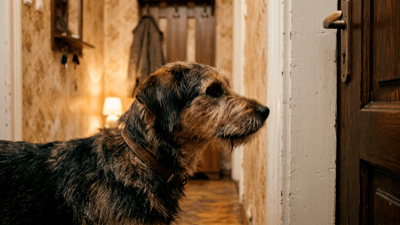
Who this article is for: Your dog barks at the doorbell, at a delivery driver, or at sounds from the hallway, and you want to work on it calmly. This guide covers proven desensitization methods. If the barking comes with strong anxiety, or the problem gets worse despite training, it's worth consulting a dog behaviorist.
The mechanism is simpler than it seems. The first time, the doorbell meant nothing to your dog. You opened the door, a stranger came in (a delivery driver, a neighbor, a friend), and your dog reacted with a bit of tension, because someone unfamiliar had appeared on their turf. The next time, hearing the doorbell, they were already expecting a stranger. After a few weeks the reaction became automatic: doorbell equals barking and a dash to the door.
This is classic conditioning, the same mechanism Pavlov described in dogs reacting to a sound before a meal. The good news is that it can be reversed. It takes consistency and a few weeks of calm work, but the method itself is genuinely simple.
Why your dog reacts so strongly to the doorbell
Three things come together to create this strong, automatic reaction.
A learned association. The doorbell signals that a stranger is about to appear. Your dog links the sound with what usually follows, and reacts ahead of time, before anyone even comes in.
An instinct to guard the territory. Reacting to someone new in their space is natural dog behavior. In some dogs, especially herding breeds and terriers, it can be more pronounced, but you'll see it in a dog of any breed and any size.
No other idea for how to react. Your dog simply doesn't know what else they could do. Barking and running to the door is the only response available to them. A big part of training is about showing him a calmer alternative.
5 steps that soften the reaction to the doorbell
The whole plan rests on two proven techniques: desensitization (gradually getting your dog used to the sound at a low, non-overwhelming level) and building a new association (pairing the sound with something pleasant). Always work at a level where your dog isn't getting worked up yet.
Step 1: Record the sound of your doorbell
Record your doorbell on your phone, just a short 2 to 3 seconds. With a recording you control the trigger: you don't wait for a delivery to happen to arrive, you practice when you're ready and your dog is calm. This is the foundation of the whole plan.
Step 2: Quiet sound and a reward
Play the recording very quietly (level 1 to 2 on your phone). At that volume your dog usually doesn't react, or reacts only slightly. Right after the sound, give them a treat. Repeat it 5 to 10 times over the course of the day. You're building a new association: a quiet doorbell means something good. If your dog won't take the treat or starts barking, the sound is still too loud, so turn it down.
Step 3: Gradually turn up the volume
Each day, raise the volume of the recording by one level. If at any point your dog reacts (barks, jumps up), go back to the previous volume for two days and only then try to move on. Your dog sets the pace, not the calendar. For many dogs, after about ten days the recording at full volume stops making an impression. That's when you can move on to the real doorbell.
Step 4: The real doorbell
Ask someone in the household or a friend to press the doorbell. Your reaction is the most important part here: you don't run to the door and you don't shush your dog by shouting, you calmly toss a treat on the floor by their paws. Repeat it a dozen or so times over the week. Your dog starts to learn that the real doorbell also means a treat from you, not the need to guard the door.
Step 5: Give your dog a new job
After about two weeks of working with treats, add a cue. The doorbell becomes a signal: "go to your bed." Doorbell, the cue "place" or "down," then a reward given on the bed. After a few weeks of consistency, for many dogs the doorbell changes meaning, from a signal to bark into a signal to calmly go to their spot.
The most common mistakes that undo your progress
Doorbell training can be frustrating, because it's easy to unintentionally reinforce the very thing you want to quiet down. Here are five slip-ups that most often stall progress.
- Shushing by shouting. "Quiet!" barked out in a raised voice is often read by your dog as you joining the alarm, or as extra tension. You end up with more noise, not less.
- Rewarding after the barking. A treat given once your dog is already barking teaches them that barking pays off. Reward only after the sound, before your dog reacts, not after the reaction.
- Moving too fast. Skipping volume levels because "it's going well" usually ends with your dog crossing their threshold and getting worked up. Better to go slower, but without any backsliding.
- No agreement in the household. If one person trains calmly while another leaps to the door at every ring, your dog gets mixed signals. Everyone in the home reacts the same way.
- Punishment-based methods. Scaring, yanking, or devices meant to "break" your dog of the habit through an unpleasant stimulus usually increase anxiety and make things worse. Calm desensitization and rewards work longer-term, because they change how your dog feels, not just suppress the symptom.
What to do when the reaction is already deeply ingrained
The most common mistake is trying to interrupt the barking with a reward: "I'll give a treat so they calm down." That doesn't work, and actually does harm. Your dog then learns that barking brings a treat, so you reinforce exactly what you want to quiet down.
If the reaction is already deeply rooted, go back to desensitization from the start (steps 1 to 3). This time it usually takes longer, because the association is stronger. Arm yourself with patience and stick even more closely to the rule: work only with quiet sounds, at a level where your dog isn't reacting yet.
The most important thing is breaking the chain of "doorbell, barking, stranger at the door." During a period of intensive work, cut down on real doorbell rings you can't control. For the training period you can ask a delivery driver to call instead of ring, or put your dog in another room when you're expecting an unavoidable sound. Every reactive bark during this time sets you back a step.
Other sounds that trigger the same reaction
A dog who struggles with the doorbell often reacts to other sounds that signal a stranger too. The mechanism is the same, so the desensitization plan looks similar.
- The hallway. Footsteps, the elevator, the building's front door slamming. Your dog links these sounds with someone unfamiliar showing up. You desensitize them the same way: record it, play it quietly with a reward, gradually turn up the volume.
- Knocking. This often triggers a stronger reaction than the doorbell, because it sounds "closer," as if someone were right on the other side of the door.
- The mail carrier and delivery drivers. Some dogs learn the rhythm of deliveries that come at a set time and react even to the sound of the mailbox alone.
- The garbage truck. A distinctive mechanical noise, usually on a regular, weekly rhythm.
For each of these sounds the routine is the same: record it, play it quietly with a reward, gradually turn up the volume. If you want to understand this method more deeply, we covered it step by step in the article on systematic desensitization.
When your dog only barks while you're away
A common and confusing situation: with you around, your dog is calm, but the moment you leave, they bark at every sound from the hallway. The reason is simple. When you're there, you're the one in charge of the situation, so a stranger at the door isn't your dog's problem. When they're left alone, they take on the guard role themselves.
The tricky part is that you can't see what's actually happening when you're not there. A second device left with your dog (a phone, a tablet, or an old laptop) lets you check without guessing:
- A notification when your dog starts barking. You get an alert and you know that a particular sound set off the reaction, instead of hearing about it from the neighbors.
- Live view. You can see whether your dog barked once and went back to resting, or work themselves up for longer. That's a completely different picture of the problem, and a different plan of action.
This kind of watching over helps you tell ordinary alertness apart from something more serious. If your dog barks briefly and settles quickly, calm desensitization training is usually enough. If they vocalize for a long time and you can see the tension in them, the barking may be driven by trouble being alone, and then it's worth working on that first, with a dog behaviorist's support if needed.
Find out what your dog is really reacting to
A second device left with your dog becomes a camera with sound recognition. You'll see when and for how long your dog barks while you're away, and it'll be easier to pick the right sounds for desensitization.
Frequently asked questions
My dog only barks at the doorbell when I'm not home. How do I work on that?
When you're around, your dog feels safe because you're the one in charge of the situation. When they're left alone, they take on the guard role themselves. First, find out what's actually happening: leave a second device running the app to keep an eye on things and see whether your dog barks once and settles, or reacts for a long time. A single bark followed by calm is nothing to worry about. Nonstop barking for more than ten or fifteen minutes can be tied to separation anxiety, and it's worth working on calm alone time, and consulting a dog behaviorist if needed.
Can I cover the peephole or the window in the door?
Yes. For dogs that react mainly to what they see, covering the peephole or the glass helps. If your dog can see a stranger through the door, the reaction is stronger. Cutting down the visual trigger takes the edge off some of the tension, but it doesn't undo the link with the doorbell sound itself, so treat it as a support for training, not a replacement.
My dog barks at everyone who comes into the building. What do I do?
That's a territorial reaction. Your dog links specific sounds, like the building's front door, the elevator, or footsteps in the hallway, with a stranger on their turf. Those triggers happen often, so desensitization takes longer. Usually the best approach combines two things: gradually desensitizing to recorded sounds, and limiting your dog's exposure to the hallway noises, for example by keeping the door to the room nearest the entrance closed.
Is barking at the doorbell anxiety or territorial defense?
Usually a bit of both. Some dogs react mainly out of unease (you'll see whimpering, nose licking, calming signals between barks). Others react out of territoriality (confident barking, body on alert). The good news: the desensitization plan works in both cases, because it teaches your dog a new, calmer association with the same sound.
How long does it take to teach a dog not to bark at the doorbell?
For many dogs you'll see clear improvement after about 4 to 6 weeks of steady, daily work. If the reaction is deeply ingrained or comes with a lot of tension, it can take longer. What matters most is consistency and working at a level of the trigger where your dog isn't barking yet. Rushing usually undoes your progress.
In short
- Your dog barks at the doorbell because of a learned association: the doorbell signals that a stranger is about to appear.
- The 5 steps: record the doorbell, quiet sound with a treat, gradually turn up the volume, real doorbell with a treat, a new job (going to the bed).
- Timeline: for many dogs, 4 to 6 weeks of steady work, sometimes longer.
- The most important rule: don't reward your dog after the barking. Work with quiet sounds, at a level where your dog isn't reacting yet.
- Other sounds (footsteps, the elevator, knocking, the garbage truck) you desensitize the same way.
This article is a general guide and describes proven desensitization methods. If the barking comes with strong anxiety, panic while you're away, or the problem doesn't ease despite steady work, consult a dog behaviorist or a veterinarian.
Sources and further reading
- Overall, K. L. (2013). "Manual of Clinical Behavioral Medicine for Dogs and Cats." Elsevier Mosby. Protocols for desensitization and building a new association with sounds and door-related situations.
- VCA Animal Hospitals. "Introduction to Desensitization and Counterconditioning." vcahospitals.com. What desensitization and building a positive association involve, and why you need to start from a very weak trigger.
- VCA Animal Hospitals. "Barking in Dogs." vcahospitals.com. Causes of barking and how to approach working on reactions to the doorbell and to guests.