
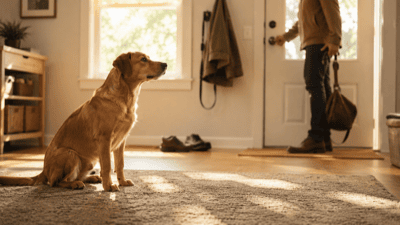
Who this article is for: you've noticed your dog reacting to your keys, shoes, or jacket - standing up, panting, pacing around the room, before you've even opened the door. This piece explains why that happens and lays out a concrete 10-day plan for desensitizing these cues.
Every morning looks the same. You get up, make coffee, take a shower. Your dog sleeps peacefully in their bed. You come out of the bathroom and start getting dressed. Your dog opens their eyes. You put your shoes on. They stand up. You pick up your keys. Now they're at the door, panting, pacing in circles.
Dogs often don't start reacting only at the moment you leave. The tension can show up earlier - at the whole sequence of cues that signals your departure. From a behavioral standpoint, this is an example of classical conditioning - the same mechanism of associating stimuli that Pavlov observed in dogs in the early 20th century. Your dog links the sequence of stimuli with your absence and can slip into a tense state before you've even crossed the threshold.
The good news: this kind of association can be worked on. The goal is to weaken the link between pre-departure cues and your dog's tension. Organizations like the ASPCA describe this approach as one part of working with separation anxiety, especially in dogs that already react to pre-departure rituals. Clinical protocols (Karen Overall, 2013) point out, though, that the process needs regular repetition and can be spread out over many weeks.
What pre-departure cues are
They're all the stimuli that regularly come before you leave the house. From your dog's perspective, these are specific sounds, sights, smells, and sequences of movements that add up to a predictable map: "First this, then that, then my human disappears."
Your dog learns them in the first few weeks of living with you. The more ritualized and repetitive your preparations are, the more firmly the chain of associations sets in. A dog that already has separation anxiety reacts more strongly and earlier - sometimes 30 minutes before you leave, the moment you turn on the hair dryer after your shower.
Each stimulus triggers your dog's brain to predict the next one. Keys → shoes → door → being alone. The level of tension can start rising at the very first link in the chain.
12 common pre-departure cues
This list covers the cues that pet parents most often notice while watching their dog in the morning. Some are obvious (keys, shoes), others subtle (the hair dryer, the alarm).
- Keys in hand. The most common cue. Just the jingle of the keys or the sight of the bunch in your hand.
- Putting on shoes. A specific type of shoe (the work ones, not the take-out-the-trash ones) plus the telltale movements.
- Doing makeup or shaving. A 10-15 minute routine in front of the mirror - your dog notices.
- The hair dryer after a shower. A specific sound that doesn't happen on the weekend when you're not going anywhere.
- The alarm clock in the morning. Especially if the morning routine always leads to you leaving.
- Putting on a jacket. A specific jacket, not the casual one you wear to the park.
- The backpack or work bag. The sight of the backpack, the sound of the zipper.
- Checking your wallet and documents. A specific sequence of movements in front of the mirror or at the table by the door.
- Closing the laptop in the evening. Your dog hears the sound and connects it with you leaving tomorrow.
- Setting the home alarm. The specific beeping sound of the alarm keypad.
- Clipping on your dog's leash, if you take them out briefly before you leave. Your dog learns that a short walk ends with you leaving.
- A verbal cue. "Bye bye, I'll be right back." Seemingly harmless, but if you say it every single time, your dog connects those words with you disappearing.
How to spot which cues your dog reacts to
The simplest way: watch your dog in the morning for 30-60 minutes before you leave. If you use a second device to keep an eye on your dog, the app can show you exactly when a vocalization happened. That's usually the moment the chain of cues set off the tension.
If you don't use the app, watch your dog directly (or ask someone at home to). Look for subtle stress signals - the behavioral literature describes them, for example in Turid Rugaas's concept of Calming Signals:
- Yawning when they're not sleepy
- Licking their nose every few seconds
- Brief panting when it isn't hot
- Pacing back and forth
- Staring tensely toward the door
On top of these are signals described in other behavioral sources: a stiff body posture, a tightly closed mouth, raised front paws. These signals are subtle, and without paying close attention it's easy to miss them.
According to the RSPCA, some dogs with separation-related difficulties don't show obvious signs that you'd easily notice when you get back or in day-to-day contact - the stress happens while you're gone, in quiet ways. That's why just checking things over when you get home (whether anything's chewed up, whether there's a puddle) isn't enough to judge it.
A 10-day starter plan for desensitizing pre-departure cues
This is a starter plan - the first stage of working to weaken the "cue = being alone" association. The plan is built around doing the exercises without actually leaving: you go through the full sequence of cues, but you stay home. The ASPCA describes this approach as a process that usually needs many repetitions over several weeks - 10 days is a good starting point, but not a complete fix.
| Days | What you do | Repetitions |
|---|---|---|
| 1-3 | Pick up your keys and sit back down on the couch | 15-20x a day |
| 4-6 | Put on your shoes + pick up your keys + sit down | 12-15x a day |
| 7-10 | The full sequence (keys + shoes + jacket + backpack + open the door) and you stay home | 8-10x a day |
After each sequence, do something neutral - sit on the couch, go to the kitchen, look at your phone. No emotional talk to your dog. No petting, no "don't worry." Your dog sees that your departure sequence doesn't end with you leaving. Repetition weakens the association.
In some dogs, after about 10 days of regular exercises, the reaction to the sound of the keys alone can noticeably fade. That means one conditioned stimulus has largely been neutralized. At that point you can move on to the later phases of full desensitization training - gradually extending your time away (described in the article on systematic desensitization for dogs). In dogs with more firmly set reactions, the full process can take several weeks.
Worth knowing: research by Lenkei et al. (2021) shows that dogs' separation-related behaviors stem from different underlying emotions (fear, frustration, phobia) and show up as different behavior patterns. This suggests that a one-size-fits-all desensitization protocol doesn't fit every dog - work with a specific dog should be tailored to the dominant emotion. If the classic plan isn't producing results after 3-4 weeks, it's worth talking the situation over with a dog behaviorist.
Common mistakes
Only doing this 1-2 times a day. Too few to neutralize the association. The key is high frequency - 15-20 repetitions a day for the first week.
Working on just one cue and ignoring the rest. If you desensitize only the keys but keep putting on your shoes solely before leaving, your dog connects the shoes with leaving. You have to work on all the common cues.
Skipping this phase and jumping straight to extending your time away. If your dog still reacts to the keys, stepping out for just 30 seconds won't help - your dog goes into the session already tense.
Doing the exercises only while your dog is asleep. The goal is the opposite - you want your dog to see the full sequence, but not slip into unease. If they're asleep and don't notice, the exercise doesn't build a new association.
How Merdilo helps with desensitizing pre-departure cues
The app recognizes specific sounds in real time - barking, howling, whimpering. It all happens locally on your device; nothing goes to our servers.
Here's how it works for pre-departure cue training: you start a session, go through your departure sequence (keys, shoes, door), and come back after a minute. In the app you can see whether your dog vocalized during the exercise or stayed calm. On top of that, the Calm Score after each session helps you gauge how calm the exercise was compared to previous days. The Calm Score itself doesn't diagnose your dog's emotions, but it helps you notice changes in vocalizations and in how long the calm stretches last.
After 10 days you have concrete data: whether your dog has stopped reacting to the cues, or whether you need a longer plan. Without that observation, you're going on a general impression.
Try Merdilo for pre-departure cue training
A second device you already have at home (a phone, tablet, or laptop) becomes a camera for watching over your dog, recognizing barking, howling, and whimpering in real time. The Calm Score after each session helps you gauge whether your cue-desensitization exercises are working.
Frequently asked questions
My dog only reacts to the keys once I'm at the door - should I be worried?
That's good. Reacting only at the door means the chain of cues is short for your dog - the tension doesn't build for half an hour before you leave. It's still worth working on shifting the association (keys don't always end with you leaving), but it's not an urgent situation.
Can I just leave without keys so my dog doesn't get anxious?
In short - no. Avoiding the cues doesn't solve the problem, because your dog will notice the others anyway (shoes, jacket, backpack). Desensitization training works the opposite way: you regularly show your dog the cues without the consequence of you leaving. Repetition weakens the association.
How long does desensitizing pre-departure cues take?
For dogs with mild difficulties, about 10 days of intensive work on a single cue (e.g. the keys) is usually enough for the dog to stop reacting to the sound alone. Fully desensitizing all the common cues (keys, shoes, jacket, backpack) usually takes 3-4 weeks of consistent work.
My dog reacts to pre-departure cues but doesn't have separation anxiety - is it worth training?
Yes. Reacting to pre-departure cues can be the start of building unease, even in dogs that don't yet show full-blown separation anxiety. Working on it early is faster and gives your dog lighter emotions at the start of each time you're away.
Can I do the exercises while my dog is asleep in another room?
That's not how desensitization works. The goal is the opposite - you want your dog to see and hear the full sequence of cues, but not slip into a state of tension. If your dog is asleep and doesn't notice, the exercise doesn't build a new association. Do it when your dog is nearby and can watch.
Summary
- Your dog reacts to pre-departure cues, not just to the moment you leave. Keys, shoes, jacket, backpack - any link in the chain can trigger tension.
- The mechanism is classical conditioning - your dog has linked neutral stimuli with a consequence (your absence). It can be reversed with repetition.
- 12 common cues - from the most obvious (keys, shoes) to the subtle (the hair dryer, the alarm clock buzzer, a verbal cue).
- A 10-day desensitization plan - 3 phases of increasing difficulty, 15-20 repetitions a day in phase 1.
- Common mistakes: too infrequent, one cue instead of all of them, skipping this phase, exercises while your dog is asleep.
- Merdilo helps you gauge whether your dog vocalizes during the exercise - the Calm Score gives indirect data about tension over the course of a session.
Sources
- Rugaas, T. (2006). "On Talking Terms With Dogs: Calming Signals" (2nd ed.). Dogwise Publishing. The classic concept of calming and stress signals in dogs - yawning, nose licking, panting when it isn't hot.
- RSPCA. "Separation-related behaviour in dogs." rspca.org.uk. The RSPCA notes that some dogs with separation-related difficulties don't show obvious signs that are easy to spot when the owner returns.
- ASPCA. "Separation Anxiety." aspca.org. Organizational guidance on desensitizing pre-departure cues and the context of separation anxiety.
- Overall, K. L. (2013). "Manual of Clinical Behavioral Medicine for Dogs and Cats." Elsevier Mosby, 812 pages. A clinical protocol for unlearning the associations a dog makes between pre-departure cues and leaving.
- Sherman, B. L., Mills, D. S. (2008). "Canine anxieties and phobias: An update on separation anxiety and noise aversions." Veterinary Clinics of North America: Small Animal Practice, 38(5), 1081-1106.
- Lenkei, R., Faragó, T., Bakos, V., Pongrácz, P. (2021). "Separation-related behavior of dogs shows association with their reactions to everyday situations that may elicit frustration or fear." Scientific Reports, 11(1), 19207. nature.com. Dogs' separation-related behaviors are linked to different underlying emotions (fear, frustration, phobia) that show up as distinct behavior patterns.
- AAHA (2015). "2015 AAHA Canine and Feline Behavior Management Guidelines." Journal of the American Animal Hospital Association. aaha.org. Clinical guidelines for veterinarians on dog behavior.
This article is for educational purposes. Desensitization training for pre-departure cues can be effective for mild to moderate separation-related difficulties. For severe separation anxiety (self-injury, prolonged howling over 30 minutes, refusing food for a whole day), it's worth consulting a dog behaviorist or a veterinary behaviorist.