
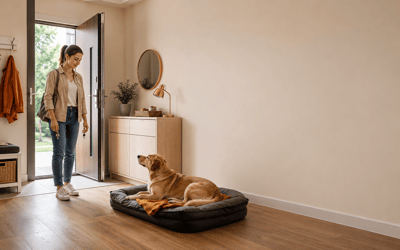
Who this article is for: your dog struggles with your absence, you hear barking through the door, and you want to plan systematic desensitization training step by step. This is educational content - it doesn't replace a consultation with a veterinary behaviorist. With severe separation anxiety (self-injury, long howling beyond 30 minutes, refusing food all day), it's always worth booking a visit with a specialist.
Many pet parents only figure this out after a few hard attempts. They step out for gradually longer stretches, hear barking through the door, come back stressed, and don't know what went wrong. A month later the dog still reacts the same way. The problem isn't the dog - it's the logic of the whole approach.
If your dog gets anxious every single time you leave, they aren't learning to be alone. They're learning that being alone is dangerous. Every departure like that reinforces the association "my person disappeared = intense emotions."
Systematic desensitization (also known in the professional literature as graduated desensitization) reverses this mechanism. You start with very short absences - ones where your dog doesn't have time to get anxious. You come back before the emotion builds. You repeat this many times a day, in a consistent context. With each session you extend the time by seconds, then by minutes. After a few weeks, your dog has dozens of short, calm absences behind them, instead of a few traumatic experiences.
This article walks you through the 4-week plan, step by step. I draw on the research of Butler, Sargisson and Elliffe (2011) and the guidance from AVSAB and ASPCA. You'll find links to the originals in the sources section.
Why the classic "getting your dog used to it" approach doesn't work
The classic mistake you'll see on forums and in groups: "leave for longer, your dog will get used to it." You leave for an hour, your dog barks for an hour, you come back. Next time, same thing. A month later your dog is still barking. What happened?
Your dog spent that hour in a state of stress. Cortisol up, heart rate racing, some form of compulsive reaction - pacing around the home, licking their paws, scratching the door, howling. Every experience like this reinforces the association: "you leaving = intense emotions." The more hours like this, the stronger the association. Your dog doesn't "get used to it." Your dog learns that being alone hurts.
Systematic desensitization brings a different logic. Exposure to the trigger (being alone) happens at an intensity that doesn't set off an anxiety response. Without a negative experience, there's no reinforcing of anxiety. Hundreds of small positive exposures help build a new association: your leaving doesn't have to mean danger, and sometimes it even signals something pleasant (like a treat-filled toy).
Butler, Sargisson and Elliffe's 2011 study tested this logic on a group of 8 dogs with separation-related difficulties and their owners. Systematic desensitization training combined with counter-conditioning produced a statistically significant reduction in the frequency and intensity of separation behaviors compared with the starting point (P = 0.008). At a 3-month follow-up after the training ended, 6 of the 8 dogs showed near-complete elimination of the problem. The authors' conclusion: systematic desensitization can be effective even when the owner applies it inconsistently.
The 4-week desensitization plan - the phases
The plan has four phases, each with a specific goal and way of doing it. The key: the order of the phases matters. Jumping from phase 1 to phase 3 sets you back weeks.
Phase 1 (week 1) - Baseline and departure cues
Goal: learn how your dog reacts to current situations before you change anything.
For 7 days, you don't change your routine or your absences. Departures happen just as usual. Your job is to observe, not to intervene.
Every day, record 30-60 minutes after you leave. If you use a monitoring app with sound recognition, you'll get concrete data: the time of the first vocalization, how long it lasts, the type of sound (barking, whimpering, howling), the number of pauses between episodes. Without an app like this, record video on a second device and review it in the evening.
Write down in a notebook or a spreadsheet:
- The time of the first vocalization after you leave
- How long the anxiety lasts (did it quiet down after 20 minutes, or go on for an hour)
- External triggers that set off reactions (a neighbor in the hallway, the doorbell, keys)
- The pattern of the day (when it's calmer, when it's worse)
After a week you have a starting picture. That's your baseline, the one you'll keep coming back to over the following weeks.
Bonus: at the same time, notice your own departure cues. Keys, shoes, jacket, makeup, coffee in a travel mug. Your dog probably already reacts to the first of these - panting, getting up, following you around the home. These are the cues that signal you're leaving, and you'll work on them in phase 2.
Phase 2 (week 2) - Desensitizing the departure cues
Goal: weaken the association between the departure cues (keys, shoes, jacket) and the feeling of anxiety.
This week, don't leave at all if you don't have to. Any longer departure outside the plan can set the training back - it reinforces the old association. The plan assumes you practice at home for 7 days.
The core exercise: 10 times a day, you pick up your keys and sit back down on the couch. You put your shoes on and take them off. You open the door and close it, without going out. You grab your backpack, put on your jacket, check your phone - and you don't leave.
Repeat the sequences in a different order, at different times of day. The goal: your dog stops reacting to the sound of the keys alone, the sight of the shoes alone. That means one conditioned cue has been neutralized.
After a week, watch the reaction. Most dogs stop getting up at the sound of the keys after 5-7 days. Some need 10-14 days. If your dog still reacts after two weeks, don't move on to phase 3 - go back to basics and check whether you're missing a cue (like the alarm clock, the shower, makeup).
Phase 3 (weeks 3-4) - Gradually extending your absence
Goal: gradually extend the length of your absence from seconds to a few hours.
This is the longest and most demanding phase. It takes consistency and observation.
A sample schedule inspired by ASPCA guidance (ASPCA gives a general rule: increase the absence by a few seconds each session, with bigger jumps only after 40 minutes):
| Day | Departure time | Sessions per day |
|---|---|---|
| 1 | 30 seconds | 8-10 |
| 2 | 1 minute | 8 |
| 3 | 3 minutes | 6 |
| 4 | 5 minutes | 5 |
| 5 | 10 minutes | 4 |
| 6 | 15 minutes | 3 |
| 7 | 25 minutes | 2 |
| 8 | 40 minutes | 2 |
| 9 | 60 minutes | 1-2 |
| 10-14 | add 15 minutes each session | 1-2 |
The rule emphasized throughout the behavior literature: you always come back before your dog starts to get anxious. A monitoring app with sound recognition shows you this in real time - you get a notification if your dog starts whimpering or barking. Then you come back even halfway through the planned session.
According to ASPCA guidance, after 40 minutes of a calm absence you can increase the steps in bigger blocks: first jumps of 5 minutes, then of 15 minutes. A dog who tolerates 90 minutes without stress usually handles 4-8 hours.
What to do when your dog starts getting anxious mid-session: come back calmly, without rushing, without an emotional greeting. The next day, start at the step that last worked. This isn't a regression - it's an adjustment.
Phase 4 - Tracking progress (after week 4)
Goal: maintaining progress and catching relapses.
After 4 weeks, your dog should be able to handle 1-2 hours of calm alone time. Fully settling into 4-6 hours usually takes another 1-2 weeks.
Once a week, test a 1-2 hour session. Compare the results with phase 1 (your baseline). If the Calm Scores are going up, you're on the right track. If they're dropping, you go back one step earlier in the plan.
The most common relapse triggers:
- A change in routine (vacation, illness, a guest at home)
- Your own stress (your dog senses your anxiety)
- Your dog being sick (pain changes tolerance)
- Unexpected noises from outside (a storm, fireworks, construction)
If you notice a relapse, don't panic. Go back one phase, work at it for 5-7 days, then gradually return to longer absences.
The 5 most common mistakes in desensitization training
Below is a list of the mistakes that, in practice, set progress back most often.
- Leaving outside the plan, "because I have to." Even a single session with strong anxiety sets you back weeks. The plan takes discipline. If you know you have to be out for 6 hours in the middle of training, arrange a trusted person ahead of time (a neighbor, partner, pet sitter) to stay with your dog.
- Skipping phase 2 (desensitizing the departure cues). Your dog still reacts to the keys, so the anxiety starts before you even leave. Phase 3 on its own won't work then, because your dog enters the session already stressed.
- Extending the times too fast. Jumping from 5 minutes to 30 minutes skips the in-between steps. A dog who does well with 5 minutes won't necessarily hold up for 30. Stick to the schedule, step by step.
- No consistency between the weekend and workdays. Short sessions during the week, a full-day departure on Saturday. This teaches your dog that your behavior is unpredictable, which raises the anxiety level.
- Training without watching. If you can't see how your dog reacts in the first 15 minutes, you're blindly guessing when to come back. A second device with a monitoring app, or a simple camera on a tripod, solves this.
What you need to start the training
- A second device to watch with - a phone, tablet or laptop that stays with your dog. This lets you see when your dog starts getting anxious, so you can come back before the emotion builds. Without it, you're guessing blindly.
- A food toy (like a Kong filled with xylitol-free peanut butter) - as a positive cue tied to your leaving. Your dog starts to associate "my person is leaving = something tasty to do."
- Patience and consistency - the plan takes regularity over 4 weeks. No shortcuts.
- Notes - a spreadsheet or a plain notebook where you record the results of each session. After 4 weeks you see a trend you wouldn't have spotted otherwise.
How Merdilo helps with the training
Merdilo is an app we build in Toruń. It runs on two of your devices - a phone, tablet or laptop. One device stays with your dog as the camera, the other is your live view.
In desensitization training, it helps with three things:
- Sound recognition of barking, howling and whimpering in real time. When your dog starts getting anxious, you get a notification. You can come back before the emotion builds. Sound recognition happens locally on your device - nothing reaches our servers.
- A Calm Score after every session. Your dog's calm rating on a 0-100 scale. It comes from analyzing five dimensions: how much time your dog spent vocalizing, which type of sound was dominant, when the first reaction appeared, how long the quiet periods between episodes were, and whether the reactions were triggered by outside stimuli. You compare days and see the training progress.
- Live video with two-way audio. When you need to, you turn on the live view and check what's going on. For dogs with separation anxiety, during the first weeks it's best to use the live view only for watching, without talking - your voice without your presence can heighten the anxiety.
Try Merdilo for your desensitization training
A second device (a phone, tablet or laptop) you already have at home becomes a monitoring camera with real-time sound recognition of barking, howling and whimpering. The Calm Score after every session shows you whether the plan is heading in the right direction.
Frequently asked questions
How long does full dog desensitization training take?
Usually 4-6 weeks of consistent work. Some dogs need 2-3 months, especially if they have long-standing, deeply set separation anxiety or coexisting health issues. The key is consistency: a few sessions every day, plus zero "emergency" departures outside the plan. In Butler's study (2011), 6 of the 8 dogs showed near-complete elimination of separation behaviors 3 months after the training ended. The toughest cases are worth discussing with a veterinary behaviorist - beyond at-home work, there are other forms of support that a specialist can tailor.
Do I need a camera to run desensitization training?
You don't need a dedicated hardware camera - a second device with a monitoring app is enough. But without any way to watch, you're blindly guessing when your dog gets anxious. That significantly lowers the effectiveness of the training, because you come back at the wrong moments. Some people manage with a simple video camera they review in the evening, but then you're not reacting in real time - you base your decision about the next step of the plan on the previous day's recording.
What if my dog hurts themselves or howls for hours?
Then you need a consultation with a certified dog behaviorist or a veterinary behaviorist. At-home desensitization training works well for mild and moderate cases. With serious separation anxiety - self-injury, long howling beyond 30 minutes, refusing food for a whole day - you need specialized support that a veterinary behaviorist tailors. Concrete observations from the app (vocalization patterns, reaction times, alerts) are then valuable material for the specialist - they shorten the diagnosis.
Does a puppy need desensitization too?
Yes, but in a lighter form. A puppy doesn't have deeply set anxiety yet, so training is about introducing alone time positively from the very first days in their new home. More details in the article on helping a puppy get comfortable being alone.
My dog panics after 30 seconds. What should I do?
Go even smaller. If 30 seconds is too much, start with 5-10 seconds. Sometimes the first weeks are about simulating leaving without actually going out: you pick up your keys, put on your shoes, stand by the door - and sit back down. Your dog learns that these cues don't have to mean you disappearing. Gradually you add a step past the door, then two, then 5 seconds away. If your dog keeps reacting with panic even after you scale back, consult a veterinary behaviorist.
Summary - key takeaways
- Desensitization training is systematic exposure to being alone at an intensity that doesn't trigger anxiety. The key: you come back before the emotion builds.
- 4 phases: baseline → desensitizing the departure cues → gradual extending → tracking progress.
- Duration: 4-6 weeks of regular work. Some dogs need 2-3 months.
- The most common mistakes: leaving for longer than your dog can handle, skipping phase 2, extending too fast, no consistency between the weekend and workdays, training without watching.
- Helpful tools: a monitoring app with sound recognition, a food toy, notes.
- Specialist support: for severe cases, a consultation with a behaviorist or a veterinary behaviorist - beyond at-home work, a specialist can add extra forms of support.
Your dog doesn't need you to stop leaving. They need you to understand how they experience your absence, and to have concrete tools to help them.
Sources
- Butler, R., Sargisson, R. J., & Elliffe, D. (2011). "The efficacy of systematic desensitization for treating the separation-related problem behaviour of domestic dogs." Applied Animal Behaviour Science, 129(2-4), 136-145. Study of 8 dogs; 3-month follow-up: near-complete elimination of the problem in 6 of the 8 dogs (P = 0.008). sciencedirect.com
- ASPCA. "Separation Anxiety." aspca.org
- AVSAB (American Veterinary Society of Animal Behavior). Stepita, M. "Separation Anxiety: The Great Imitator" (4-part series). avsab.org
- Sherman, B. L., & Mills, D. S. (2008). "Canine anxieties and phobias: An update on separation anxiety and noise aversions." Veterinary Clinics of North America: Small Animal Practice, 38(5), 1081-1106.
- Overall, K. L. (2013). "Manual of Clinical Behavioral Medicine for Dogs and Cats." Elsevier Mosby, 812 pages. ISBN 9780323008907.
This article is educational and does not replace a consultation with a veterinarian or a certified behaviorist. If your dog shows serious signs of separation anxiety (self-injury, long howling beyond 30 minutes, refusing food for a whole day), consult a specialist.