
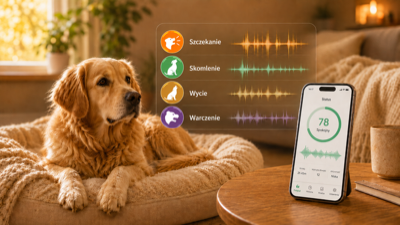
Who this article is for: you use a dog-watching app, or you're thinking about using one, and you want to understand how sound recognition works. No jargon, no dumbing it down into hollow marketing. Educational content based on publicly available scientific literature (Pongrácz et al., 2017; Marx et al., 2021).
Picture this: you leave for work and set up a second device running a dog-watching app next to Amber. Three hours later you get a notification: "Amber started barking." You come home in the evening and see it in the report: 6 minutes of barking, 2 minutes of whimpering, the rest of the day calm. The question that comes up for every pet parent sooner or later: how does the app know all this?
And a second, equally important one: how much can you trust this technology? Isn't the app accidentally counting noise from behind the wall? What happens to the audio? Isn't the app listening in on conversations?
This article answers those questions without technical jargon and without hiding the tricky parts of the technology. It shows what the app actually analyzes, how it learns to recognize sounds, why mistakes happen, and what sets on-device approaches apart from ones that rely on cloud servers.
What sets barking apart from whimpering - the acoustics of dog vocalizations
Let's start with what the app is even trying to recognize. Dogs use several different types of vocalizations, and each one has a distinct sound signature. They're not synonyms - acoustically, they're clearly different from one another.
Barking is an impulsive sound: short (typically 0.2-0.5 seconds), with energy that rises and falls quickly and a clear attack. It has a distinctive, repeating rhythm - a series of short barks with gaps in between. Acoustically, barking covers a wide band of frequencies, from low to high.
Whimpering has a different acoustic signature. It's long (from a few seconds up), continuous (tonal), with a fairly narrow frequency band and often a rising and falling pitch. It sounds "sing-song," wave-like. Pongrácz et al. (2017) showed that whimpering appears sooner and more often in dogs with separation-related difficulties than in dogs without them - so the type of sound alone can be an important clue when watching for separation difficulties. It's not just about how loud a sound is, but also the kind of vocalization.
Howling, in turn, is the longest and most tonal sound - a single wave can last 10 seconds or more, with a very steady tone. It's a social, contact vocalization, with evolutionary roots in how wolves communicate.
Growling is low and throaty, usually short, dominated by a band of low frequencies. Most often it serves as a warning.
Marx et al. (2021) studied 167 dogs and included 4,086 whimpers from 121 individuals in their acoustic analysis. They showed that even within a single type of vocalization (whimpering), small differences in the "roughness" of the voice and irregularities in pitch periodicity can be linked to arousal or stress. In other words: dog sounds carry a lot of information that's often imperceptible to the human ear - but can be described acoustically.
These acoustic differences are the starting point for any dog sound recognition technology. The clearer the acoustic signature of a vocalization, the easier it is for a machine to recognize it.
How a computer "hears" sound
The next question: how does the sound from the microphone even get to the analysis stage? This is where artificial intelligence comes in - but before we get there, the sound has to be turned into something a computer can work with.
Raw sound is an acoustic wave - a continuous stream of values changing over time. To a computer, it's just a long series of numbers (usually tens of thousands of numbers per second). But it's hard to recognize barking or whimpering straight from that wave, because the acoustic patterns of these sounds don't live in the wave itself, but in its frequency content - which tones sound at what intensity, and how that changes over time.
That's why sound recognition apps first turn the signal into a spectrogram - an image showing how sound energy is spread across different frequency bands over time. Picture a heat map: the horizontal axis is time, the vertical axis is frequency (from low tones at the bottom to high ones at the top), and color shows how loud a given tone is at a given moment.
A spectrogram of barking looks different from a spectrogram of whimpering. Different from a spectrogram of a vacuum cleaner running. Different from a spectrogram of a human voice. These are exactly the patterns the AI model analyzes.
The app splits the continuous audio stream into shorter chunks (usually windows a few seconds long), computes a spectrogram for each, and then analyzes which sound category it best matches. The whole process happens on the device, in real time - each piece of audio is analyzed in a fraction of a second.
How artificial intelligence learns to recognize sounds
The artificial intelligence in dog-watching apps isn't a magic box - it's a program that learned to recognize sounds from many thousands of labeled examples. The learning process (training the model) looks roughly like this:
- A set of training recordings. Researchers gather large collections of recordings: dogs barking, howling, whimpering, but also everyday sounds - the TV, conversations, the street, appliances, cats, kids. Each recording is tagged with a label: "this is barking," "this is whimpering," "this is not a dog."
- Feature extraction. Each recording is turned into a spectrogram. The model learns which visual patterns in the spectrogram match which label.
- Correcting mistakes. At first, the model gets things wrong a lot. Every mistake ("that was barking, but the model said growling") is a signal to nudge its internal parameters slightly. After thousands of such corrections, the model keeps getting better.
- Validation on new recordings. After training, the model is tested on recordings it has never seen before. The result shows how well it recognizes the real world, not just the training set.
Once training is done, the model receives a piece of audio from your device, computes a spectrogram, compares it with what it learned, and returns a decision. Importantly, it doesn't return a hard "yes/no," but a confidence level: "the probability that this is barking is 87%."
That confidence level is key. Apps only show you detections above a certain confidence threshold - which keeps the number of false alarms on ambiguous sounds down.
Tricky sounds - why mistakes happen
Every dog sound recognition app makes mistakes. That's not a flaw in one particular product - it's an inherent feature of sound recognition technology. It's worth knowing why, so you can read the app's reports correctly.
The main sources of false alarms - situations where the app wrongly recognizes a sound as coming from a dog:
- A neighbor's sounds behind the wall. The microphone doesn't know a sound is coming from another apartment. If a neighbor's dog barks loudly, the app may read it as yours. Models recognize "the sound of barking," not "the sound of your Amber."
- Cat vocalizations. Some cat sounds - especially loud, drawn-out yowling - are surprisingly close acoustically to a dog whimpering or howling. It's one example of sounds that are hard to recognize automatically.
- Human snoring. The low, rhythmic, modulated sound of snoring can be misclassified as whimpering - both sounds can share a similar frequency band and rhythm.
- Household appliances. Some appliances - vacuum cleaners, hair dryers, washing machines in the spin cycle - produce sounds with spectral features close to vocalizations.
- TV and radio. If a show happens to be playing in the background with a dog barking in it, the app will usually register that as barking. From its point of view, it's simply barking, no matter whether the source is a dog or a speaker.
That's why well-designed models are trained not only on "positive" examples (a dog barking), but also on large sets of "negative" ones - snoring, appliances running, street noise, cat sounds. The more tricky cases the model saw during training, the better it handles them in the real world.
The practical takeaway for you: if the app reports barking but you don't see any reaction from your dog in the live view, the source of the sound was most likely outside the camera's view - from the stairwell, the street, or the apartment next door. Live view is a good way to check quickly.
On the device or in the cloud - two processing models
Dog sound recognition apps fall into two main families - depending on where the analysis happens.
Model 1: cloud analysis
The app sends the recorded sound to the company's external servers. The servers run the analysis, and the result comes back to the app. The upside of this approach is the greater computing power of the servers - they can run larger, more accurate models.
The downsides, though, matter for your privacy:
- Raw sound from your home leaves your device and lands on the company's servers. What happens to it next - how long it's kept, who has access to it, whether it's used to train models - depends on that particular company's policy.
- The app needs a constant internet connection. Without a network, it doesn't work.
Model 2: on-device analysis
The recognition model is built directly into the app. All of the analysis happens on the device - phone, tablet, or laptop - that stays with your dog. The recordings used to classify sounds are not sent to a server for analysis.
Upsides:
- The recordings used to recognize vocalizations are not sent to the company's servers - classification happens locally, on the device.
- Sound recognition works even without the internet. A network is only needed to send a notification from the watching device to yours.
Trade-offs:
- The model has to be smaller to fit in a mobile device's memory. For many well-defined tasks, smaller on-device models can reach sufficient accuracy, but the actual results depend on the model, the training data, and the recording conditions.
- Higher battery use - the analysis requires constant computation on the device. In practice, a session lasting several hours can drain a good chunk of the battery, so it's a good idea to plug the device into a charger.
From a privacy standpoint, on-device analysis is meaningfully different from cloud analysis. It's not just a marketing slogan - it's a fundamental difference in where the data from your private home lives.
How Merdilo approaches sound recognition
Merdilo uses an on-device analysis model. In practice, that means:
- Four types of dog vocalizations recognized directly in the app: barking, whimpering, howling, and growling. Every detection comes with a confidence level.
- The sound from the second device's microphone is analyzed locally - the recordings used to recognize vocalizations are not sent to Merdilo's servers.
- Communication between the two devices - yours and the one left with your dog - happens directly between the devices (peer-to-peer, meaning without sending recordings to a server for analysis). Live video, if you use it, travels over the same channel.
- The notifications you get tell you "your dog is barking," "your dog is howling," "your dog is whimpering," but they don't include a recording.
The sound recognition model is trained on thousands of labeled recordings - both dog vocalizations (from different breeds, in different situations) and large sets of sounds that are easy to confuse with dog vocalizations (snoring, appliances, cats, background noise). Every app update may include an improved version of the model, but the way it works stays on-device - your recordings are not sent off for training.
If you're interested in the bigger privacy picture across dog-watching apps, our article about dog-watching apps covers the categories of solutions available on the market.
What the app interprets beyond the sound type itself
Recognizing that your dog is barking or whimpering is just the first step. What's more valuable for you are the broader interpretations - probabilistic ones, based on observed patterns. In practice, a well-designed app can try to assess two things:
The emotional state in a vocalization
The type of sound alone doesn't show everything. A dog can bark out of frustration or out of alertness to an outside trigger. Whimpering can be a sign of anxiety, but also of loneliness. These differences are rooted in the acoustics - the rhythm, pace, and regularity of the vocalization - and you can try to read them from observed patterns.
Example states the app can try to tell apart based on a vocalization:
- Frustration - regular, rhythmic vocalizations, without clear escalation. Your dog is protesting, but not panicking.
- Anxiety - chaotic, irregular sounds, a faster pace, frequent switches between types.
- Loneliness - long, tonal howling. It's a contact vocalization, an attempt to call back a pet parent or the social group.
- Alertness - reactive barking at an outside trigger, natural watchdog behavior.
- Unease - a moderate pace with some irregularity, a sign of growing discomfort.
This is still a statistical interpretation, based on acoustics - not a reading of your dog's mind. A dog alert to a neighbor behind the wall and a dog feeling mildly uneasy can produce acoustically similar vocalizations, and telling them apart sometimes needs context (time of day, how long it lasts, what happened earlier).
A separation anxiety risk indicator
The second level of interpretation is assessing whether the vocalization pattern during your absence falls within a typical range, or shows features characteristic of separation difficulties. Here the clinical literature offers a few indicators (Pongrácz et al., 2017; McCrave, 1991):
- How quickly the first vocalization appears - sounds showing up within the first 5 minutes after you leave are more common in dogs with separation difficulties.
- Whimpering dominance - if whimpering makes up a significant share of the vocalizations (roughly at least 30%), it can be a stronger observational signal than barking alone.
- How continuous the pattern is - vocalizations spread evenly across the session point to a different situation than reactive, short episodes tied to outside triggers.
- Prolonged unease - longer, sustained vocalization (say, over 30 minutes) is a pattern worth taking into account.
- Escalating intensity - a rise in frequency and loudness over the course of a session can signal growing unease.
Treat the thresholds above (30%, 30 minutes, 5 minutes) as rough observational indicators, not hard diagnostic criteria. They're signals to keep observing rather than a basis for a diagnosis on their own.
Combining these criteria gives you a rough risk level - low, moderate, high, or serious. This is still an observation, not a diagnosis. A formal separation anxiety diagnosis requires a veterinary behaviorist, who will take a broader context into account: behavior beyond the vocalizations, history, your dog's health, the family situation. The app can provide observational material, but it doesn't replace a consultation.
This approach - surfacing signals that line up with the literature, calling them "risk," not "diagnosis" - is a safer and more responsible way to communicate the result. A bit like a thermometer: it shows a fever, but it doesn't tell you whether it's the flu or an ear infection.
What the artificial intelligence in the app does not do
What you shouldn't expect matters just as much.
It doesn't recognize a specific dog. The app knows "this is barking," but it doesn't know whether it's your Amber barking or a neighbor's dog. Recognizing individual dogs by their voice is a much harder task, and typical dog-watching apps don't do it.
It doesn't make a clinical diagnosis. Even if the app shows a separation anxiety risk indicator, that doesn't replace a visit to a specialist. The indicator says "these patterns line up with separation difficulties described in the literature," not "your dog has disorder X." The difference is significant - the same vocalization can have different roots (medical, environmental, behavioral), and telling them apart takes an expert.
It doesn't read your dog's mind. Reading emotions from acoustics is an approximation, not a certainty. A dog feeling uneasy and a dog focused on a sound from the stairwell can produce acoustically similar vocalizations. That's why it's worth reading the app's reports alongside other observations: the situational context, the body language you can see in the live view, and your dog's everyday routine.
It doesn't analyze human conversations. The recognition model isn't designed to transcribe or understand the content of human conversations - its job is to classify dog sounds and select background sounds. In the on-device model, recordings aren't sent to a server for recognition either, which significantly reduces privacy risks.
What concrete data from a dog-watching app gives you
Recognizing types of sound isn't a tech novelty - it's data that helps you better understand what's happening with your dog while you're away. Time to the first vocalization, total barking time, whimpering showing up where there wasn't any before, a shift in the Calm Score (a result that sums up how calmly a given dog-watching session went) from week to week - these are concrete things you can base decisions on: your dog's daily rhythm, alone-time training, or when to consult a specialist.
See how sound recognition works in practice
You can use a second device - a phone, tablet, or laptop - as a camera that recognizes barking, howling, whimpering, and growling. Sound classification happens locally on your device - recordings are not sent to Merdilo's servers. The post-session report shows the types of vocalizations, reaction times, and the Calm Score.
Frequently asked questions
Does a dog-watching app listen in on my conversations?
Apps that recognize dog sounds have access to the microphone, but what happens to the audio depends on how the app works. In apps with on-device analysis (like Merdilo), the sound is analyzed inside the app itself and is not sent to outside servers. In apps with cloud analysis, the audio goes to external servers - here your privacy depends on the company's policy. Merdilo's model is not designed to understand human conversations. In cloud-based apps, the extent of processing depends on the specific company and its privacy policy.
Does a bark-detection app work without the internet?
It depends on the app. An app with on-device analysis (like Merdilo) recognizes sounds without the internet - all of the analysis happens on the device. The internet is only needed for communication between the two devices (notifications, live view). Apps with cloud analysis won't work without a connection - all of the analysis requires sending the audio to a server.
What if the app misidentifies a sound (a false alarm)?
It happens in every app that recognizes sounds - it's an uncertainty built into the technology. The most common mix-ups: a neighbor's dog behind the wall read as your dog, street noise picked up as barking, a cat's vocalization classified as whimpering. Good-quality apps keep these mix-ups to a minimum by training on a wide range of background sounds, but they'll never reach 100% accuracy. In practice: if the app reports barking but the live view shows nothing, it was most likely a sound from outside.
Does the app recognize my specific dog?
No - recognizing individual dogs by their voice is a much harder task, and typical dog-watching apps don't do it. The model learns the general sound of dogs barking, whimpering, or howling, regardless of breed or age. That's why a neighbor's dog barking loudly can sometimes be picked up as yours. The app says, "this is barking," not "this is Amber barking."
Does the app's AI learn from my dog?
In apps with on-device analysis (like Merdilo) - no. The model is installed in the app and stays fixed. App updates introduce new versions of the model, improved by the developers using broader training datasets, but your recordings are not used for this learning. In apps with cloud analysis, some companies use collected recordings to further train the model - it's worth checking the privacy policy to see whether your data is used this way.
Summary
- Dog vocalizations differ acoustically: barking is impulsive, whimpering is tonal and modulated, howling is long and steady, growling is low and throaty. These differences are the starting point for recognition.
- A computer "hears" sound through a spectrogram - a heat map of frequency over time. Artificial intelligence analyzes the patterns on the spectrogram.
- The AI model learns from thousands of labeled recordings - both dog vocalizations and tricky background sounds. Every detection has a confidence level.
- Mistakes are built into the technology. A neighbor, a cat, appliances, the TV - each can trigger a false alarm. Live view helps you check quickly.
- On-device analysis vs. cloud analysis are two different privacy models. In the on-device model, recognition happens on the device, and the recordings used for classification are not sent to Merdilo's servers.
- The app can interpret more than the sound type alone - the emotional state in a vocalization and a separation anxiety risk indicator (based on criteria from the literature). But this is an observation, not a diagnosis - a formal diagnosis requires a specialist.
- What the AI doesn't do: it doesn't recognize a specific dog, doesn't make a clinical diagnosis, doesn't read your dog's mind, and doesn't analyze human conversations.
Sources
- Pongrácz, P., Lenkei, R., Marx, A., Faragó, T. (2017). “Should I whine or should I bark? Qualitative and quantitative differences between the vocalizations of dogs with and without separation-related symptoms.” Applied Animal Behaviour Science, 196, 61-68. sciencedirect.com. A study showing that the type of vocalization (whimpering vs. barking) can have observational significance - dogs with separation-related symptoms whimper sooner and more often.
- Marx, A., Lenkei, R., Pérez Fraga, P., Bakos, V., Kubinyi, E., Faragó, T. (2021). “Occurrences of non-linear phenomena and vocal harshness in dog whines as indicators of stress and ageing.” Scientific Reports, 11, 4468. nature.com. The study included 167 dogs, with 4,086 whimpers from 121 individuals in the acoustic analysis. Small pitch irregularities in whimpering correlate with arousal and stress markers.
- McCrave, E. A. (1991). “Diagnostic criteria for separation anxiety in the dog.” Veterinary Clinics of North America: Small Animal Practice, 21(2), 247-255. pubmed.ncbi.nlm.nih.gov. A classic paper introducing diagnostic criteria for separation anxiety in dogs. A reference point when assessing indicators such as how quickly the first vocalization appears or how continuous the pattern is.
- Faragó, T., Pongrácz, P., Range, F., Virányi, Z., Miklósi, Á. (2010). “«The bone is mine»: affective and referential aspects of dog growls.” Animal Behaviour, 79(4), 917-925. sciencedirect.com. A study showing that a dog's growl carries information about its emotional state and context (play, guarding a bone, reacting to a stranger) - it's not a uniform signal.
- Yin, S., McCowan, B. (2004). “Barking in domestic dogs: context specificity and individual identification.” Animal Behaviour, 68(2), 343-355. sciencedirect.com. A classic study on the acoustic differences between dog vocalizations in different contexts.
This article is educational in nature. It describes the general mechanisms behind sound recognition in dog-watching apps. Specific products differ from one provider to another - if you're considering a particular app, check its privacy policy and description of how it works against the categories described in this article.