
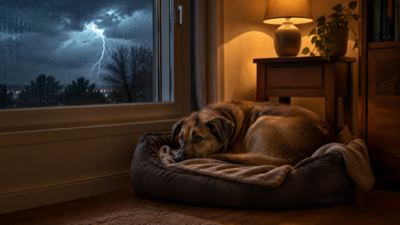
Who this article is for: Your dog handles storms badly (hiding, shaking, panting) and you're looking for concrete ways to help. Educational content - it does not replace a consultation with your vet. Any pharmacological or supplement support should be chosen only by a specialist after assessing your dog.
Summer means storms. In many regions, the warmer months are when storms roll through most often. For a lot of dogs, every storm means hours of stress: shaking, panting, hiding under the furniture, sometimes destroying things or trying to escape.
The Dreschel and Granger study from 2005 showed that in dogs with storm anxiety, cortisol (the stress hormone) rose by more than 200% on average in response to a simulated storm - and didn't return to baseline even 40 minutes after it ended. This isn't a fleeting reaction. It's a state that, when it keeps repeating, can take a toll on a dog's wellbeing.
Here's what matters: storm anxiety isn't a dog being "difficult" or the result of spoiling them. It's a reaction to specific triggers - the noise of thunder, the flashes, the change in pressure, the static charge in the air. You can genuinely influence some of them: cut down on the flashes, dampen the noise, set up a safe space for your dog.
Why dogs are afraid of storms
The behavioral literature usually points to a few factors that add up to storm anxiety:
- The noise of thunder. Thunder can be very loud, and dogs hear a wider range of frequencies than we do. For many dogs, a storm is far more intense sensorially than it is for us.
- The change in air pressure. Some dogs react to an approaching storm before we hear or see it. That's where the "my dog is acting strange and there's no storm yet" behavior comes from.
- Static charge in the air. The air before a storm is electrostatically charged. Some observations suggest that dogs with thick coats may feel it more clearly.
- Sensory association. Darkness, rain, flashes. Each of these triggers on its own may be neutral, but together they create the signal "something unpleasant is coming."
8 ways to help your dog during a storm
1. A safe space
Your dog will choose the spot where they feel safer on their own - under the bed, in the bathroom, in a closet. Accept their choice. Don't drag them out into "the middle of the room so they get used to it."
You can set this spot up before the storm: open the bathroom door, move their bed there, cover the windows in that room. Fewer triggers means fewer reasons for tension.
2. Dampening the noise and the flashes
Since the main triggers are sound and light, it's worth cutting them down. Draw the curtains or blinds - that removes most of the flashes. Play a calm sound in the background that partly drowns out the thunder. Research on shelter dogs (Bowman et al., 2017) suggests that a calm sound backdrop may lower some measures of tension in some dogs - but at home during a storm, treat it mainly as a way to mask the thunder, not a therapy in itself. White noise can help in the same way. Place the speaker close to the bed, at a moderate volume - loud enough to muffle the thunder, but not so loud that the background itself is stressful.
3. A pressure vest
In some dogs, gentle, even pressure on the chest can have a calming effect. Clinical observations suggest that for some dogs this kind of support may reduce visible signs of tension. It doesn't work for every dog, but for some the difference is noticeable. Put the vest on before the storm, when you see the first signs of unease, and take it off once the storm has passed.
4. A treat to redirect attention
In the first few minutes of a storm, offer your dog a food-stuffed toy (like a KONG with dog-safe paste) or a lick mat. Focusing on licking and digging out the food has a calming effect on many dogs - the rhythmic licking motions help your dog settle.
Note: if a stressed dog won't touch food at all, that's a sign the tension is too high. In that case, don't push it, and go back to the other methods (safe space, dampening the triggers).
5. Your calm presence
Your presence gives your dog a sense of safety. Sit calmly next to their safe space. Speak quietly, in a normal tone, without the dramatic "oh you poor thing, poor thing."
An interesting finding from the research: in the Dreschel and Granger (2005) study, petting a dog during a storm didn't lower their cortisol. That doesn't mean you should ignore your dog - the point is that what matters most is the calm you keep yourself, not intense comforting. If you signal tension ("oh no, another storm"), your dog may read it as confirmation that something worrying really is happening.
6. Long-term desensitization to storm recordings
This is one of the most lasting solutions, but it takes patience - usually 6-8 weeks of regular work. In practice it looks like this: you play a storm recording at a very low volume, one your dog doesn't yet react to. While it plays, you give a treat or play with your dog. You repeat short sessions a few times a day. You raise the volume gradually - only when your dog is still calm.
After a few weeks, a real storm becomes less emotionally intense for some dogs. It's the same principle behind systematic desensitization for other kinds of anxiety.
7. Preparing ahead, before the season
Storm anxiety is easier to manage if you prepare before the season, rather than in the middle of the first storm. Plan the safe space, test the pressure vest on a calm dog, start the recording desensitization a month early so it's working by the time storms arrive. If your dog reacted strongly in previous years, book a vet visit ahead of time to discuss a plan for the season to come.
8. A consultation with your vet (ideally one who specializes in dog behavior)
In more serious cases - shaking for hours, self-injury, refusing food all day, escape attempts - the do-it-yourself methods may not be enough. That's when a consultation with a specialist is necessary.
Your vet will assess how severe the anxiety is and choose the right support for your specific dog. This can include both behavioral work and - if the vet sees it as warranted - other forms of support that only a specialist decides on. Don't choose anything on your own: the dosage, choice and combination of any products is a medical decision, made after assessing your dog's health and any other medications they take.
What to avoid
- Punishing your dog for shaking or hiding. Anxiety isn't a choice your dog makes. Punishment raises the stress and cements the association: storm = danger plus a reaction from you.
- Forcing him out of his safe space. Your dog chose that corner because they feel safer there. Dragging them out "to get used to it" does the opposite.
- Excessive, emotional comforting. "Poor puppy, oh you poor thing" in an anxious tone with lots of petting reinforces the association: storm = a special event.
- Giving your dog anything without consulting a vet. Human sedatives can be toxic to dogs. Don't give your dog any products, supplements or medications on your own - always through your vet.
How Merdilo helps during a storm
Storms don't always arrive when you're home. If you're at work or out of the house, it's hard to tell how your dog is handling a storm when no one can watch over them.
An app that uses a second device (a phone, tablet or laptop left with your dog) helps in two concrete situations:
- A notification when your dog starts to get anxious. The app recognizes barking, howling and whimpering. If your dog starts making sounds during a storm - barking, howling or whimpering - you get a signal that their stress is building.
- Live view. You open the video and check whether your dog is in their safe space, or whether they're behaving in a way that means it's worth coming home early or asking someone close to look in on them.
The Calm Score (a 0-100 score after a watching session) helps you compare storm days with calm ones - over time you see how your dog reacts and whether their reactions are changing for the better. The app doesn't replace care or a vet consultation, but it gives you concrete observations instead of guesswork.
See how your dog handles a storm when you're not home
A second device left with your dog (a phone, tablet or laptop) becomes a camera with sound recognition. A notification when your dog starts to get anxious, live view and a Calm Score after each session - so you know what a storm really looks like from your dog's perspective.
Frequently asked questions
My dog hides under the bed during storms - should I pull them out?
No. Your dog chose the spot where they feel safer. Dragging them out by force only raises their stress. Accept their choice, make that corner accessible (open the door to the room, move their bed there) and sit calmly nearby if that helps.
Does storm anxiety get worse with age?
In some dogs, yes. The literature describes noise anxiety as often developing or worsening in middle-aged and older dogs. This is sometimes linked to age-related changes in hearing and in the nervous system. If you notice your dog reacting to storms more and more strongly, it's worth talking to your vet.
My dog keeps shaking long after the storm - is that normal?
To some degree, yes. Cortisol, the stress hormone, drops slowly. In the Dreschel and Granger (2005) study, cortisol levels in dogs with storm anxiety stayed elevated for 40 minutes after a simulated storm. But if your dog shakes for hours after every storm, refuses food or harms themselves, talk to your vet.
Can I give my dog something calming for storms without consulting anyone?
Never give your dog any calming products, supplements or medications on your own - including human medications, which can be toxic to dogs. Any pharmacological or supplement support should be chosen by your vet after assessing your specific dog. Some options also need to be started ahead of time, not during a storm, so it's best to discuss a plan with a specialist before storm season.
Can a dog stop being afraid of storms altogether?
It's hard to promise a complete cure. But many dogs with storm anxiety show real improvement after combining a few things: a safe space, dampening the triggers, desensitization to storm recordings and - if needed - support chosen by a vet. Some dogs are left with a mild reaction in the first few minutes of a storm, but without hours of stress.
Summary
- Storm anxiety has a physiological basis. In the Dreschel and Granger (2005) study, cortisol levels in storm-fearful dogs rose by more than 200% on average and took a long time to return to normal.
- Triggers of the anxiety: the noise of thunder, the change in pressure, static charge, the flashes.
- 8 ways to help: a safe space, dampening the noise and flashes, a pressure vest, a treat to redirect attention, your calm presence, long-term desensitization, preparing ahead of the season, a consultation with your vet.
- What to avoid: punishment, dragging your dog out of their safe space, excessive comforting, giving them anything without consulting a vet.
- A consultation with your vet is necessary for severe signs (shaking for hours, self-injury, refusing food). Any pharmacological support is chosen only by a specialist.
Sources
- Dreschel, N. A., & Granger, D. A. (2005). „Physiological and behavioral reactivity to stress in thunderstorm-phobic dogs and their caregivers.” Applied Animal Behaviour Science, 95(3-4), 153-168. sciencedirect.com. A study of 19 dogs with storm anxiety: cortisol rose by 207% on average and stayed elevated for 40 minutes after a simulated storm. Petting by the owner did not lower cortisol.
- Bowman, A., Scottish SPCA, Dowell, F. J., Evans, N. P. (2017). „The effect of different genres of music on the stress levels of kennelled dogs.” Physiology & Behavior, 171, 207-215. sciencedirect.com. A study on the effect of different music genres on behavior and selected stress measures in dogs in kennel/shelter conditions.
- Sherman, B. L., & Mills, D. S. (2008). „Canine anxieties and phobias: An update on separation anxiety and noise aversions.” Veterinary Clinics of North America: Small Animal Practice, 38(5), 1081-1106. pubmed.ncbi.nlm.nih.gov. A clinical update on separation anxiety and noise aversions (including storm anxiety) in dogs.
This article is educational and does not replace a consultation with your vet. For severe storm anxiety (shaking for hours, self-injury, refusing food, escape attempts), consult a specialist. Don't give your dog any products, supplements or medications on your own - pharmacological support is chosen only by your vet after assessing your specific dog.