
Who this article is for: you use Merdilo (or you're thinking about it), you've seen a Calm Score after a session, and you want to know exactly what the numbers mean. This piece explains how the score works, where its limits are, and how to use it in practice.
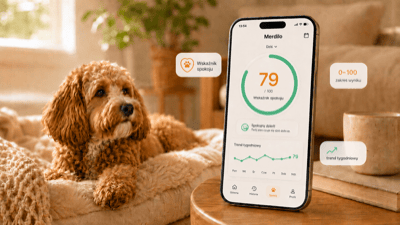
The Calm Score is one of the main measures in the Merdilo app. Every watching session ends with a result from 0 to 100. It shows how calm your dog was while you were away. The number alone says little without context: for some dogs, "64" is a great day; for others, it's worth a closer look.
We base the algorithm on scientific research into dog vocalizations. The weights of the individual elements (whimpering, howling, reactive barking, the gaps between barks) reflect what the literature shows about the link between sound and a dog's stress level - including Pongrácz et al. (2005, 2017), Yin & McCowan (2004), and Lenkei et al. (2021).
In this article we explain what makes up the Calm Score, how to read the result, how to compare one day with the next, and where the limits of this score lie.
What the Calm Score is
The Calm Score is a 0-100 result generated after every dog-watching session. A higher score = your dog was calmer during that session. It's not a grade. It's a summary.
The scale is deliberately neutral, with two levels:
- 60-100 - calm: your dog was quiet for most of the session.
- 0-59 - active: your dog was vocally active.
Being vocal is natural behavior for a dog, not always a sign of trouble. Whether a particular session is worth a closer look is best judged in the context of the day and the trend across the whole week.
5 parts of the sound analysis
The Calm Score is built from five parts of the sound analysis of a session.
1. Time spent vocalizing in the session
The percentage of the session during which your dog was vocalizing. If your dog barked for 5 minutes in a 60-minute session, the share of barking is low - about 8% - so this part of the score will be higher. At 20 minutes out of a 60-minute session, the share is around 33%, and this part of the score is correspondingly lower.
2. Which sound came up most often
Whimpering and howling can point to unease more often than short, reactive barking - especially if they go on for a long time or repeat in a similar pattern. A study by Pongrácz et al. (2017) found that early, frequent whimpering during separation is more characteristic of dogs with signs of separation anxiety than barking alone.
3. The gaps between barks
The algorithm looks at how individual barks are spread out over time. Longer gaps (roughly over a second) usually go with calmer arousal - the dog notices something, reacts briefly, and settles back down. Very short gaps and a monotonous, regular rhythm are described in the literature as more typical of dogs under greater tension (Pongrácz et al. 2005). This dimension helps tell event-driven reactions apart from long, continuous barking.
4. Time to the first reaction
How soon after you left your dog started vocalizing. No vocalizations for the first 30 minutes or longer raises this part of the score. A first vocalization within 5 minutes does not. In behavioral literature, the first 30 minutes after you leave is often treated as a key moment for spotting difficulties with being alone.
5. Reactivity to outside triggers
Whether your dog's reactions were set off by specific outside triggers (a doorbell, noise in the stairwell) or came up with no clear trigger. Reactions to triggers are natural and raise this part of the score. Vocalizations with no obvious trigger can be a sign of unease, especially if they repeat.
How the parts combine into a score
All five parts combine into a single result on a 0-100 scale. A higher score = your dog was calmer. The specific weights of the individual parts are based on research into dog vocalizations (including Pongrácz et al. 2017, Yin & McCowan 2004, Lenkei et al. 2021).
How to compare one day with another
A single score tells you less than a weekly trend. The Merdilo app shows a weekly chart, so you can see the tendency.
| Pattern | Example | What it may mean |
|---|---|---|
| Gradual rise | 45 → 52 → 60 → 67 | May suggest that desensitization training is working. Your dog is slowly building tolerance. |
| Sudden drop | 75 → 78 → 45 | Something happened. Possible causes: a new trigger (neighbors renovating), illness, a change in routine. |
| High stability | All sessions above 70 | The scores don't suggest lasting unease while you're away. |
| Low stability | All sessions 30-40 | May suggest lasting tension or stress, especially if it repeats across many sessions. It's worth considering steady work on separation anxiety and a chat with a dog behaviorist. |
| Big swings | 30 → 65 → 25 → 75 | Your dog may be reacting mainly to specific triggers rather than to your absence itself. It's worth comparing the alerts and the timeline of episodes from the lower-scoring days. |
What the Calm Score is not
It doesn't grade your dog. A dog with a score of 40 isn't "bad" or "worse" - he was simply louder in that session. The scale is neutral.
It doesn't replace a diagnosis. The score shows patterns of behavior, but diagnosing separation anxiety or other difficulties calls for a vet or a dog behaviorist.
It doesn't analyze single events. It's an overall result for the session. If you want to know "why did my dog bark at 2:32 p.m.," you look at the alerts and the timeline of episodes, not the score itself.
Practical uses of the Calm Score
Desensitization training. A Calm Score after every desensitization session helps you see whether the plan is heading in the right direction. A rising score over several weeks can be a sign of progress. More in the article on systematic desensitization for dogs.
Comparing environments. Your dog at a pet sitter's, your dog at a boarding facility, your dog at home. A Calm Score from three different settings gives you a solid basis for a decision.
Checking changes in routine. You go back to work after a long break, your schedule shifts, someone new joins the household. A Calm Score over the following weeks shows how your dog is adjusting to the new situation.
Records for a behaviorist. A Calm Score trend over 4-6 weeks is concrete information a behaviorist can use to make an assessment.
Try Merdilo and see your dog's first Calm Score
A second device you already have at home (a phone, tablet, or laptop) becomes a watching camera with real-time recognition of barking, howling, and whimpering. A Calm Score after every session shows you how your dog handled the time away.
Frequently asked questions
My dog scored 80 yesterday and 45 today. What happened?
Look at what was different today: a storm, neighbors doing renovations, a different time of day. Swings aren't a problem in themselves; they show your dog is reacting to what's around him. High stability (always above 70) is the ideal, but swings in real life are perfectly normal.
Can I reach a Calm Score of 100?
In theory, yes. In practice: a dog who stays quiet for the whole session, sleeps peacefully, with no vocalizations, scores above 95. A perfect 100 is rare, because even a healthy dog whimpers in his sleep now and then.
My dog's Calm Score is 30. What should I do?
Check the session length. If it was a 30-minute session, a low score can be a one-off. If a trend over several days shows 30-40, it's a sign your dog struggles with time away. A plan: desensitization training plus a chat with your vet if there's no improvement after 6-8 weeks.
How long should a session be for the score to be meaningful?
At least 30 minutes. Shorter sessions give less data, so swings are bigger. Ideally: 1-2 hours a day plus the occasional longer one (4-8 hours) for the full picture.
Does the Calm Score work for all dog breeds?
The algorithm is designed to analyze vocalization patterns regardless of breed, but it's always worth reading a single score in the context of your particular dog. Patterns of unease are largely similar across breeds, though the intensity and frequency of vocalizations can vary.
Summary
- The Calm Score is a neutral 0-100 result after every watching session. 60-100 - a calm session, 0-59 - active.
- 5 parts of the sound analysis: time spent vocalizing, the type of sound, the gaps between barks, the time to react, and sensitivity to triggers.
- The value is in trends, not single numbers. The weekly chart helps you spot a trend: possible progress in training, or a sign that it's worth looking at the situation more closely.
- It is NOT: a grade for your dog, a medical diagnosis, or an analysis of single events.
- Practical uses: tracking training, comparing environments, checking changes in routine, keeping records for a behaviorist.
Sources
- Pongrácz, P., Molnár, C., Miklósi, Á. (2017). „Should I whine or should I bark? Qualitative and quantitative differences between the vocalizations of dogs with and without separation-related symptoms." Applied Animal Behaviour Science. Whimpering as an indicator of emotional discomfort.
- Yin, S., McCowan, B. (2004). „Barking in domestic dogs: context specificity and individual identification." Animal Behaviour, 68(2), 343-355. Howling and the context-specific character of dog vocalizations.
- Lenkei, R., Faragó, T., Bakos, V., Pongrácz, P. (2021). „Separation-related behavior of dogs shows association with their reactivity to acoustic stimuli." Behavioural Processes, 186, 104376. Reactivity to acoustic triggers as a sign of tension.
- Pongrácz, P., Molnár, C., Miklósi, Á., Csányi, V. (2005). „Human listeners are able to classify dog (Canis familiaris) barks recorded in different situations." Journal of Comparative Psychology, 119(2), 136-144. Patterns in the gaps between barks (inter-bark interval).
- Siniscalchi, M., d'Ingeo, S., Minunno, M., Quaranta, A. (2018). „Communication in dogs." Animals, 8(8), 131. Characteristics of different types of dog vocalizations.
- Overall, K. L. (2013). „Manual of Clinical Behavioral Medicine for Dogs and Cats." Elsevier Mosby, 812 pages. Time to react after you leave and protocols for systematic desensitization.
- AAHA (2015). „2015 AAHA Canine and Feline Behavior Management Guidelines." Journal of the American Animal Hospital Association. aaha.org
This article is for educational purposes. The Calm Score is a supporting tool, not a diagnosis. If you notice serious signs of separation anxiety in your dog (self-injury, prolonged howling, refusing food for a whole day), talk to a vet or a dog behaviorist.
Read next
- Alone-time training for your dog - systematic desensitization step by step
- Separation anxiety in dogs - how to recognize it and help
- Monitoring your dog at home in 2026 - a comparison of 7 types of solutions
- How to read your dog's body language - 15 signs of stress
- Dogs that can stay home alone - a ranking of 15 breeds