
Who this article is for: Your dog stays home alone and you want to give them something to keep busy during the first, hardest minutes. This is a practical guide - if your dog won't touch food at all while you're gone, it can be a sign of stronger stress, and it's worth talking to your vet or a dog behaviorist.
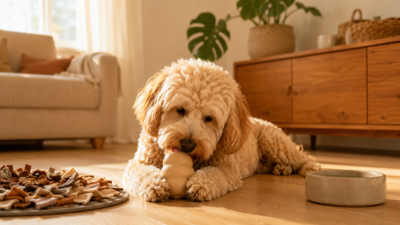
The idea is simple: you give your dog a toy that can keep them busy during the first 15-30 minutes you're away - often the hardest stretch. Your dog focuses on the toy, not on you leaving. Over time, a positive association can build: you head out, and your dog gets something enjoyable to do.
Simple in theory. In practice, plenty of pet parents try 2-3 toys and find that none of them work. Often the problem isn't the toy itself, but how you introduce it or which type you pick for your dog.
This article walks through 6 types of interactive toys, who each one works for, how to introduce them, and why sometimes a toy alone isn't enough.
What an interactive toy actually does
An interactive toy can help in three ways:
It keeps your dog busy during the first minutes after you leave. For many dogs, the first 15-30 minutes after you head out are the hardest. If your dog is focused on getting food out of the toy, it's easier for them not to dwell on the fact that you just disappeared. That tough beginning can become more neutral, and for some dogs even pleasant.
It can build a positive association. This is classic conditioning. Every time you leave paired with a tasty toy can, over time, build the association "leaving = something enjoyable to do." For some dogs, the toy becomes a predictable, positive part of the leaving routine.
It tires out the mind. Solving the puzzle - how to get the food out - engages your dog mentally. After that kind of mental effort, dogs often rest more easily during the second half of your absence, once the toy is empty.
6 types of interactive toys - comparison table
Each type of toy works for a different dog. The table below compares the average time it keeps a dog busy, who each type is best for, and how hard it is for a dog to figure out at first.
| Type of toy | Average time busy | Best for | Difficulty for the dog |
|---|---|---|---|
| Fillable rubber toy (Kong-style) | 20-40 min | Most dogs | Easy |
| Rubber toy - frozen version | 40-60 min | Very active dogs | Medium |
| Snuffle mat | 15-30 min | Dogs who love to sniff | Easy |
| Lick mat | 10-20 min | Dogs who get stressed | Easy |
| Food puzzle toys | 5-15 min | Clever dogs who love a challenge | Hard |
| Food-dispensing toy | 10-30 min | Dogs who love to move | Medium |
Difficulty "for the dog" means whether the toy makes sense right away or takes some learning. A dog with no puzzle experience might give up after 30 seconds - you have to show them how it works first.
Fillable rubber toy - step-by-step guide
A rubber toy you fill with food (best known as the Kong) is the most versatile option. For many dogs it's the most all-around choice - it's durable and easy to clean. The whole secret is in how you fill it.
What to put inside
The layer at the opening (easiest to reach, gets them started): a handful of dry food, a small piece of wet food, or a training treat.
The middle layer (the main filling): plain yogurt, cottage cheese, wet food, or dog-safe pate. This is where your dog will spend the most time.
The layer at the bottom (the plug, the final reward): dog-safe pate or plain baked sweet potato, or a piece of dry food wedged in as a "cork."
Peanut butter is a popular filling, but it needs care - only use natural peanut butter, with no xylitol (a sweetener toxic to dogs). Plain yogurt, cottage cheese, and dog-safe pate are safer and just as appealing.
Freezing
A frozen toy keeps a dog busy about 2-3 times longer than a freshly filled one. Fill it in the evening, leave it in the freezer overnight, and hand it over in the morning before you leave. It's a simple way to stretch the busy time at no extra cost.
How often
Once a day is usually enough, ideally only when you're heading out. If your dog gets this toy every day in all kinds of situations, it becomes ordinary and stops feeling special. Reserved "for leaving," it usually stays more appealing.
Size
Match the size to your dog: a small toy for a small dog, a big one for a big dog. A toy that's too small for a large dog is a real risk of being swallowed whole.
Snuffle mat - how it works
A snuffle mat is a flat toy with lots of fabric pockets where you hide food. Your dog has to nudge with their nose and mouth to work out each piece. It's simple but effective stimulation - sniffing is a natural, calming activity for a dog.
Pros: gentle on teeth (soft fabric), usually easy to wash, works for dogs of any age, including seniors. Using their nose engages your dog and settles them.
Cons: some dogs quickly learn to grab the whole mat and shake the food out - then the toy loses its point. It also needs cleaning after every use.
Lick mat - for dogs who get stressed
A lick mat is a flat silicone surface with grooves that you spread a paste onto (yogurt, cottage cheese, dog-safe pate). Your dog licks it to eat.
Why it can help: rhythmic licking has a calming effect on many dogs. For dogs who get stressed easily, it's a gentle support tool.
Best uses:
- a dog who gets stressed by thunderstorms or noises from outside,
- a dog right after you leave - the mat can help settle those first, hardest minutes,
- a dog in stressful situations, for example during grooming (the mat can stick to the side of the bathtub).
For a dog who doesn't handle being alone well, it's worth pairing the lick mat with a fillable rubber toy: the mat covers the first 10-15 minutes, and then the rubber toy can keep your dog busy for the next several dozen minutes.
Food puzzle toys - for dogs who love a challenge
Puzzle toys are mechanical toys where your dog has to slide a piece, open a flap, or turn a wheel to get the food out. The difficulty scales in levels - from beginner to advanced.
Pros: very high mental stimulation, builds your dog's confidence (a solved puzzle = a reward), can be used several times a day.
Cons: they take some learning - a dog with no experience gives up fast. Puzzles that are too easy get boring after 2-3 weeks. Some have plastic parts that certain dogs try to chew.
Introducing it: start with the easiest level, show your dog how it works, and set them up to succeed on the first few tries. Only increase the difficulty gradually, once your dog handles the previous level confidently.
What to avoid
- Toys with bisphenol A (BPA). Look for labels like "BPA-free." If the materials or labeling are unclear, it's better to choose a different product.
- Hard chews for weak teeth. For seniors, dogs after a tooth extraction, or dogs with gum disease, hard rubber can hurt. Choose soft alternatives - a lick mat or a snuffle mat.
- Tennis balls. They're sometimes sold as "dog" toys, but the felt coating on a tennis ball is abrasive and, with frequent chewing, can wear down tooth enamel. Rubber balls made for dogs are a better choice.
- Ropes with a ball inside. When the rope gets chewed through, your dog can swallow the ball. Risk of a blockage.
When a toy isn't enough
If your dog consistently ignores the toy - won't touch the filled rubber, walks past the snuffle mat - the problem usually isn't the toy. It's a sign that your dog is too stressed to eat.
In a dog under strong stress, appetite often drops, and attention locks onto the source of the tension (you leaving), not the food. It's a natural reaction: under strong stress, eating takes a back seat.
What to do then: go back to desensitization training and work on lowering your dog's baseline tension. After a few weeks of work, toys may start working better, because your dog handles the start of your absence more calmly. If you still don't see improvement, or the symptoms are severe (howling, destruction, escape attempts), talk to your vet or a dog behaviorist.
How to check whether a toy actually works
The biggest problem with interactive toys: you don't know what happens after you leave. Did your dog get to the toy right away, or spend the first 20 minutes pacing by the door? Did the toy settle them, or was it left untouched?
An app that uses a second device (a phone, tablet, or laptop left with your dog) lets you check without guessing:
- A notification when your dog starts to get anxious. If your dog starts barking or whimpering despite the toy, you get a signal - maybe the toy isn't enough, or you need to switch to a different type.
- Live view. You open the video and see whether your dog is actually using the toy or ignoring it. That's concrete information you can use to pick a better solution.
The Calm Score (a 0-100 result after a watching session) helps you compare days with different toys and see whether your dog's reactions are changing for the better. It's a supporting indicator, not a replacement for talking to a dog behaviorist or a vet.
See whether a toy really keeps your dog busy
A second device left with your dog (a phone, tablet, or laptop) becomes a camera with sound recognition. You'll see whether your dog is using the toy or starting to get anxious - and you'll pick what really works for them.
Frequently asked questions
My dog finishes a food toy in 5 minutes. What now?
A few options: freeze the filled toy (frozen keeps your dog busy 2-3 times longer), use a thicker filling (firmer paste is harder to lick out), and pair the toy with a snuffle mat (mat first, then the toy). You can also switch to a tougher rubber toy that's harder to empty quickly.
Is peanut butter safe for dogs?
Natural peanut butter (no sugar, no xylitol) can usually be given to a dog in small amounts, as long as they tolerate it well. Critical note: xylitol (a sweetener) is toxic to dogs even in small doses. Always check the label - if you see "xylitol" or "E967", don't use it. Safe alternatives for filling toys include plain yogurt, cottage cheese, or dog-safe pate. When in doubt, talk to your vet about your dog's diet.
Can I use the same toy every day?
It's better to rotate. Dogs get used to a stimulus, and the same toy every day loses its appeal after 2-3 weeks. Keep 3-4 toys and switch between them. You can also reserve one specific toy just for when you leave - then your dog links it to that situation and looks forward to it.
What if my dog won't touch the toy when I'm gone but eats it when I'm around?
This is a common sign of separation difficulties. Without you there, your dog is too tense to eat - strong stress often lowers appetite. A toy alone won't fix it. Go back to desensitization training and work on lowering your dog's baseline stress. Add toys after a few weeks, once your dog starts handling short absences more calmly. If symptoms are severe, talk to a professional.
At what age can a dog start using interactive toys?
As early as puppyhood, matching the type and size to their age and teeth. For puppies and seniors with dental issues, softer options (snuffle mat, lick mat) are better than hard rubber toys. Always match the size to your dog - a toy that's too small for a big dog is a swallowing risk.
Summary
- Interactive toys keep your dog busy during the first 15-30 minutes of your absence - the hardest stretch.
- 6 types to choose from: a fillable rubber toy, the same one frozen, a snuffle mat, a lick mat, food puzzle toys, and a food-dispensing toy. Each for a different kind of dog.
- Fillable rubber toy: the most versatile, easy, and freezable. Best used once a day at most, only when you leave.
- Lick mat: rhythmic licking helps your dog settle - good for dogs who get stressed.
- What to avoid: xylitol (toxic), tennis balls, ropes with a ball inside, and hard chews for weak teeth.
- If your dog won't touch the toy at all while you're gone - that's a sign of stress, not the toy's fault. Go back to desensitization training and, if needed, talk to a professional.
This article is for educational purposes. Interactive toys are a form of support, not treatment. If your dog shows severe signs of stress when alone (howling, destruction, escape attempts, refusing food), talk to your vet or a dog behaviorist. It's also worth discussing your dog's diet and any food additions with your vet.
Sources and further reading
- FDA (U.S. Food and Drug Administration). "Paws Off Xylitol; It's Dangerous for Dogs." fda.gov. Warning about the toxicity of xylitol for dogs.
- RSPCA. "Separation-related behaviour in dogs." rspca.org.uk. Guidance on separation-related difficulties, including the role of food toys as support when leaving.
- ASPCA. "Separation Anxiety." aspca.org. Material on separation anxiety, including the calming role of chewing and licking.
- Animal Medical Center (NYC). "Dogs and Tennis Balls: It's Not Always a Match." amcny.org. On the abrasive effect of tennis-ball felt on a dog's tooth enamel.