
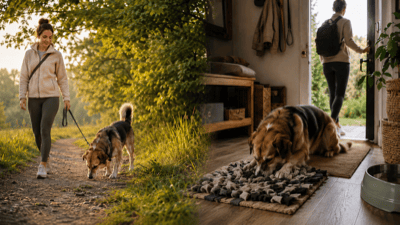
Who this article is for: you head to work or leave home for a few hours and you're wondering whether you're preparing your dog properly for that time away. This is educational material based on behavioral practice and general veterinary guidelines - it's not a substitute for a vet visit if you notice health symptoms or intense separation-related struggles in your dog.
The saying "a tired dog is a calm dog" is popular among pet parents and behaviorists, but in practice it's not quite accurate. Not every kind of activity leads to calm. A dog that ran hard with another dog right before you left may end up more wound up at home, not more settled. What helps is a specific kind of effort, paired with time to wind down before you go.
In this article you'll find: how exercise affects your dog's behavior while you're away, how much physical and mental activity a dog needs each day at different ages, how to put together a 30-minute morning routine, and the common mistakes that cancel out all that preparation.
Why exercise affects calm while you're away
In dogs, just as in people, regular physical activity supports the regulation of the nervous system. A Finnish study of 3,262 dogs (Tiira and Lohi, 2015) found that daily physical activity was one of the most important environmental factors linked to lower noise sensitivity and separation anxiety. A similar direction of the relationship between an active lifestyle and lower fearfulness was also described in a study by Hakanen et al. (2020) of 13,700 dogs. The mechanism isn't fully understood yet - the authors hypothesize a link to serotonin levels, by analogy with research in humans.
Exercise helps burn off excess energy and makes it easier for a dog to settle into rest. A dog that lay around all morning with nothing to engage with but watching your pre-departure routine is more likely to slip into a watchful state than into calm rest - even if they look settled on the surface.
Just as important is the second dimension: mental stimulation. Smell is a dog's strongest sense, and also one that demands a lot of attention. In a study by Duranton and Horowitz (2019), two weeks of scent work (known as nosework) helped dogs handle ambiguous cues better - their judgment bias, meaning the way they interpret ambiguous signals, shifted toward a more positive read. For many dogs, 15-20 minutes of free sniffing in a new setting (a forest, a meadow, a varied sidewalk) can engage the mind more than a longer, monotonous march along a familiar route.
Keep in mind: activity before you leave is a supporting element, not a magic fix. If your dog has entrenched separation-related struggles, exercise alone won't be enough - see systematic desensitization and desensitizing departure cues.
How much activity a dog needs each day
The ranges below are practical guidance - you won't find specific minute counts in official veterinary guidelines. The AAHA guidelines (Creevy et al., 2019) stress that needs depend on the breed, age, temperament, and condition of the individual dog, and that daily activity and mental stimulation reduce the tendency to seek stimulation out of boredom. Treat these numbers as a starting point, not a rule.
| Type of dog | Physical exercise per day | Mental stimulation | Notes |
|---|---|---|---|
| Puppy (3-6 months) | 3-4 short sessions of 10-15 minutes | Short puzzles, basic cues, sniffing | Avoid long, intense runs - they affect joint development. |
| Adult of a calm breed (basset, bulldog, pug) | 45-60 minutes | 15-30 minutes | More emphasis on sniffing and short puzzles than on intense running. |
| Adult of an active breed (Labrador, Border Collie, Husky) | 90-120 minutes | 30-45 minutes | Without mental stimulation they often stay wired even after a long walk. |
| Adult dog with a large home and a yard | 60-90 minutes | 20-30 minutes | A yard alone doesn't replace a walk - it lacks new scent cues. |
| Senior (over 8 years) | 30-45 minutes, gently | 10-20 minutes | Light activity supports circulation and joints, but avoid intensity. |
If your dog doesn't fit the table (a very active working breed, a dog recovering from an injury, an older dog with health conditions), treat these numbers as a starting point, not a rule. Always adjust to your dog's individual condition, and when in doubt, check with your vet.
Physical activity - what works
A sniffing walk, not just a march
A standard walk - "on leash, brisk pace, straight ahead" - tires a dog less than it seems. The dog follows along behind you but has little chance to explore on their own. A walk where you let your dog stop, sniff, and change pace is far more relaxing for them. A good minimum is 50-60% of the walk in "the dog leads, I follow" mode.
Running and swimming
These are a good option for active breeds, but it's worth paying attention to the time of day. An intense run right before you leave can raise arousal instead of lowering it. Better: run 60-90 minutes before you leave the house, with time to wind down slowly (a walk home with sniffing, a drink of water, a few minutes of calm at home before you start the departure routine).
Play with other dogs
Social activity is valuable for a dog, but also highly stimulating. If your dog comes back from a dog group all revved up with no time to settle at home, it's better to save this activity for the afternoon or the weekend - not for the morning before you leave for work.
Mental stimulation - the often-overlooked piece
For many pet parents this is a new idea: a dog that comes back from a 90-minute walk can still be wound up and struggle to settle. What they're missing isn't exercise, but engaging mental work. For many dogs, mental stimulation helps them shift into a calmer mode faster than another round of intense exercise.
Sniffing outdoors
The simplest method: you take your dog to a park, a forest, or a meadow and for 15-20 minutes you simply let them sniff. No rushing, no "come on." For a dog this is the equivalent of reading a long, interesting text - absorbing and tiring in a good way.
Snuffle mat and food puzzles
You scatter part of the daily food portion into a snuffle mat (a rolled rug with little pockets). The dog searches, works their nose, and eats more slowly. For many dogs, 10-15 minutes of this work can make it easier to settle afterward. Alternatives: a Kong-style toy filled with pâté or food, interactive toys, dog puzzle games.
A short cue session
5-10 minutes of training (sit, down, "stay," small tricks) engages your dog mentally and strengthens your bond. Best done in a calm setting at home, with rewards. It's an often-underrated way to help a dog settle.
Nosework - a more advanced option
Nosework is a structured activity in which the dog searches for a specific scent in a room (for example, a small container with a scented insert). You can start at home with a piece of dried meat hidden in one of several boxes. After a short bit of scent work, many dogs move into calm rest more easily.
A 30-minute morning routine before you leave
This is a sample plan for an adult dog of average activity. Adjust it to your dog and to your own pace in the morning.
- 0-15 minutes: a walk with time to sniff. Goal: your dog does their business, burns off energy, and gets a chance to engage their nose, attention, and curiosity with new cues from the environment.
- 15-20 minutes: back home, water, a short wind-down. Your dog gets water, you make yourself a coffee. Don't hype your dog up with an excited tone or play - this is meant to be a calm moment.
- 20-30 minutes: 10 minutes of a snuffle mat with a portion of food, or a chew toy filled with food. Your dog works mentally, eats slowly, and settles down.
- The last 5 minutes: you leave calmly, with no emotional goodbyes. Your dog may already be busy with the mat or the chew - then your leaving isn't the most important event of the moment for them.
The key: the final minutes are calm. You don't leave when your dog is wound up, only when they're focused on a task or starting to settle.
Common mistakes
Exercise only, no mental stimulation. 90 minutes of intense running with no sniffing and no puzzles often leaves a dog that's physically tired but still mentally "switched on."
Intense play right before you leave. Throwing a ball for 20 minutes 5 minutes before you close the door raises arousal. Your dog is left alone in a state of high arousal instead of calm.
The same walking routes. A walk in the same spot 5 times a week gives a dog less to take in than a new route once a week. Try to work 1-2 new places into your weekly rhythm.
Rushed mornings. You get up 30 minutes before you leave, give your dog a 10-minute quick walk, dash around the house, and head out stressed. Your dog picks up on your agitation and becomes tense too. A good routine needs a calm 45-60 minute morning window.
"The yard is enough." Running around the yard doesn't replace a walk. In the yard your dog knows every smell - there are no new mental cues. A walk beyond home delivers dozens of new smells a day.
How Merdilo helps you tell whether the routine is working
The mere fact that your dog "lies down" after you leave doesn't yet mean they're resting calmly. A dog in a watchful state can lie still without moving while being tense inside. Merdilo gives you indirect clues about what's happening while you're away:
- Vocalizations in the first 30 minutes after you leave can help you tell whether the morning routine is helping your dog settle. If your dog whimpers or barks within the first 15 minutes, that's a sign the routine wasn't enough or the difficulty runs deeper (departure cues, separation anxiety).
- Long stretches of quiet may suggest sleep or calm rest - exactly what the morning routine is meant to support.
- The Calm Score after each session is a numerical summary of periods of quiet and vocalizations - the higher it is, the more quiet there is relative to vocalizations in that session. Comparing a few days helps you notice whether a change in the routine (more sniffing, a mat before you leave, less intense play) actually made a difference in your dog's behavior.
The score doesn't diagnose your dog's emotions, but it helps you see whether a specific change in the pre-departure routine shows up in your dog's real behavior while you're away. More on it in the article what the Calm Score numbers mean.
See how your dog behaves after the morning routine
You can use a second device - a phone, a tablet, or a laptop - as a camera to watch over your dog, with real-time recognition of barking, howling, and whimpering. The Calm Score after each session helps you tell whether the change in your pre-departure routine is paying off.
Frequently asked questions
Is 15 minutes of walking in the morning enough to keep a dog calm for 8 hours?
For most dogs, probably not. 15 minutes isn't enough for a dog to physically and mentally wind down before a longer stretch alone. A safe baseline is 30-45 minutes of morning activity, with part of it spent on sniffing (letting your dog sniff at a relaxed pace), not just marching along. The more active the breed, the longer they need.
My dog is wired after a long walk, not tired. What am I doing wrong?
Often the cause is intense excitement right before you leave - running with other dogs, tug-of-war, throwing a ball for 30 minutes. That raises arousal instead of lowering it. Better: do the active part at the start of the walk, and spend the last 10 minutes on a calm return with sniffing.
What works better - a long walk or a snuffle mat?
These two don't compete, they complement each other. Physical exercise burns off energy, while sniffing and mental puzzles help your dog switch into calm rest mode. The combination: 30 minutes of a sniffing walk plus 10-15 minutes of a snuffle mat or a food game right before you leave usually works better than a longer walk on its own.
Does a senior dog need activity before I leave if they already sleep a lot?
Yes, but in a different form. A senior dog doesn't need intense exercise, but light activity (a calm walk, short sniffing puzzles) supports circulation, joints, and the mind. Watch how your dog responds: if they fall asleep calmly soon after the walk, the amount was right. If they're restless, dial back the intensity.
My dog pants and paces even after a walk. What next?
This may be a sign of separation-related struggles rather than excess energy. Exercise alone won't always help if your dog tenses up at departure cues (keys, shoes, jacket). In that case it's worth working on desensitizing departure cues and observing your dog's rhythm while you're away - if the struggles persist, consult a veterinary behaviorist.
Summary
- "A tired dog = a calm dog" is an oversimplified formula. The key isn't the sheer amount of exercise, but its kind: physical exercise + mental stimulation + a calm wind-down right before you leave.
- A rough baseline for many adult dogs: 45-90 minutes of activity a day, including 15-30 minutes of free sniffing or mental stimulation. In the morning, before a longer time away, it's usually worth planning at least 30-45 minutes of calm activity with some sniffing.
- A 30-minute morning routine: a sniffing walk → a short wind-down → a snuffle mat or a food-filled chew → a calm departure.
- Common mistakes: exercise only with no sniffing, intense play right before you leave, the same routes, rushed mornings.
- A senior dog needs activity, but the gentle kind. Adjust the intensity to your dog's condition.
- Merdilo helps you tell whether a change in the routine shows up as calmer behavior while you're away.
Sources
- Tiira, K., Lohi, H. (2015). „Early Life Experiences and Exercise Associate with Canine Anxieties.” PLoS ONE, 10(11), e0141907. journals.plos.org. Daily physical activity was the biggest environmental factor linked to noise sensitivity and separation anxiety (n=3,262 dogs, 192 breeds).
- Hakanen, E., Mikkola, S., Salonen, M., Puurunen, J., Sulkama, S., Araujo, C., Lohi, H. (2020). „Active and social life is associated with lower non-social fearfulness in pet dogs.” Scientific Reports, 10(1), 13774. nature.com. A related study of 13,700 Finnish dogs: an active and social life was linked to lower non-social fearfulness (including toward noise and new situations).
- Duranton, C., Horowitz, A. (2019). „Let me sniff! Nosework induces positive judgment bias in pet dogs.” Applied Animal Behaviour Science, 211, 61-66. sciencedirect.com. Two weeks of scent work (nosework) increased dogs' positive read of ambiguous cues (judgment bias) compared with a group training heelwork.
- Meehan, C. L., Mench, J. A. (2007). „The challenge of challenge: Can problem solving opportunities enhance animal welfare?” Applied Animal Behaviour Science, 102(3-4), 246-261. sciencedirect.com. Theoretical rationale for why problem solving (puzzles, games) supports animal welfare.
- Creevy, K. E. et al. (2019). „2019 AAHA Canine Life Stage Guidelines.” Journal of the American Animal Hospital Association, 55(6), 267-290. aaha.org. Official veterinary guidelines stressing that daily physical activity and mental stimulation reduce a dog's tendency to seek stimulation out of boredom. Individual needs depend on breed, age, and temperament.
- Overall, K. L. (2013). „Manual of Clinical Behavioral Medicine for Dogs and Cats.” Elsevier Mosby. Practical clinical recommendations on daily rhythm, activity, and preventing behavioral problems.
This article is educational in nature. Specific activity recommendations, especially for dogs recovering from injuries, with chronic conditions, or very young puppies, are always worth discussing with your vet. If, despite a well-prepared morning routine, you notice intense separation-related struggles in your dog, consult a veterinary behaviorist.