
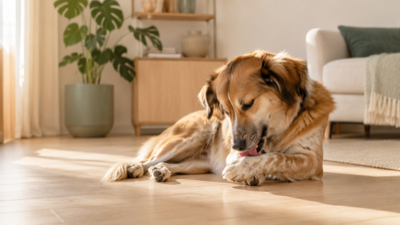
Who this article is for: Your dog is clearly licking their paws more than usual, and you're not sure whether it's stress, allergies, or something else. This is educational material - it doesn't replace a consultation with your vet. If you see visible skin changes, bleeding, limping, or an unpleasant smell, always book a visit with a professional.
Paw licking is one of the most commonly reported behaviors in dogs. It can be completely normal (routine grooming), it can be a sign of allergies (one of the most common skin symptoms), or it can be a behavior tied to stress or boredom. Three completely different causes, three different plans of action - and in each of these cases the first step is often a vet checking whether it's a medical problem.
In this article I'll show you 5 typical reasons dogs lick their paws, a simple checklist to help you get an initial sense of which direction to look in, and the specific signs that mean a vet visit is urgent.
5 reasons dogs lick their paws
Reason 1: Stress or boredom (a repetitive behavior)
For some dogs, licking their paws becomes a way to self-soothe. It works a bit like a person biting their nails or twirling their hair - it releases tension and gives brief relief. With chronic stress or heavy boredom, the behavior can set in and turn into a repetitive pattern: your dog keeps licking even when the paw is already wet, red, and irritated.
Signs: the licking has no clear link to a specific outside trigger (an allergen, a wound). Your dog licks when they're bored, when they're left alone, in the evening while you watch TV. It often involves both paws at once. It also often gets worse after you leave the house.
Reason 2: Allergies (one of the most common causes)
Food and environmental allergies are among the common causes of paw licking described in veterinary dermatology literature. The mechanism is simple: contact with an allergen leads to an inflammatory reaction in the skin, which causes itching, and your dog reacts the only way they know how - by licking.
Signs: the licking is seasonal (spring, summer - pollen allergies) or year-round (food allergies or dust mites). It most often involves the front paws, sometimes the belly or groin. The paws are red, a brown stain from saliva appears between the toes; sometimes there's secondary irritation or infection along with it.
Reason 3: Pain (a foreign object, nail, or joint)
Your dog licks the spot that hurts - it's an instinct similar to a person rubbing a sore muscle. The cause could be a splinter or a small stone between the toes, a broken nail, a torn pad, or joint inflammation (common in senior dogs).
Signs: licking one specific paw (not both at once). Your dog sometimes limps and is reluctant to climb stairs. The paws are sensitive to touch - your dog pulls the paw away when you examine it.
Reason 4: Infection (bacterial or fungal)
An infection between the toes can develop, among other things, when the paws stay damp for a long time - for example, after walks in wet grass, swimming in a lake or pond, or not drying thoroughly after a bath. Moisture combined with a lack of thorough drying creates an environment where bacteria and yeast thrive.
Signs: licking one specific paw. An unpleasant smell (yeasty, sweetish, or foul). Red, swollen tissue between the toes. Your dog may limp.
Reason 5: Ordinary grooming (short, occasional)
Every dog licks their paws sometimes as part of grooming - after a walk, when the paws are dirty, when they notice something that bothers them. Short sessions, a few times a day, with no marks on the paws and no signs of stress - that's normal.
Signs: short (1-2 minutes), occasional, not obsessively repeated. The paws look healthy, the fur is fine, no redness.
A checklist - how to identify the cause
The checklist below is a starting point, not a diagnosis. It helps you get an initial sense of which direction to look for the cause and whether the situation calls for an urgent vet visit.
Question 1: Does your dog lick one specific paw, or more like all of them?
- One → go to question 2
- All/both → go to question 3
Question 2 (one paw): Do you see redness, swelling, signs of pain, or an unpleasant smell?
- Yes → this may point to pain, infection, or a foreign object. Book a vet visit.
- No → possibly an early contact allergy (your dog came into contact with something irritating during a walk). Keep an eye on it and wash the paws after walks.
Question 3 (all paws): Is the licking seasonal (spring/summer), or year-round?
- Seasonal → this may point to a pollen allergy. See your vet (ideally one with additional training in dermatology).
- Year-round → go to question 4
Question 4 (year-round, all paws): Does the licking get worse in specific situations (after you leave, when your dog is bored)?
- Yes, situational → possibly a repetitive behavior tied to stress or boredom.
- No, unrelated to the situation → this may point to a food or environmental allergy. See your vet.
Whatever the checklist points to: if the licking lasts longer than 1-2 weeks or you see changes on the paws, the first step should be a vet visit. The checklist helps you understand what to ask and how to describe the problem - it doesn't replace a medical evaluation.
Stress-related licking - what you can do
If the checklist suggests the cause may be stress or boredom, and your vet has ruled out a medical cause, you can start with a few simple behavioral steps. Keep in mind, though, that obsessive licking in a dog is a symptom worth discussing with a professional - even if it seems "just" behavioral at first.
Step 1: Observe and take notes
For a week, write down when your dog licks the most. After you leave? In the evening? When there's noise? This will help you and a professional spot the pattern.
Step 2: Check whether the licking is tied to your absence
If your dog licks intensely after you leave, the licking may be connected to a struggle with being left alone - in other words, separation anxiety. A systematic approach to alone-time training can help, along with a dog monitoring app that lets you see how long and how intensely your dog licks while you're away.
Step 3: Mental stimulation
Many cases of repetitive licking in young dogs come down to not enough mental stimulation. Interactive toys, snuffle mats, short obedience training sessions, feeding meals in toys instead of a bowl - these are all ways to keep your dog's mind busy and help burn off energy.
Step 4: More exercise (matched to your dog)
A dog with pent-up energy looks for a way to release the tension - and licking is sometimes one of them. Longer, more varied walks (switch up the routes), letting your dog sniff instead of just marching along, contact with other dogs in safe conditions. Activity matched to your dog can help lower their overall level of tension.
Step 5: See a professional
If the licking doesn't ease up after 4-6 weeks of behavioral work, book a visit with a vet who specializes in behavior, or with an experienced dog behaviorist working alongside a vet. A professional will assess whether there's a deeper cause (for example, a compulsive disorder) and whether extra support is needed.
Important: don't give your dog any calming products, supplements, or "human pharmacy" medications on your own. Decisions about any medication or supplement support are made only by a vet, after evaluating your specific dog, their health, and any other medications they're taking.
When to see the vet urgently
There are situations where there's no point in waiting and watching - a vet visit is urgent:
- Bleeding paws. Licking to the point of bleeding is an advanced stage. It needs attention - both a dressing and a diagnosis of the cause.
- Your dog is clearly limping. A sign of pain that may have a structural cause - a broken nail, a tear, a foreign object, a joint problem.
- No interest in walks. The paws are too painful for your dog to walk normally.
- Hot, swollen paws. Possible inflammation or a deeper infection.
- An unpleasant smell. A distinctive yeasty, sweetish, or foul smell often points to an infection that needs treatment.
- Bleeding from a nail. Often a broken nail; sometimes it needs to be extracted or dressed by a professional.
- The licking lasts longer than 2 weeks, despite your attempts to change the situation. Time for a professional diagnosis.
How a dog monitoring app helps with stress-related licking
If you suspect the licking happens mainly when you're not home, it's hard to confirm without a witness. A dog monitoring app on a second device (a phone, tablet, or laptop left with your dog) lets you see exactly what's happening while you're away.
When it comes to paw licking, two features are useful:
- A notification when your dog starts to get anxious. The app recognizes whimpering, barking, and other sounds that can go along with unease. If the licking shows up together with these sounds, you have an extra signal that it's worth looking more closely.
- Live view. You open the video and see whether your dog is actually licking their paws while you're away, or behaving differently. That's concrete information you can then share with a professional.
The app doesn't diagnose the causes of licking, and it doesn't replace a vet visit. But it helps you gather concrete observations (when the licking shows up, how long it lasts, whether other signs go along with it) that make it easier to talk things through with a professional.
See when your dog licks their paws while you're away
A second device left with your dog (a phone, tablet, or laptop) becomes a camera with sound recognition. You see when your dog starts to get anxious and can open the live view to check what exactly they're doing. Concrete observations make it easier to talk things through with your vet afterward.
Frequently asked questions
My dog only licks their paws after a walk - what does that mean?
Most often it's a contact allergy: your dog comes into contact with substances on the grass, on the street, or with road salt in winter. The plan: rinse the paws with warm water and dry thoroughly between the toes after every walk. If you use a cleanser, choose a gentle product made for dogs. If that doesn't help, talk to your vet - allergy testing may be needed.
Can I put a cream from my own medicine cabinet on my dog's red paws?
No. Your dog may lick the treated spot and swallow the product, and many human products are toxic if a dog ingests them. Without talking to your vet, don't use any human ointments, creams, or supplements on your dog. A professional will choose a safe product suited to the cause.
My dog only licks one paw - the exact one that hurt after a vet visit. What should I do?
It could be pain that's lingering after the procedure, or sensitivity in that area. Call the vet who performed the procedure - a quick phone call will help assess whether an extra visit or a change to pain management is needed.
Can licking leave lasting marks?
Yes, if it goes on for months. The fur gets worn down, a brown stain appears between the toes (saliva residue combined with bacteria), and in extreme cases a lick granuloma (acral lick dermatitis) develops - a thickened, wart-like skin lesion that needs veterinary treatment.
Can I give my dog something calming from the pharmacy for obsessive licking?
Don't buy any calming products, supplements, or medications on your own. Decisions about medication support are made only by a vet (ideally one with additional behavioral training) - after evaluating your specific dog, their health, and any other medications they're taking. Giving human medications or supplements on your own can be harmful.
Summary
- 5 reasons dogs lick their paws: stress or boredom (a repetitive behavior), allergies (one of the most common causes), pain (a foreign object, nail, or joint), infection (bacterial or fungal), and ordinary grooming.
- The checklist helps you get an initial sense, but doesn't replace a vet visit. One paw versus all of them. Seasonal versus year-round. Situational versus unrelated.
- For stress-related licking: observe, check for a connection to your absence, add mental stimulation and exercise, and if there's no change after 4-6 weeks - see a professional.
- Urgent vet visit: bleeding paws, clear limping, no interest in walks, hot or swollen paws, an unpleasant smell, blood from a nail, licking that lasts more than 2 weeks.
- Don't use human ointments, supplements, or calming medications on your own. Medication decisions are made only by a vet after evaluating your dog.
Sources
- Overall, K. L. (2013). "Manual of Clinical Behavioral Medicine for Dogs and Cats." Elsevier Mosby. A clinically important textbook on diagnosing and working with behavior disorders in dogs and cats, including repetitive behaviors such as obsessive licking.
- Luescher, A. U. (2003). "Diagnosis and management of compulsive disorders in dogs and cats." Veterinary Clinics of North America: Small Animal Practice, 33(2), 253-267. pubmed.ncbi.nlm.nih.gov. A clinical review of compulsive disorders in dogs and cats, including a discussion of acral lick dermatitis.
- Sherman, B. L., & Mills, D. S. (2008). "Canine anxieties and phobias: An update on separation anxiety and noise aversions." Veterinary Clinics of North America: Small Animal Practice, 38(5), 1081-1106. pubmed.ncbi.nlm.nih.gov. A clinical update on separation anxiety and noise aversions in dogs.
- Cornell University College of Veterinary Medicine. "Atopic dermatitis (atopy)." vet.cornell.edu. Educational material on atopic dermatitis in dogs - one of the common causes of itching and of paw licking and chewing. Symptoms can be seasonal or become year-round.
This article is educational and doesn't replace a consultation with your vet. Paw licking can have a medical cause (allergies, infection, pain) that needs professional diagnosis and treatment. Don't use any products, supplements, or medications on your own - medication decisions are made only by a vet after evaluating your specific dog.