
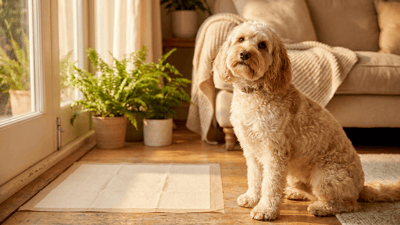
Who this is for: your dog has accidents indoors when they're left alone and you want to understand why before you try to change it. This guide helps you put the causes in the right order. If your dog was house-trained and suddenly started soiling indoors, the first step is always a visit to the vet.
A puddle in the hallway can really throw you off, especially when your dog has been reliably doing their business outside for a long time. It's easy to decide they're being "spiteful" or "acting out." But that's a misunderstanding: a dog doesn't soil the house with any plan in mind, and what you're seeing almost always communicates something. Our job is to figure out exactly what.
Accidents while you're away usually come down to one of a few causes: a medical issue, a gap in house-training, too long alone, or separation anxiety. They look alike, but they lead in completely different directions, and one of them calls for a vet visit first. So let's start with health.
First, rule out a medical cause
This is the most important step in the whole article. If your dog was house-trained and suddenly started having accidents indoors, treat it first as a possible health signal, not a behavior problem. Many causes are medical, and no amount of training will fix them.
The most common ones include urinary tract infections (UTIs), incontinence, diabetes, kidney disease, or other conditions that increase the need to go or take away control. Signs that strongly suggest a vet visit include:
- A sudden change in a previously house-trained dog.
- More frequent or heavier urination, or drinking more water.
- Wet patches where your dog sleeps, when they seem unaware they have leaked (typical of incontinence).
- Signs of discomfort while going, or traces of blood.
The vet usually starts with a urine test and basic checks to rule out infection and other conditions. Only once health is cleared is it worth looking at house-training or emotions. This isn't a delay, it's the right order, and it can save you weeks of work on something that was really a medical issue.
Why your dog has accidents when left alone
Once health is ruled out, what remains are causes tied to training and emotions. It's worth knowing all of them, because each leads somewhere different.
Incomplete house-training. Some dogs were never fully house-trained, or the habit slipped after a move, a change of routine, or a longer illness. A dog like this also has accidents while you're home, you just don't catch it, and the problem is fairly regular. This isn't about emotions, it's about a habit that never really set in.
Too long alone. Sometimes the reason is the simplest one possible: your dog physically can't hold it that long. Bladder capacity depends on age and condition, and a puppy or an older dog needs to go out more often. This isn't a training issue, it's about matching the rhythm of walks to what your dog actually needs.
Separation anxiety. With strong anxiety, a dog loses control of their bladder and bowels from the tension alone. They then have accidents only while you're away, usually soon after you leave, even if they went out on a walk moments before. It's almost never the only sign: howling, destruction, pacing, and drooling come with it. This isn't a lack of training, it's panic at being separated.
Submissive or excitement urination. Some dogs release a little urine when they greet you, cower, or feel unsure, for example when you get home. It's an emotional reaction, not a house-training problem. It's easy to tell apart, because it happens with you and in contact with you, not when your dog is alone.
Separation anxiety or a gap in house-training - how to tell them apart
Once health is ruled out, the easiest way to settle the cause is to look at three things: when your dog has accidents, whether it also happens with you there, and whether other signs come with it.
Separation anxiety means accidents only while you're away, soon after you leave, with clear tension and other symptoms. A gap in house-training also shows up while you're home, is more regular, and doesn't come with panic. Submissive urination is easy to spot: it happens in contact with you, usually during a greeting. This is easiest to work out calmly: exactly when the "accidents" tend to happen.
| Trait | Separation anxiety | Gap in house-training | Medical issue |
|---|---|---|---|
| When | Only when alone, soon after you leave | With you there too, fairly regular | At various times, often suddenly |
| Other signs | Howling, destruction, pacing | None, the habit just isn't set | More drinking, more frequent peeing, wet bed |
| First step | Training for calm departures | House-training from the basics | A visit to the vet |
Keep in mind that causes can overlap, and the answer isn't always obvious. If you're unsure, the safest bet is to start with the vet, and if you suspect anxiety, add a consultation with a behaviorist.
The easiest way to figure it out
The tricky part is that the "accidents" happen when you're not there. You come home to the aftermath, but you didn't see what led up to it, and it's the process that helps tell anxiety from a simple gap in house-training. That's why it helps to record what your dog does when they're left alone.
For this kind of observation, a second device left with your dog is all you need (a phone, a tablet, or an old laptop). You'll then see things you can't guess from the puddle alone:
- When they go. Soon after you leave and with tension points toward anxiety; calmly and after a long time points more to being alone too long or a gap in house-training.
- Whether there's tension. Howling, pacing by the door, and drooling are the picture of anxiety, not of a habit that simply never set in.
- How often. A single accident after many hours is a different story from going right after you leave.
An app that uses a second device like this can also recognize your dog's sounds and let you know when they start howling or barking. These are the signals that often go hand in hand with anxiety, so they help you see whether the "accident" comes with tension. It's support for forming the right hypothesis, not a replacement for a diagnosis from a vet or a behaviorist.
What to do, depending on the cause
When it's a medical issue. The first and most important step is a visit to the vet. Once the medical cause is ruled out or treated, the problem often disappears on its own, and if it doesn't, only then do you know that training or emotions are in play.
When it's a gap in house-training. Go back to house-training basics, just as with a puppy: regular trips outside at set times, rewarding going outdoors, and calmly cleaning up accidents with an enzymatic cleaner (so the spot doesn't tempt a repeat). It takes weeks of work, but it's effective.
When it's too long alone. Match the rhythm of walks to what your dog can actually manage, or arrange a midday break, for example with the help of someone close or a pet sitter. This is the simplest cause to solve, because it doesn't call for changing behavior, only the daily plan.
When it's separation anxiety. Simply focusing on house-training won't be enough. The foundation is systematic desensitization: teaching your dog step by step that you leaving is safe, starting from very short separations. It also helps to keep your departure routine low-key. For severe signs, talk to a dog behaviorist or a vet.
Never punish after you get home. This rule applies to every cause. Your dog won't connect the punishment to something from an hour ago; they will only learn that your return is sometimes unpleasant. With anxiety this deepens the tension, and with submissive urination it only increases fear-based soiling.
See what happens when you're not there
A second device left with your dog turns into a camera with sound recognition and a live view. You'll see when and in what state your dog goes - and it's easier to settle whether the "accident" comes with tension, or it's just a gap in house-training.
Frequently asked questions
When is indoor soiling a medical issue rather than a behavior problem?
If your dog was house-trained and suddenly starts having accidents indoors, the first step is always a visit to the vet. Many causes are medical: urinary tract infections (UTIs), incontinence, diabetes, kidney disease, or other conditions. The signs that especially point to the vet are a sudden change in a previously clean dog, more frequent or heavier urination, drinking more water, or wet patches where your dog sleeps (when they seem unaware they have leaked). Only once medical causes are ruled out is it worth looking at house-training or separation anxiety.
How do I tell accidents from separation anxiety apart from a gap in house-training?
Notice when your dog has accidents. With separation anxiety it happens only while you're away, usually soon after you leave, even if your dog went on a walk just before, and it comes with other signs of tension (howling, destruction, pacing). A gap in house-training also shows up while you're home and is more regular. The easiest way to check is to record whether your dog only has accidents when left alone, and how soon after you leave.
Should you punish your dog for having an accident indoors?
No. A dog won't connect the punishment with something they did an hour earlier, so they won't understand what they're being told off for. Punishing after you get home, rubbing their nose in it, or shouting usually makes things worse: with anxiety it raises the tension, and with submissive urination it increases fear-based soiling. Focus on the cause and on calmly building good habits, not on punishing the result.
My dog only has accidents when they're left alone. What does that mean?
Soiling only while you're away, soon after you leave, is one of the signs of separation anxiety, provided the vet has ruled out medical causes. It's worth starting with training for calm alone time and lowering the tension around your departure. If the signs are strong or your dog injures themselves, talk to a dog behaviorist or a vet.
Summary
- Health first. A sudden change in a clean dog is a signal to start with the vet, not with training.
- Gap in house-training: also happens with you there, is regular, no panic.
- Too long alone: the simplest cause - match the rhythm of walks to what your dog can manage.
- Separation anxiety: only when alone, soon after you leave, with tension and other signs.
- Never punish after you get home - your dog won't connect it, and with anxiety or submissive urination you'll make the problem worse.
This article is a practical guide and helps you understand your dog's behavior, but it doesn't replace a diagnosis. With a sudden change, health symptoms, or strong anxiety, talk to a vet or a dog behaviorist.
Sources and further reading
- ASPCA. "Separation Anxiety." aspca.org. Soiling while the owner is away as one of the signs of separation anxiety, and telling it apart from other causes.
- Vetster. "Why dogs pee or poop when left alone and what can be done." vetster.com. An overview of the causes: incomplete house-training, too long alone, medical causes, and separation anxiety.
- WebMD. "Medical Causes of House Soiling in Dogs." webmd.com. Conditions worth ruling out: urinary tract infections, incontinence, diabetes, kidney disease.
- VCA Animal Hospitals. "Dog Behavior Problems - House Soiling." vcahospitals.com. Telling apart house soiling and submissive or excitement urination.