
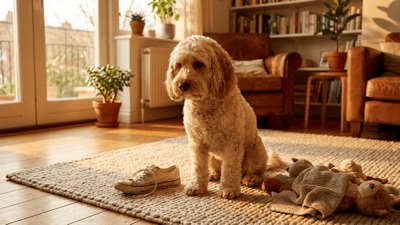
Who this is for: your dog destroys something while you're away and you want to understand why before you start changing anything. This guide helps you tell apart the two most common causes and choose the right approach. If your dog injures themselves or the signs are severe, talk to a dog behaviorist or a vet.
Coming home to destroyed things can be incredibly frustrating. It's easy to decide your dog is "doing it to spite you" or "getting back at you" for the alone time. But that's a misunderstanding: a dog doesn't plot revenge and doesn't act with premeditation. Destruction almost always communicates something, and our job is to read exactly what.
In practice, destruction while you're away usually comes down to two different causes: separation anxiety and boredom. They look similar (torn-up things, teeth marks), but they're completely different states that call for different work. Let's start with how to tell them apart.
Separation anxiety or boredom - how to tell them apart
The easiest way to settle it is to look at three things: when your dog destroys, what they destroy, and whether other signs come with it.
Separation anxiety usually strikes fast, in the first ten to thirty minutes after you leave. The destruction focuses on escape routes: the dog scratches at the door, chews the frame, goes after the windowsill and window, sometimes injuring their paws or muzzle in the process. It's almost never the only sign. Whining, howling, drooling, and pacing come with it, and the tension often starts the moment your dog sees you getting ready to leave.
Boredom has a different rhythm. The dog usually sleeps first, and only later, when there's nothing to do, starts looking for something to occupy themselves. They then destroy whatever happens to be within reach: shoes, trash, cushions, the remote. There's no panic here - the dog isn't trying to escape and isn't whining in despair, they're simply bored. It's also telling that with boredom the destruction eases off when the dog gets more exercise and things to do, while with anxiety the problem comes back despite the best toys.
| Trait | Separation anxiety | Boredom |
|---|---|---|
| When | Right after you leave, first minutes | Later, after a nap |
| What | Doors, windows, windowsill (escape routes) | Random items (shoes, trash) |
| Other signs | Howling, drooling, panic, self-injury | No panic, dog is calm |
| Response to activity | Problem returns despite toys | Eases off with more exercise and stimulation |
Keep in mind that these two causes can overlap, and there are other, rarer reasons too, like teething in a young dog or pain. If the destruction appears suddenly in an adult dog that used to be calm, it's a good idea to have a vet rule out a health cause.
The simplest way to be sure
The tricky part is that the actual behavior happens when you're not there. You come back to the finished result, but you didn't see the process - and it's the process that reveals the cause. That's why behaviorists point to the same thing: the surest way to settle whether it's anxiety or boredom is to record what your dog does when they're left alone. And it's not just about the first hour: anxiety usually shows up in the first minutes after you leave, but boredom can appear only after a nap, sometimes two or three hours in. So the fullest picture comes from watching the whole time you're away, or at least the first few hours.
For this kind of observation, a second device left with your dog is enough (a phone, a tablet, or an old laptop). You'll then see things you can't guess from the damage alone:
- How fast the dog starts. A reaction in the first minutes points strongly to anxiety; calm hours and later digging around point more to boredom.
- Whether there's panic. Whining, howling, pacing by the door, and escape attempts are the picture of anxiety, not boredom.
- What they focus on. Scratching at doors and windows is an escape signal; chewing a random cushion on the couch is a completely different story.
An app that uses a second device like this can also recognize your dog's sounds and let you know when they start barking or howling. That way you don't have to watch hours of footage - you get a signal exactly when something is actually happening. It's support for forming the right hypothesis, not a replacement for a consultation with a behaviorist.
What to do when it's separation anxiety
If the picture points to anxiety, simply guarding your things won't be enough. You need to work on helping your dog cope more calmly with your absence. It takes weeks of work, but it's effective and long-lasting.
Training for calm alone time. The foundation is systematic desensitization: teaching your dog step by step that you leaving is safe, starting from very short separations. It's the most effective path with genuine anxiety.
Defusing the departure ritual. If your dog already winds up at the sight of your keys and shoes, it helps to disarm those cues by repeating them without actually leaving, until they stop signaling anything. We write about it in the article on how dogs react to their owner leaving.
No punishment after you get home. Your dog won't link the punishment to damage from an hour ago; they will only learn that your return is sometimes unpleasant, which, with anxiety, deepens the tension.
Professional support for severe signs. If your dog injures themselves, howls for hours, or nothing helps, that's a signal to talk to a dog behaviorist or a vet. Strong separation anxiety is sometimes treated on several fronts, and it's worth doing that under a specialist's guidance.
What to do when it's boredom
If your dog destroys things out of a lack of anything to do, the good news is that it's usually the easier problem. The goal is to make sure your dog is already tired and occupied when left alone, rather than charged with energy that has nowhere to go.
Exercise before you leave. A proper walk or a game before you head out makes your dog more likely to rest, instead of looking for entertainment on their own. More on this in the article on activity before alone time.
Something to do for the first minutes. Interactive toys (a snuffle mat, a food-stuffable toy, a simple puzzle) can occupy your dog right when boredom is most likely, and redirect the chewing onto something allowed.
Mental stimulation, not just physical. Mental work tires a dog out faster than physical exercise. Short sessions of scent work, learning cues, or thinking games can tire them more than a long walk and genuinely reduce the urge to "get busy" with the furniture.
Clear away the temptations. While your dog is learning new habits, simply put away what tempts them most (shoes, the trash can, the remote). This doesn't treat the cause, but it limits the damage until everything else kicks in.
When it's neither anxiety nor boredom
Separation anxiety and boredom are the two most common causes, but not the only ones. Before you call the case closed, it's worth knowing about three other leads, because each one points in a completely different direction.
Teething in a puppy. Young dogs, roughly between three and six months, chew to relieve sore gums while their teeth come in. This usually has nothing to do with either anxiety or boredom, only with growing teeth. Here what helps is giving your dog allowed things to chew and waiting the stage out, not alone-time training.
Something hurts. A sudden change in behavior in a dog that never destroyed anything before can have a medical basis. Pain, digestive trouble, or, in senior dogs, age-related changes sometimes show up exactly as restlessness and chewing. If the destruction appeared out of nowhere and doesn't fit your dog's usual habits, the first step is a visit to the vet to rule out a medical cause.
The problem is being alone, not one specific person. Some dogs don't panic from missing one particular person; they simply can't stand being alone in an empty home. Behaviorists sometimes call this isolation distress, as opposed to classic separation anxiety. The signs can be similar, and so is the way out: calm training for being left alone. Recording tells you the most here too - it shows whether your dog is looking for a way to you, or simply can't cope with the quiet and the empty space.
See what really happens when you're not there
A second device left with your dog turns into a camera with sound recognition and a live view. You'll see when and how your dog starts to destroy things - and you'll find it easier to settle whether it's anxiety or boredom.
Frequently asked questions
How do I tell destruction from anxiety apart from destruction from boredom?
Watch three things: when, where, and how. Separation anxiety usually hits in the first ten to thirty minutes after you leave, focuses on doors and windows (escape routes), and comes with other signs of tension like whining or drooling. Boredom shows up later, once your dog has slept and has nothing to do, targets random items (shoes, trash, toys), and doesn't come with panic. The surest way to settle it is to record how your dog copes with being alone, ideally for the whole time you're away, because anxiety shows in the first minutes while boredom often appears only after a nap.
Does punishing a dog after you get home for the damage make sense?
No. A dog doesn't connect the punishment with something they did an hour earlier, so they won't understand what they're being told off for. Instead, they learn that your return is sometimes unpleasant, which, with separation anxiety, only raises the tension. The so-called "guilty look" is a reaction to your tone and posture, not an admission of guilt. Focus on the cause, not on punishing the result.
Will a bigger crate or closing the dog in one room solve the problem?
Simply limiting space doesn't treat the cause. With boredom, a smaller, well-arranged space with something to do can help. But a dog in strong separation anxiety, shut in a crate, can injure themselves trying to escape. If you suspect anxiety, first work on lowering the tension and only then think about managing space, ideally after a session with a behaviorist.
My dog only destroys things when they're alone. What does that mean?
Destruction that shows up only while you're away and is focused on doors or windows is one of the classic signs of separation anxiety, not ordinary boredom. It's worth starting with training for calm alone time and lowering the tension around your departure. If the signs are strong or your dog injures themselves, talk to a dog behaviorist or a vet.
Summary
- Destruction communicates something - your dog isn't doing it out of spite or revenge.
- Separation anxiety: fast after you leave, focused on doors and windows, with panic (howling, drooling), returns despite toys.
- Boredom: later, after a nap, random items, no panic, eases off with more exercise and stimulation.
- The surest test is recording how your dog copes with being alone - ideally the whole time you're away, because anxiety shows right away while boredom often appears only after a nap.
- Never punish after you get home - your dog won't connect it, and with anxiety you'll make the problem worse.
This article is a practical guide and helps you understand your dog's behavior, but it doesn't replace a diagnosis. If your dog injures themselves, howls for hours, or the signs don't ease despite your work, talk to a dog behaviorist or a vet.
Sources and further reading
- ASPCA. "Separation Anxiety." aspca.org. Signs of separation anxiety, including destruction focused on escape routes and intensifying right after the owner leaves.
- Small Door Veterinary. "Destructive Behavior in Dogs." smalldoorvet.com. Causes of destruction and telling anxiety from boredom and health problems.
- Vetster. "Boredom, anxiety, and destructive behavior in dogs." vetster.com. How enrichment affects destruction from boredom, but not from anxiety.