
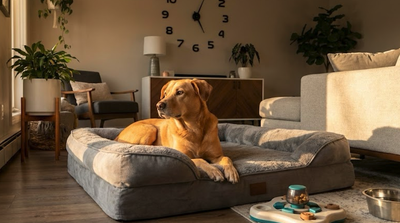
The alarm goes off at 6:30. A quick walk, a bowl of food, a pat on the head - and you close the door. Ahead of you: 8 hours at the office. Ahead of your dog: 8 hours of quiet.
If this feels familiar, you're not alone. Millions of dog owners around the world face the same dilemma every day. And millions of them feel the same thing: guilt, uncertainty, and the question "is this OK?"
The answer isn't black and white. But it is an honest one - and in this article we'll do our best to give it. No scare tactics, no sugarcoating. Just facts, research, and concrete solutions.
Is 8 hours alone too much for a dog?
Let's start with what the science says. Research into dogs being left alone has been going on for years, and while the results don't give one simple answer, they paint a fairly consistent picture.
The Rehn and Keeling study (2011) from the Swedish University of Agricultural Sciences in Uppsala is one of the most frequently cited. The researchers measured how dogs reacted after 30 minutes, 2 hours, and 4 hours alone. The result? After 2 hours, dogs greeted their owners far more intensely than after 30 minutes - more tail wagging, more physical contact, higher heart rate. This suggests that dogs feel the passage of time and that a longer separation is more emotionally taxing for them.
Meanwhile, research on cortisol - the stress hormone - shows something even more important. In dogs left alone for longer than 4 hours, cortisol levels can stay elevated for the entire time their owner is away. That doesn't mean the dog is in a panic - but it does mean their body is responding to stress, even if the dog is "just lying there sleeping."
So is 8 hours too much? It's the upper limit of what most adult dogs can tolerate. It's not ideal, but it's realistic - and with the right preparation, most dogs do fine. Organizations like the RSPCA recommend a maximum of 4 hours of regular alone time, but they also acknowledge that many dogs adapt to longer stretches, especially when they're the right age and well prepared.
The key word is: adaptation. Dogs are masters of adjusting. But adapting doesn't always mean being comfortable. That's why it's worth doing everything you can to make those 8 hours as low-stress as possible.
What happens to your dog over 8 hours alone
Thanks to studies using video cameras (including Lund and Jorgensen, 1999), we have a fairly detailed picture of what a dog's day looks like when no one is home. Here's a typical scenario:
The first 30 minutes - the hardest moment
This is the time when most dogs show the most distress. Pacing by the door, listening, whimpering, and sometimes barking. The dog hasn't "accepted" your departure yet and is hoping you'll be back any moment. Research shows that cortisol rises fastest in exactly these first few minutes.
1-2 hours - settling down
Most dogs slowly settle. They may still wander around the apartment, check the windows, sniff your things. But the intensity of their distress drops. This is where toys and activities (like a Kong) do the most work - they help your dog get through the toughest stretch.
3-5 hours - napping and rest
Good news: adult dogs sleep 12 to 14 hours a day. Most of those hours fall exactly during the time when no one is home. In this phase your dog usually sleeps or lies quietly in their favorite spot. This is the easiest part of the day.
6-8 hours - waiting
In the final hours, many dogs start to wake up and grow more alert. If you keep a steady schedule, your dog "knows" your return is getting close. They may go to the door, listen for footsteps in the hallway. Some dogs get restless in this phase - especially if they need to go outside.
An important note
This scenario describes a healthy adult dog who's used to being alone. Dogs with separation anxiety may spend this entire time in a state of intense stress - barking, destroying furniture, and even hurting themselves. If you suspect separation anxiety, this "timeline" can look completely different.
7 proven ways to a calmer 8 hours
You can't change the fact that you work 8 hours. But you can change how your dog experiences those hours. Here are the strategies that really work.
1. A morning walk - the foundation of a calm day
This is the absolute basics. At least 30 minutes of an active walk before you leave the house. This isn't about a "walk on the leash around the block" - it's about movement that lets your dog get tired. Running, fetch, sniffing around in the grass.
Research confirms what trainers have said for years: a tired dog is a calm dog. A dog who's had a solid dose of exercise in the morning falls asleep much more easily after you leave. And the first hours - the hardest ones - they'll sleep through instead of tearing up the couch.
If you work an early shift and don't have time for a long walk, get up 30 minutes earlier. Your dog (and your conscience) will thank you for it.
2. A dog walker or pet sitter midday
If you can afford it, this is probably the best investment you can make for your dog. One midday visit - a 30-minute walk, some play, a quick bit of human contact - splits those 8 hours into two much easier 4-hour blocks.
4 hours alone is something most dogs handle without any trouble. That's a huge difference compared to a straight 8 hours. If you can't afford a daily pet sitter, consider even 2-3 times a week - every day with a break makes a difference.
3. A Kong and interactive toys
A Kong stuffed with peanut butter (or another dog-friendly treat) is a classic for a reason. It keeps your dog busy for 20-40 minutes - right at that hardest moment after you leave. A snuffle mat, a ball with hidden treats, a puzzle toy - these all engage your dog mentally and help them get through that first phase of distress.
Pro tip: Prep the Kong in the evening and freeze it overnight. A frozen Kong keeps your dog busy even longer. Hand it over right before you leave - your dog won't even notice you closing the door.
4. A calm environment
A study from the University of Glasgow (Bowman et al., 2015) found that classical music lowers stress levels in shelter dogs. Newer research suggests that reggae and soft rock may work even better. Play calm music or white noise before you leave - it creates a background of sound that masks outside noise (neighbors, the hallway, street traffic) and helps your dog relax.
If your dog reacts to things outside the window - barking at passersby, cats, or other dogs - draw the curtains or blinds. Fewer triggers = less stress.
5. A safe space
Your dog needs a place of "their own." Not a crate (unless they're positively used to one), but a safe, comfortable space where they feel good. It could be their bed in the bedroom, a corner of the living room, or a separate room.
It's important that this space has:
- A comfortable bed
- Access to fresh water
- No dangerous objects (cables, chemicals, small things they could swallow)
- Something with your scent - an old T-shirt or hoodie. Your scent has a calming effect
6. Monitoring with an app
Not sure what your dog does over those 8 hours? Monitoring gives you the answer. Apps like Merdilo use AI-powered sound recognition to listen to the sounds in your home - they tell barking, howling, and whimpering apart and notify you in real time.
Monitoring isn't just peace of mind for you. It's also a diagnostic tool. With it, you'll learn whether your dog:
- Sleeps peacefully for most of the day
- Barks for the first 30 minutes and then settles down
- Howls and whimpers for hours (which can point to separation anxiety)
This knowledge lets you adjust your approach. Maybe your dog needs a longer morning walk? Maybe it's worth adding a pet sitter? Monitoring data gives you concrete answers instead of guesses.
7. Doggy daycare 2-3 days a week
You don't have to send your dog to daycare every day. Even 2-3 days a week makes a huge difference. Your dog gets contact with other dogs, exercise, and stimulation - and on the "off" days they're tired enough to sleep peacefully through your time away.
Doggy daycare is a great fit for social dogs who love company. But it's not for everyone - shy, reactive, or older dogs may find it stressful. Watch how your dog reacts and talk to the staff about their behavior.
See what your dog does over those 8 hours
Merdilo is a dog monitoring app that listens to your pup and notifies you when they need help - all you need is your phone as a dog camera, no hardware to buy. Find out whether your dog is sleeping peacefully or barking at the door.
Which dogs handle 8 hours well, and which don't?
Breed isn't a verdict, but it matters. Thousands of years of breeding created dogs with different levels of independence and different needs for human company.
Breeds that usually cope better with being alone
More independent breeds are the ones historically bred to work on their own. The Basset Hound, Shar Pei, Chow Chow, Shiba Inu, or Greyhound can spend many hours in their own company without much stress. Greyhounds, despite being racing dogs, are surprisingly lazy couch potatoes at home who happily sleep through the whole afternoon.
Bulldogs (English and French), the Basenji, or the Chihuahua can also be relatively independent - though of course every dog is different.
Breeds that may struggle
At the other end are dogs bred to work closely with people. The Border Collie, Australian Shepherd, Labrador, Golden Retriever, Cocker Spaniel, Vizsla, and Cavalier King Charles Spaniel - these breeds are incredibly attached to their people and may cope less well with long hours alone.
This doesn't mean you can't have a Labrador while working full-time. It means a dog like that will need more support - longer walks, more stimulation, and probably a pet sitter midday.
Remember: every dog is an individual
Breed is a starting point, not a diagnosis. Your Border Collie might be surprisingly calm on their own, and your Basset Hound might howl at the door. Watch your own specific dog and adjust to their needs, not to breed statistics.
Signs your dog isn't coping with 8 hours alone
You come home from work. You open the door. And what do you see? What you find at home says more than a thousand words. Here are the signs you need to watch for:
Damage - especially near doors and windows
A chewed door frame, scratched doors, a torn-down blind - this isn't spite. It's desperation. A dog who destroys things near the entrance is trying to get out and follow you. It's one of the strongest signs of separation anxiety.
"Accidents" even though your dog is house-trained
If your dog has long been house-trained and you regularly find puddles when you get home - this isn't a lack of training. Stress can cause a loss of bladder control. It's a sign that 8 hours is too much for this particular dog.
Excessive drooling and sweaty paws
If you come home to a wet bed or see drool marks on the floor - your dog is probably under serious stress. Excessive drooling is a physiological response to anxiety in dogs.
Apathy or over-the-top excitement when you return
A dog who greets you with a happy tail wag - that's normal. A dog who jumps, whines, trembles, and can't calm down for 20 minutes - that's a sign they experienced your absence very intensely. On the other hand, a dog who doesn't react to your return at all may be emotionally worn out.
Excessive licking or chewing at paws
Compulsive behaviors - obsessively licking the paws or flanks, chewing the tail - are a dog's way of coping with stress. If you notice redness, bald spots, or sores from licking, talk to your vet.
Refusing to eat
You leave a full bowl and it's untouched after 8 hours? A healthy dog who won't eat all day may be too stressed to think about food. That's a serious warning sign.
Neighbors report barking or howling
You don't hear it because you're at work. But your neighbors might. If you're getting word that your dog barks or howls for hours - don't brush it off. This isn't a "bad dog." It's a dog who needs help.
Alternatives to 8 hours alone
If you notice warning signs - or you simply want to give your dog a better life - here are solutions that can help:
Remote or hybrid work
If your company offers the option to work from home even 1-2 days a week, take it. For your dog, it's a huge difference. You don't have to spend those days playing with your dog - your presence alone is enough to lower their stress level.
Flexible working hours
Maybe you can start earlier and get home earlier? Or work with a break for a walk? Even cutting alone time from 8 to 6 hours makes a difference - research suggests that 6 hours is still a comfortable range for most dogs.
Bringing your dog to the office
More and more companies - especially in the tech industry - allow dogs in the office. If your workplace doesn't do this, maybe it's worth raising the topic? Research shows that having dogs in the office lowers employee stress and improves the atmosphere.
Family and neighbors
Sometimes the simplest solutions are the best. Could a grandparent stop by at noon? Would a retired neighbor happily let your dog out into the yard? Maybe a friendly neighbor who works from home could take them on a 15-minute walk? It's worth asking - people love dogs, and you can return the favor in other ways.
A second dog?
Two dogs aren't twice the work - but they are twice the company for each other. If you're considering a second dog, remember that canine company doesn't replace human company, but it can significantly ease loneliness. It's important that both dogs like each other - forced cohabitation can bring more stress than benefit.
Summary - key takeaways
Here are the most important points from this article:
- 8 hours is the upper limit - not ideal, but doable for a healthy adult dog with the right preparation.
- Science confirms it: cortisol levels rise in dogs when they're alone, but most dogs adapt to a steady schedule.
- The first 30 minutes are the hardest moment - a morning walk and a Kong can turn them into a nap instead of a panic.
- A midday pet sitter turns 8 hours alone into two 4-hour blocks - and that makes a huge difference.
- Watch your dog: damage, "accidents," barking, and apathy are signs they need more support.
- Monitoring lets you see what's really happening instead of guessing.
- The fact that you worry already shows you're a good owner. Look for solutions, not perfect conditions - because those rarely exist.
Your dog doesn't need you to quit your job. They need you to come home and give them what matters most: your attention, your warmth, and your time. And over those 8 hours - make sure they have a safe space, something to do, and the certainty that you always come back.
Because that's where all the magic is: Your dog isn't counting the hours. They're counting on you.
Sources
- Rehn, T., & Keeling, L. J. (2011). "The effect of time left alone at home on dog welfare." Applied Animal Behaviour Science, 129(2-4), 129-135.
- Lund, J. D., & Jorgensen, M. C. (1999). "Behaviour patterns and time course of activity in dogs with separation problems." Applied Animal Behaviour Science, 63(3), 219-236.
- Bowman, A., Scottish SPCA, Dowell, F. J., & Evans, N. P. (2015). "The effect of different genres of music on the stress levels of kennelled dogs." Physiology & Behavior, 171, 207-215.
- Beerda, B., Schilder, M. B., Van Hooff, J. A., & De Vries, H. W. (1999). "Chronic stress in dogs subjected to social and spatial restriction. I. Behavioral responses." Physiology & Behavior, 66(2), 233-242.
- Nagasawa, M., Mitsui, S., En, S., et al. (2015). "Oxytocin-gaze positive loop and the coevolution of human-dog bonds." Science, 348(6232), 333-336.
- RSPCA (2024). "How long can I leave my dog alone?" Royal Society for the Prevention of Cruelty to Animals.
This article is for informational purposes and does not replace a consultation with a veterinarian or a certified dog behaviorist. If your dog shows serious signs of separation anxiety or other behavioral issues, consult a professional.