

Who this article is for: your dog struggles with the bangs of fireworks and firecrackers, and you want to get them ready for New Year's Eve calmly. Any medication or calming product is chosen by your vet, so we don't name any here.
Dog afraid of fireworks? Start three to four weeks before New Year's Eve: set up a quiet safe spot and play a very quiet recording of bangs. If past years were very hard for your dog, ask a behaviorist for help. On December 31, walk before dark, close the curtains, put on music and stay with your dog. If they come to you for comfort, give it calmly.
Plenty of dogs react this way. In a Finnish study of nearly 13,700 dogs, 26% were afraid of fireworks and 32% reacted to at least one kind of noise (Salonen et al., 2020). In UK interviews, almost half of owners described at least one sign of fear in their dog around loud noises, and fireworks were the most common trigger (Blackwell et al., 2013). It usually passes quickly: about three in four dogs who react to fireworks are back to normal by the next morning (Riemer, 2019).
How to tell your dog is struggling with fireworks
Some dogs react loudly, others quietly. It helps to know both, because a dog lying still under the bed isn't necessarily calm.
- Trembling, panting, drooling in a cool room, without any exercise.
- Hiding under the bed, in the bathroom, behind the sofa or in the darkest corner.
- Pacing, scratching at doors, trying to leave the room.
- Barking, whining or howling with each new bang.
- Seeking closeness: pressing against your legs, climbing onto your lap, following you everywhere.
- Loss of appetite, turning down treats that usually vanish in a second.
We cover these signals in more detail in our guide to dog body language. Dogs who struggle with fireworks often react to thunder the same way, because a reaction to one loud noise tends to spread to others. If your dog also hides during storms, see dog afraid of storms.
A 4-week plan before New Year's Eve
It pays to start early. In Riemer's study (2019), dogs taught to link bangs with something pleasant before any fear appeared coped much better with fireworks later, and training started after the fear had developed also led to improvement more often. The plan below assumes you start in early December.
Week 1: a safe spot
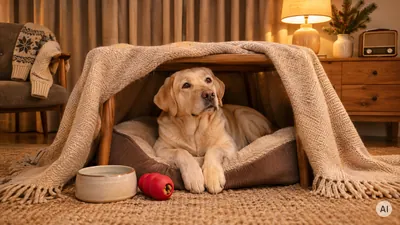
Set up a safe spot. Ideally in the room with the fewest windows, or in the bathroom. A dog bed, a table or an open crate covered with a blanket, a few things that smell of home and a water bowl are enough. Your dog should be able to come and go freely, so leave the crate door open. Over the next weeks, give treats and toys there so the spot feels good.
If past years were hard, it's worth asking a behaviorist for help now, for example if your dog trembled for a long time, tried to escape or took more than a day to recover. A behaviorist will look at how your dog reacts to noise, build a plan for getting used to the bangs at your dog's pace and help you prepare for the night itself. If pain might be making things worse or medication is needed, your vet joins the plan. Some medicines are given before the first bangs, so it's better not to leave either conversation to the last days before New Year's Eve. Don't give your dog anything on your own, especially medicines meant for people.
Weeks 2 and 3: getting used to the sound
Play a recording of fireworks so quietly that your dog barely notices it, and give treats or play at the same time. If your dog stops eating, lifts their head to listen or starts panting, turn the volume down or take a break, and try again once they're relaxed. Raise the volume a little at a time over several days, never in big jumps. With a strong fear this takes months, and it's easiest to do with a behaviorist, but even small progress makes New Year's Eve easier. The same small-steps idea is behind systematic desensitization in alone-time training.
Week 4: safety and a plan for the night
Check that your dog's microchip details are up to date and that they wear an ID tag with your phone number. Fit the harness so your dog can't back out of it, and keep them on a leash around New Year's Eve, even for short trips outside. Firecrackers often start a few days before and go on for a few days after. Agree with your household who stays home with the dog on the night of December 31.
December 31: the day hour by hour
The times are a rough guide. In many places the first bangs start in the afternoon, so adjust the plan to your area.
| When | What to do |
|---|---|
| Late morning | A long sniffy walk, on a leash and in a harness. A tired dog rests more easily in the evening. |
| Early afternoon | Main meal. Once the bangs start, your dog may not want to eat. |
| Before dark | Last longer walk and a toilet break before the fireworks begin. |
| Evening | Windows shut, curtains drawn, lights on. Radio, TV or calm music in the background to partly mask the noise. Safe spot open. |
| An hour before midnight | A food-filled toy or a lick mat. If your vet prescribed medication, give it at the time they set. |
| Around midnight | Stay close and speak calmly. A dog who wants closeness can have it. A dog who has hidden can stay in the hiding spot. |
| After midnight | Toilet breaks on a leash only, even in your own yard. Check the lawn for firework debris first. |
| January 1 | A quiet day with shorter walks on a leash. Bangs may still come back. |
What helps and what to avoid
Comforting your dog doesn't reinforce fear. The advice to ignore a dog who trembles at the bangs still gets passed around, but it hasn't held up: the UK charity Dogs Trust says plainly that ignoring your dog won't help. If your dog comes to you, stroke them calmly and stay close. If they'd rather hide, let them. What helps most is your calm voice and normal behavior, without nervous fussing.
- Don't punish your dog for barking, trembling or a stress accident. That's how stress shows, and your dog isn't doing it on purpose.
- Don't pull them out of a hiding spot or hold them on your lap by force.
- Don't take your dog to a fireworks display or anywhere people are setting them off, even if they were calm in past years.
- Don't let them off the leash in the days around New Year's Eve. A sudden bang can send a dog running far from home.
- Don't give anything without your vet. Even popular calming remedies can harm a dog or work differently than you'd expect.
Afterwards, write a few sentences about how your dog reacted, how long it lasted and what helped. That note helps a behaviorist or a vet, and next year you can start from what worked.
If you can't be with your dog on New Year's Eve
A dog who struggles with bangs does best with someone they know. Dogs Trust advises not leaving your dog alone on fireworks night. If being out is unavoidable, ask someone your dog knows well to stay with them, or plan to be back before midnight. Leave the safe spot, the drawn curtains and the background sound ready, just as for an evening at home.
The bangs aren't limited to one night. Firecrackers go off in the days before and after New Year's Eve too, often while your dog is home alone and everyone is at work. That's exactly when it's hard to know how your dog is doing, unless you use your phone as a dog camera in the room with the safe spot.
How does your dog handle firecrackers while you're out? See the report when you get home
A phone, tablet or laptop with Merdilo left next to your dog recognizes barking, whining, howling and growling. When you get home, the report shows when it was quiet and when your dog spoke up. That makes it easier to see whether the safe spot and the plan are helping, and gives you concrete data to share with a behaviorist.
Your first 7 days of Watching are free, no credit card needed.
When to ask a behaviorist for help
For most dogs the reaction passes with the night, but not for all. In Riemer's study (2019), more than 3% of dogs took weeks or months to recover, and in roughly one in four dogs the reaction to fireworks got worse over time. In the UK study, fewer than a third of owners of noise-sensitive dogs sought professional advice (Blackwell et al., 2013). It's worth asking for help when:
- your dog takes longer than a day to recover or won't go for walks for several days,
- the reaction gets stronger every year or starts at quieter and quieter sounds,
- your dog gets hurt trying to escape, damages doors or doesn't eat for a long time,
- noise sensitivity appears suddenly in a dog who never had it, especially a senior.
A behaviorist will build a plan for getting used to the bangs and for practice all year round, so the next New Year's Eve is easier. In Riemer's study (2019), dogs who started training after the fear had appeared were more likely to improve. If the noise sensitivity appeared suddenly or your dog might be in pain, start with your vet. In more serious cases a veterinary behaviorist can combine training with treatment. Read more about choosing a specialist in when to see a dog behaviorist.
Frequently asked questions
How early should I start preparing my dog for New Year's Eve?
Ideally three to four weeks ahead, in early December. That gives your dog time to like their safe spot, get at least a little used to a quiet recording of bangs, and gives a behaviorist time to build a plan if it's needed. With a strong fear, preparation takes longer, so it's worth practicing all year, not just before New Year's Eve.
Does comforting a dog who is afraid of fireworks reinforce the fear?
No. That's old advice that hasn't held up. Dogs Trust says plainly that ignoring your dog won't help. If your dog comes to you for comfort, stroke them calmly and stay close. If they'd rather hide, let them stay in the hiding spot. What helps most is your calm voice and normal behavior.
Can a behaviorist help prepare my dog for New Year's Eve?
Yes, especially if past years were hard. A behaviorist will look at how your dog reacts to noise, build a plan for getting used to the bangs at your dog's pace and suggest how to set up the safe spot and get through the night itself. It's best to reach out a few weeks before New Year's Eve, because getting used to the sound takes time. If pain needs to be ruled out or medication is needed, your vet joins the plan.
Can I leave my dog home alone on New Year's Eve?
A dog who struggles with bangs does best with someone they know, so ideally someone familiar stays home on fireworks night. If going out is unavoidable, set up the safe spot, close the curtains, put on background sound and plan to be back before midnight. Even a dog who has coped well so far is better not left alone all night, because the reaction can also start in adulthood.
What can I give my dog to calm down on New Year's Eve?
Only what your vet chooses after examining your dog. Don't give anything on your own, especially medicines for people, because they can harm your dog. If you're considering that kind of support, talk to your vet early, because some products are given before the first bangs. Without a prescription you can still do a lot: a safe spot, closed curtains, background sound and a food-filled toy.
How long does it take a dog to recover after fireworks?
Usually not long. In Riemer's study (2019), about three in four dogs were back to normal by the next morning. For some it takes a day or a week, and for a few, several weeks. If your dog takes more than a day to recover or won't go for walks for several days, talk to a behaviorist or your vet.
Quick cheat sheet
- December: a safe spot and short daily sessions with a quiet recording of bangs, plus a behaviorist if past years were hard.
- The last week: microchip, ID tag, a well-fitted harness, walks on a leash only.
- December 31: walk and meal before dark, curtains drawn, background sound, a food toy, someone familiar at home.
- During the fireworks: your dog chooses closeness or a hiding spot. Comforting is fine.
- Afterwards: a short note on how your dog reacted, and a behaviorist if recovery takes more than a day.
This article is a practical guide and doesn't replace a consultation with a behaviorist or your vet. Medication and calming products are chosen only by a vet after examining your dog.
Sources and further reading
- Salonen, M., Sulkama, S., Mikkola, S. et al. (2020). "Prevalence, comorbidity, and breed differences in canine anxiety in 13,700 Finnish pet dogs." Scientific Reports, 10, 2962. nature.com. 26% of dogs were afraid of fireworks; 32% reacted to at least one kind of noise.
- Blackwell, E. J., Bradshaw, J. W. S., Casey, R. A. (2013). "Fear responses to noises in domestic dogs: Prevalence, risk factors and co-occurrence with other fear related behaviour." Applied Animal Behaviour Science, 145, 15-25. doi.org, summary: sciencedaily.com. Almost half of interviewed owners described at least one sign of fear around noise; fireworks were the most common trigger; fewer than a third sought professional advice.
- Riemer, S. (2019). "Not a one-way road: Severity, progression and prevention of firework fears in dogs." PLOS ONE, 14(9), e0218150. journals.plos.org. About three in four dogs recovered by the next morning, more than 3% needed weeks or months; the reaction got worse in about a quarter of dogs; training with positive associations reduced later fear.
- Dogs Trust. "Fireworks and dogs." dogstrust.org.uk. A safe spot, daytime walks, closed curtains and background sound, comforting a dog who seeks it, not leaving the dog alone, up-to-date microchip details and contacting your vet.
- PDSA. "Firework fear: experts urge pet owners to start preparing their furry friends for New Year's Eve." pdsa.org.uk. Quiet firework recordings paired with treats, lowering the volume at signs of stress.