
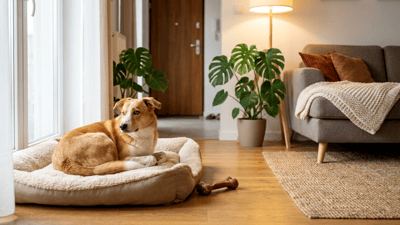
Who this is for: you've just adopted a rescue dog (or you're about to) and you want to gently help them get used to being alone. If your dog injures themselves around separations, panics, or the signs don't ease despite your work, talk to a vet or a dog behaviorist.
The first days after an adoption can feel beautiful and overwhelming at once. Your new dog follows your every move, lies down at your feet, trails you to the kitchen and the bathroom. And somewhere in the back of your mind sits one question: how will they cope the first time you leave and they're home alone?
It's one of the most common questions after an adoption, and it doesn't mean you're doing anything wrong. A rescue dog usually carries a history you don't know: a change of home, the loss of a previous family, sometimes several moves. That can make them more sensitive to being left alone - but sensitivity isn't a life sentence. Below we explain where it comes from (without scaremongering, and without hard statistics science doesn't support) and lay out a calm plan for the first days, weeks, and months.
Why rescue dogs can be more sensitive to being alone
ASPCA notes that separation anxiety is seen more often in dogs adopted from shelters than in those who stay with one family from puppyhood. The likely mechanism is intuitive: the loss of an important person or a whole group of people, and a sudden change of routine, surroundings, and household.
But how we say this matters. ASPCA itself points out there's no conclusive evidence for why dogs develop separation anxiety - it's a clinical observation, not a proven cause. What's more, the newer, better-controlled Generation Pup study (2024) didn't confirm that shelter origin on its own is an independent risk factor; early environment and upbringing mattered more.
So we talk about greater sensitivity and susceptibility, not a certainty, and we deliberately don't quote a percentage of "how many shelter dogs have separation anxiety" - those numbers are sparse and inconsistent in the research. This isn't a reason to fear adoption. It's a reason to simply start wisely from day one.
What the science says about hyper-attachment and a new owner
One of the most cited studies is Flannigan and Dodman (2001). It found that separation anxiety was significantly linked to hyper-attachment to the owner - following at every step, unease at the first departure cues, and an over-the-top greeting on return.
The same study yielded an interesting finding: dogs from a single-adult household were about 2.5 times more likely to have anxiety than dogs from multi-person homes. The researchers also debunked a popular myth - they didn't confirm that early separation of a puppy from their mother leads to separation anxiety.
There's an important caveat here: "single-adult household" isn't the same as "shelter dog" - the study didn't compare where the dog came from. The practical takeaway is universal, though: an intense, fresh bond with a new owner is lovely, but it's worth teaching your dog calm independence from the start, so attachment doesn't turn into distress at every parting.
The 3-3-3 rule: a natural rhythm for settling in
In shelter and veterinary circles you'll often hear about the 3-3-3 rule. It's a rough framework for a new dog's adjustment:
- The first ~3 days - decompression. The dog may be overwhelmed, cautious, may hide and eat little. That's normal, not a disorder.
- The first ~3 weeks - learning the routine. The dog starts to understand the rhythm of the day, shows their temperament, and the tension gradually eases.
- The first ~3 months - fuller acclimation. Trust and the dog's real character emerge.
This is a rough framework, not a hard rule from studies. Many dogs need half a year, sometimes a year, to fully settle. Most important: don't mistake natural, slow settling-in for separation anxiety. A slower pace isn't a failure - it's the patience your dog deserves.
Decompression: a calm start that prevents problems
The best thing you can do in the first weeks (months, for anxious dogs) is provide quiet, predictability, and a steady schedule. AKC stresses that a calm atmosphere and routine are key here.
Don't flood your dog with activities. A crowd of guests, a walk through a busy city, and a visit to friends in the first week is too much at once - it risks trigger stacking, where small tensions pile up into one big one.
Give your dog a safe "zen zone." A bed in a quiet corner where the dog can retreat and no one bothers them. At first, simply be calmly nearby before you start touching and petting.
Keep a steady rhythm of the day. Repeatable times for meals, walks, naps, and play give your dog predictability, and predictability gives a sense of safety. And most important for this article: teach being alone from the first days, gradually - don't be with your dog 24/7 only to suddenly disappear for eight hours.
Separation anxiety or something else? How to tell
Before you decide your dog has separation anxiety, it's worth checking that it really is that. The diagnostic feature according to ASPCA is simple: with true separation anxiety, the signs - indoor accidents, persistent barking and howling, destruction, escape attempts, pacing - appear only while you're away.
If your dog does this while you're home too, the cause is usually something else: boredom, adolescent chewing, incomplete house-training, or a reaction to something outside. A simple test also helps: distress only when crated points more to confinement intolerance, while distress both crated and with free run of the home may point to separation anxiety.
It's also worth telling separation anxiety (panic tied to a specific person) apart from isolation distress (panic at simply being alone) - with a freshly adopted dog, it's more often just about being alone. And one more thing: with a sudden onset, especially in a dog whose health history you don't know, rule out medical causes first. Urinary infections, digestive or hormonal issues can mimic anxiety.
A gentle action plan for the first weeks
If the picture points to a struggle with being alone, the good news is you have proven, gentle tools.
Teach being alone in tiny steps. The foundation is systematic desensitization: a series of very short absences that don't trigger anxiety, extended by a few seconds per session over many weeks. The point isn't for your dog to "endure" it, but to never even get anxious in the first place.
Pair leaving with something good. A long-lasting chew or a puzzle toy given right before you leave makes being alone predict something pleasant. It's also a great gauge: if your dog won't touch it, that's a sign they're worried.
Keep departures and returns low-key. No emotional goodbyes or ecstatic greetings - too big a contrast between "here" and "gone" ramps up arousal. Come back calmly and wait for your dog to settle on their own.
Never punish anxious behavior. Punished fear only grows. Reward calm instead. Early on, try not to leave your dog alone longer than a recommended few hours, and when you go out for longer, arrange care (family, a friend, a dog sitter).
How calm observation helps you understand your dog
The tricky part is that the most important things happen when you're not there. It's hard to set the pace of desensitization when you can't see how your dog really reacts to your leaving. That's why observing body language on camera is now part of modern protocols for working on separation - it helps you check whether your dog stays under the stress threshold rather than crossing it.
You can do the same at home. A second device left with your dog lets you keep an eye on your pet live, and an app that can recognize sounds (barking, whimpering, howling) helps you notice whether a pattern repeats around separations. Let's be honest: this isn't a diagnosis of anxiety or detecting where a sound comes from - the diagnosis is always up to a vet or behaviorist. Treat it as support for observing and peace of mind.
See how your new dog handles those first separations
A second device left with your dog turns into a camera with sound recognition and a live view. Instead of guessing how your dog reacts to your leaving, you simply see it - and it's easier to set a calm pace for getting used to being alone.
When to get a specialist's help
There are signals where it's worth acting, not just waiting: the signs persist beyond the adjustment window or intensify, the dog refuses food, panics, or injures themselves in escape attempts.
Start with the vet, who rules out medical causes and, if needed, points you onward - to a behaviorist or a veterinary behaviorist. We cover more on when to see a dog behaviorist.
Effective treatment of separation anxiety is usually multimodal: managing the environment, reward-based behavior modification, and sometimes pharmacological support under a vet's care. Sedatives alone don't cure anxiety - they work best combined with behavioral work, and the decision is the vet's alone. And one thing is certain: no aversive methods. AVSAB clearly advises against tools based on fear and pain, because they only deepen anxiety.
Frequently asked questions
Will every rescue dog have separation anxiety?
No. Rescue dogs can be more sensitive to being left alone, because they've been through a change of home and the loss of a previous family, but it isn't a given. ASPCA itself notes there's no conclusive evidence for what causes separation anxiety, and newer research (Generation Pup 2024) doesn't confirm that shelter origin on its own is an independent risk factor. A lot depends on how calmly and predictably you start your life together - and whether you gently teach your dog from the first days that being alone is safe.
How do I tell separation anxiety from ordinary boredom?
The simplest cue from ASPCA: with separation anxiety, the signs appear only while you're away. If your dog destroys things, barks, or has accidents while you're home too, it's more likely boredom, adolescent energy, incomplete house-training, or a reaction to something outside. A simple test helps: if your dog panics only when crated but settles alone with free run of the home, that's more confinement intolerance than separation anxiety. Before drawing conclusions, it's also worth ruling out medical causes at the vet.
How long does a rescue dog need to settle in?
A good reference point is the 3-3-3 rule: about 3 days to decompress, 3 weeks to learn the routine, and 3 months to build trust and fuller acclimation. It's a rough framework, not a hard rule - many dogs need half a year, sometimes a year, to fully settle. Give your dog as much time as they need, and don't read a slower pace as a failure. A predictable daily rhythm and a calm environment do the most here.
How do I teach an adopted dog to be alone?
Gently and gradually. Instead of being with your dog non-stop and then suddenly vanishing for a whole day, start with very short absences that don't cause unease and extend them by a few seconds per session over many weeks. Pair leaving with something pleasant, like a long-lasting chew. Keep departures and returns calm, without ecstatic greetings, and never punish anxious behavior - punished fear only grows. Early on, don't leave your dog alone longer than a few hours.
Will the Merdilo app detect that my dog has separation anxiety?
Merdilo gives you a live view and watches over your dog while you're out, and it recognizes types of sounds - barking, whimpering, and howling. Those are insights that help you notice whether a pattern repeats around separations and make calmer decisions. But it isn't a diagnosis of separation anxiety or detecting where a sound comes from. Diagnosis is always up to a vet or behaviorist. Treat the app as support and peace of mind, not a substitute for professional help.
Summary
- Sensitivity isn't a life sentence. Rescue dogs can be more prone to separation anxiety, but science doesn't confirm that shelter origin alone decides it.
- The 3-3-3 rule (3 days / 3 weeks / 3 months) is a rough framework for settling in - many dogs need more time, and that's normal.
- Teach being alone from the first days, gradually - don't be there 24/7 only to suddenly vanish for a whole day.
- It's anxiety only when it happens while you're away. If your dog acts up with you home too, the cause is usually something else; rule out health at the vet first.
- Never punish anxiety - reward calm, keep a predictable routine and a safe "zen zone."
- With severe signs, talk to a vet and a behaviorist - effective work is multimodal and reward-based.
This article is a practical guide and helps you understand your dog's behavior, but it doesn't replace a diagnosis. If your dog injures themselves, panics at every separation, or the signs don't ease despite your work, talk to a vet or a dog behaviorist.
Sources and further reading
- ASPCA. "Separation Anxiety." aspca.org. More frequent in adopted dogs, with the caveat that there's no conclusive evidence on causes; the diagnostic feature (signs only while away).
- Flannigan, G. & Dodman, N. H. (2001). "Risk factors and behaviors associated with separation anxiety in dogs." JAVMA. pubmed.ncbi.nlm.nih.gov. Hyper-attachment and single-adult households (~2.5x); debunking the early-separation-from-mother myth.
- Dale, S. et al. (2024). "Generation Pup" (Animal Welfare). pmc.ncbi.nlm.nih.gov. Acquisition source didn't reach significance in the final model - early environment factors dominated.
- ASPCApro. "Pet Adjustment Periods: 3 Days, 3 Weeks, 3 Months." aspcapro.org. A framework for a newly adopted dog's adjustment.
- American Kennel Club. "The Importance of Decompression When Bringing Home a New Dog." akc.org. The role of calm, routine, and a safe "zen zone."
- Dogs Trust. "How to help your dog get used to spending time alone." dogstrust.org.uk. Gradually teaching time alone and a long-lasting chew as a positive association with leaving.
- Today's Veterinary Practice. "Canine Separation Anxiety." todaysveterinarypractice.com. The need to rule out medical causes that mimic anxiety.
- VCA Animal Hospitals. "Separation Anxiety in Dogs." vcahospitals.com. Teaching calm independence and pharmacological support as a complement to behavioral work.
- AVSAB. "Humane Dog Training Position Statement (2021)." avsab.org. Reward-based methods; advising against aversive tools.