
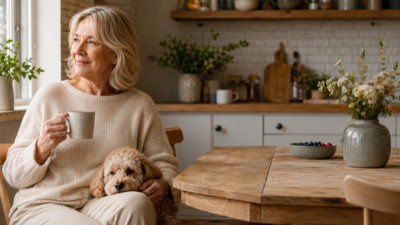
About this article: Three archetypal stories inspired by real conversations with dog parents. Names have been changed, and details are woven together from things that come up again and again in those conversations. The goal: to show what a dog's presence means in the life of someone whose home is slowly changing.
There are moments in life when a dog's role really comes into focus - the dog who has been there through the last few years. Through the years when the kids left for college. Through the years when a husband or partner moved on. Through the years when the house went quiet, and the morning coffee needed someone to say good morning to.
Statistics rarely capture something you hear all the time in conversations: who ends up being the dog's main person day to day? In my experience, often a parent living alone. Sometimes on their own after the kids have left, in the "empty nest," where the dog becomes the new center of the day.
The stories below aren't word-for-word records of specific conversations. Each one is built from things I hear again and again when I talk with dog parents. They show what that quiet presence really means.
Story 1: Anna and Migdał - after her son moved out
Anna comes home from work. She lives alone. Her son studies in another city and comes back once a month, or less. She opens the door and already hears a rustle. Migdał, her maltipoo, finds her with their eyes before she's even taken off her shoes.
The last two years had been hard. First her husband leaving. Then her son moving away. The apartment went quiet in a way Anna had never known before. The time that used to be filled with conversations, dinners, and watching a movie all together now simply passed.
Anna hadn't planned on a dog. But a family she knew had a puppy still looking for a home. "Migdał," Anna told her daughter on the phone the first time she saw the photo. "That's what I'll call them." And so Migdał stayed.
On weekends, Anna no longer waits for someone to call. She gets up in the morning and takes Migdał for a long walk. She comes back, drinks her coffee, plans her day. The dog lies under the table.
"I don't know how I would have gotten through all of it on my own," Anna tells her daughter on the phone. "Migdał doesn't know they were rescuing me. They're just there."
Her son comes to visit. Migdał greets him like one of their own - as if they'd known him their whole life, even though they've seen him maybe five times. The third member of this family: quiet, shaggy, essential.
Story 2: Krystyna and Lula - at eighty years old
Krystyna is eighty years old. She has lived alone since her husband died six years ago. Her children call every week, but they live far away - one in another city, the other even farther. Her granddaughter, Maja, lives closest, but that's still an hour and a half away.
Lula, her Yorkshire terrier, was a gift from her granddaughter for her seventy-fifth birthday.
"Grandma, get a dog," Maja said back then. "They'll keep you company."
Krystyna didn't want one. "What do I need a dog for at my age? What if I die?"
But Maja arranged a week of care with a family they knew: "Take them for a week, Grandma. You'll see."
After a week, Krystyna didn't want to give Lula back. After a week, she started going for a walk in the morning - before that, she used to get up late and sit in her armchair. After two months, she went to the doctor because a neighbor told her she looked younger. After six months, she said she was sleeping more peacefully. She always talked to her doctor about her medications, but she admitted herself that the rhythm of her days with Lula helped enormously.
When the family gathers at Krystyna's home, it's her granddaughter and her husband, the children on a video call, and Lula, who bounces around everyone as if they'd always known them.
"Maja was right," Krystyna tells her neighbor. "Lula really is a lifesaver."
Story 3: Małgorzata and Mela - after the empty nest
Małgorzata, fifty-three, works full time. Two sons, both of whom moved out within the same year: one for college, the other to move in with his partner. The apartment suddenly felt big. The rooms that used to always be occupied now stood empty.
Małgorzata hadn't planned on another dog. Their previous dog, Ofelia, had passed away three years earlier. The grief was still fresh.
Then, in the passageway near her building, she saw a notice. "Female dog rescued from the end of a chain, looking for a home." She stopped and took a photo. That evening, her husband found her sitting on the couch in tears: "Maybe we should call."
Mela arrived a week later. A herding-breed mix, fearful and wary. For the first two months, they hid under the table whenever someone opened the door. Małgorzata went through hundreds of websites, found a veterinary behaviorist, and started desensitization training.
A year later, Mela greets guests, loves their walks, and sleeps in a bed next to Małgorzata's.
"My sons come to visit sometimes," Małgorzata says. "But Mela is here every day. I know they won't replace my children. But they matter to me too. In a different way, but for real."
On special days, Małgorzata gets a call, flowers, and lunch from her sons. From Mela - a paw on her knee when she sits with her morning coffee.
What a dog's unconditional love really is
Stories like these aren't rare at all. In different versions, they play out in so many homes - almost everyone who shares their life with a dog has a version of one. Sometimes less dramatic, sometimes more. But the heart of it is the same.
What these stories have in common:
Presence without expectations or judgment. Your dog doesn't ask why you're sad. Doesn't suggest you should "pull yourself together." They rest their head on your knee and stay. That's enough.
A daily rhythm that helps you get moving on a harder day. The morning walk, feeding time, the evening round. For someone in an "empty nest," it's the kind of structure that started to slip away once the house grew quieter. You have to get up, go out, feed, care - even on a tougher day.
The feeling of being needed. A dog needs care - not in the sense of a problem, but in the sense of everyday attention. Someone who has a companion to look after also has a reason to get up in the morning. It's not just sentiment. For many people, it's an important part of feeling that the day has meaning and rhythm.
Physical closeness in silence. Calmly petting a dog can be genuinely soothing. Many dog parents say it plainly: sitting with their dog on the couch after a long day is a moment that eases the tension. No words needed.
Being listened to, without commentary. You can tell your dog how you feel. No one comments, corrects, or offers unwanted advice. Just presence. Sometimes that's all you need.
What we can do for the people who care for these dogs
If someone you love (a parent, grandparent, aunt, or neighbor) has a dog, here are a few things that genuinely make a difference:
Help with care on the harder days. Walking the dog in the rain when they don't have the energy. A trip to the vet if they can't get there on their own. Small things, but big to them.
Give them their quiet time when they want it. The dog is their companion. They don't always need visitors. Sometimes the best gift is an evening alone with the dog and a favorite movie - no plans, no guests, nothing to "check off."
Help them use technology. People who worry about leaving their dog for longer stretches often give up on their own plans: they skip visiting a sibling, cancel a doctor's appointment, don't meet up with friends. A dog monitoring app can help them feel more confident.
Listen when they talk about their dog. Do they tell you about the dog in detail? Listen. It's not "talking about the dog" - it's talking about their everyday life. About how they're doing. Often it's the most honest thing you'll hear.
Quotes worth sharing
Short quotes from this article worth sharing on Instagram or Facebook:
"A dog won't replace your children. But they matter too. In a different way, but for real."
"On weekends I no longer wait for someone to call. I get up, take them for a walk. The dog lies under the table."
"A dog needs you - not in the sense of a problem. In the sense of care."
"Migdał doesn't know they were rescuing me. They're just there."
Merdilo - a project we build with these dog parents in mind
Merdilo is a dog monitoring app we build in Toruń. Plenty of the people who use it are parents caring for a dog on their own. The question I hear all the time: "I have work, I have my kids, I have an aging parent to look after - how am I supposed to leave the dog alone all day on top of that?"
Using two devices, you can check in on what your dog is doing while you're at work or visiting family. The app sends notifications when it detects concerning sounds. The Calm Score after a session helps you gauge how your time away went, based on the sounds it picked up - it gives you an extra point of reference instead of just guessing once you're back.
For anyone who just wants peace of mind
If you know someone who worries about their dog every time they leave the house, Merdilo can be a practical gift they might not have reached for themselves. A dog monitoring app running on a second device, with notifications about concerning sounds and a report after every session.
In summary
- For many people, a dog becomes a real companion in everyday life - especially after the kids leave for college or the loss of a partner.
- Three archetypal stories: a parent after her son moved out, an eighty-year-old caring for a dog after losing her husband, and someone facing an empty nest who adopted a dog. Each of them finds in their dog something that had been missing.
- What a dog gives: presence without expectations, a rhythm to the day, the feeling of being needed, physical closeness, being listened to without judgment.
- What we can do: help with the small chores, give them space when they'd rather be alone with the dog, support them with technology, and listen when they talk about their dog.
This article was written with everyone in mind who, on a quiet morning, gets a dog's paw on their knee. That's love too. In a different way, but for real.
This article is emotional and informational in nature and does not replace a consultation with a veterinarian or a dog behaviorist. If you notice concerning behavior in your dog (prolonged howling, destructiveness, attempts to escape), it's worth talking to a specialist.