
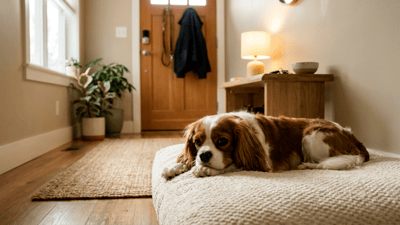
Who this is for: after a vacation or remote work you're heading back to the office, and your dog stays home alone for a few hours. You want to prepare them calmly and gently. If your dog already panics around separations or injures themselves, talk to a vet or a dog behaviorist.
If this sounds familiar, you're in good company. Struggling with time alone after a longer stretch at home is one of the most common challenges owners face when heading back to work - and one that genuinely responds well to calm preparation.
The secret is simple: the earlier you start and the smaller the steps, the more gently your dog moves through the change. Below we break it down - from reading what your dog really feels to a concrete plan for the weeks before you're back at the office.
Why the return can be hard - a dog after weeks together
After a break, your dog has grown used to you being home almost all the time. A sudden change of rhythm is a big leap for a dog - and there's no "misbehavior" in it, just an understandable reaction to a world that looks different overnight.
The data on Britain's "pandemic puppies" - dogs bought during lockdown who then had to learn to be alone once their owners returned to offices - shows just how common this is. In a peer-reviewed Royal Veterinary College study, 30.9% of dogs at 21 months of age showed separation-related behaviors.
A separate, independent project, "Generation Pup," observed such behaviors in 46.9% of puppies as early as 6 months of age - with the important caveat that this was a small subsample, and the broad definition of these behaviors isn't the same as clinical separation anxiety. These are two different studies and two different numbers, so it's worth not mixing them up.
Overall, it's estimated that separation anxiety (or separation-related behavior) affects roughly 14-20% of dogs - the exact figure depends on the study, and these struggles are reported more often after the return to in-person work. Treat these numbers as calm background, not a scare: if it's this common, it means there are proven, gentle approaches - and they work best when you start early enough.
Anxiety or boredom? How to tell what your dog really feels
Before you act, it helps to know what you're dealing with, because not every bit of damage is anxiety.
Separation anxiety is fear and panic, not the mere fact that your dog destroyed something. The specialist Malena DeMartini describes it as a genuine panic attack and a phobia of being alone. It's that emotional component that sets anxiety apart from ordinary boredom.
Boredom looks different. A bored dog can be destructive because they're looking for something to do, but they usually don't look frightened. The key cue from ASPCA: true separation anxiety happens only during the owner's absence or departure. If the "signs" also appear while you're home, the cause is usually something else: incomplete house-training, adolescent energy, a reaction to things outside.
A practical test is recording what your dog does after you leave. Distress right after the door closes points more to anxiety, while restlessness that builds only over time may suggest boredom. This is where Merdilo gently fits in: the app helps you hear whether barking, whimpering, or howling appears while you're away, and when - a hint of whether it's worth acting. It doesn't diagnose emotions, though, or detect where a sound comes from; leave the assessment to a specialist. And one more thing: your dog panicking doesn't mean you did anything wrong.
Start before your schedule changes - preparing ahead
The golden rule of prevention is simple: start practicing separations before your schedule changes, not on your first day at the office.
ASPCA advises getting your dog used to being alone through many short absences that don't cause unease, gradually extended over many weeks of daily sessions. So don't wait until Monday - start now, leaving your dog alone for short, lengthening stretches: head out for a walk on your own, work in another room, step into the garden for a moment.
Plan each "practice" separation to be shorter than the time it takes your dog to get anxious - the point is to practice calm, not stress.
It's also worth shifting your dog's routine toward your future schedule ahead of time. AKC advises moving wake-up, feeding, walk, and sleep times in stages, at least a week or two in advance, rather than overnight. There's one goal: to make your first day back at the office just another ordinary day for your dog, not a sudden, baffling change.
Desensitizing departure cues - keys, shoes, jacket without panic
Dogs quickly learn that keys, shoes, or a coat signal being alone - and tension rises at the mere sight of them. That's why it helps to defuse those cues.
The technique ASPCA describes is simple: perform these actions without leaving. Put on your shoes and coat, then sit down. Pick up your keys and stay at the table. Do it in a different order, several times a day, until the cues stop predicting anything.
Be patient: your dog has years of learning what these objects mean, so they need many repetitions. Do it calmly, 3-4 times a day, with your dog relaxed between repetitions. An important nuance: working on the cues alone usually isn't enough with real anxiety - it's one part of a broader, gradual process of getting used to the absence itself (with deeper anxiety, ideally with a specialist's help).
Alone-time training step by step - from seconds to hours
The heart of preparation is gradual alone-time training. It starts with literally a few seconds out of your dog's sight.
Go in stages. Practice a "stay" as you step to the other side of a door inside the home: first the bathroom door, then the bedroom, finally the front door. Only then gradually extend the time.
Always pair being alone with something good. Each time you leave, give a snuffle mat or a food toy that keeps your dog busy for 20-30 minutes. This builds the association "alone = nice."
Step back when signs of unease appear - panting, pacing, excessive licking, whining. That's a signal (from Dogs Trust) that the pace was too fast, not that your dog "can't cope."
Build independence while you're home too. Teach a calm "stay" on a bed in another room and reward self-reliance, not just demands for attention. And one thing for peace of mind: a realistic pace is weeks, sometimes months of small, daily work. It can't be rushed, and that's completely normal.
A tired, occupied dog rests more easily - exercise, scent, calm departures
A dog left alone tired and occupied handles separation far more easily than a dog with pent-up energy.
Exercise before leaving. Aim for at least 30 minutes of aerobic activity a day, ideally letting your dog burn off energy right before the separation. We cover more in our piece on exercise before an absence.
Scent and mental stimulation. Snuffle mats, puzzle toys, food served in toys rather than a bowl - chewing and licking have a calming effect on dogs.
Calm goodbyes and returns. No emotional scenes on the way out and no ecstatic greeting on the way back - too big a contrast between "here" and "gone" ramps up tension. Come home, say hello, and wait for your dog to settle. An honest caveat: chews, mats, and exercise are support and prevention, not a standalone "cure" for more severe separation anxiety.
See whether your dog settles after you leave
A second device left with your dog turns into a camera with sound recognition and a live view. As you head back to the office, instead of guessing how your dog handles those first longer separations, you simply see it - and it's easier to set a calm pace.
Support for the tough hours and when to get a specialist
While you're retraining, don't leave your dog alone beyond their tolerance threshold. If your dog can't yet handle a few hours and you're already back at the office, lean on support: a dog sitter, daycare, help from family or friends, or a few days off or flexible hours to start.
The point is simple: avoid leaving your dog alone beyond their comfort threshold until they're used to it - otherwise you set progress back.
When to get help? With moderate to severe signs, it's worth consulting a certified behaviorist or a veterinary behaviorist. A dog's reactions can be hard to read, and the plan needs adjusting as you go. We cover more on when to see a dog behaviorist.
In tougher cases, combining behavioral work with treatment can help - the decision about pharmacological support is always the vet's, always alongside reward-based methods, never aversive ones. And most important: separation anxiety isn't a life sentence. With patience, a gentle pace, and support, the vast majority of dogs learn that being alone is safe.
Frequently asked questions
How do I prepare my dog for going back to the office after the holidays?
The most important thing is to start early, not on your first day back. A few weeks before the change, slowly shift your dog's routine - wake-up, feeding, and walk times - toward your future schedule. Practice short absences every day: step out for a moment, come back calmly, gradually extend the time. Each time you leave, give your dog a snuffle mat or a food toy so being alone comes to mean something nice. The goal is for your first day back at the office to be just another ordinary day for your dog, not a sudden, baffling change.
How do I know if my dog has separation anxiety or is just bored?
The emotion matters, not the damage itself. With true separation anxiety, the dog panics - distress appears right after you leave or even as you're heading out. A bored dog can be destructive because they're looking for something to do, but they usually don't look frightened, and their restlessness may build up only over time. True anxiety happens only while you're away. A good way to check is a live view or a recording after you leave, to see how your dog really behaves. If you're unsure, it's worth consulting a behaviorist.
How long does it take to get a dog used to being alone?
Usually weeks, sometimes months of calm, small steps - and that's completely normal. Training starts with literally a few seconds out of your dog's sight and extends gradually, second by second, minute by minute. There's no quick fix, and trying to rush it usually sets progress back. If signs of unease appear, that's a cue to slow down, not that your dog "can't cope." Patience and a gentle pace matter more than how fast you reach a few hours.
Is leaving my dog a toy or a chew enough for separation anxiety?
A snuffle mat, a food toy, or a long-lasting chew is great support and prevention - it helps your dog link being alone with something good and keeps them busy for the first, hardest minutes after you leave. But with deeper separation anxiety it isn't enough on its own, because it doesn't remove the panic of being alone. Then the foundation is gradually getting your dog used to your absence, and for moderate to severe signs - help from a certified behaviorist or a veterinary behaviorist.
Does my dog really suffer when they're left alone after the holidays?
For a dog that had you around almost constantly for weeks, sudden silence in an empty home is a big change - and it's understandable that they need a moment to adjust. It's not a whim or misbehavior. The good news is that struggling with being alone is common and well understood, and gentle, gradual preparation really works. The vast majority of dogs learn that being alone is safe - especially when departures and returns are calm and the pace fits the dog.
Summary
- Start early - practice short absences and shift the routine in the weeks before you go back, not on day one.
- Tell anxiety from boredom - anxiety is panic and happens only while you're away; when unsure, record what your dog does after you leave.
- Desensitize departure cues (keys, shoes) and train alone time from a few seconds, always pairing being alone with something good.
- A tired, occupied dog rests more easily - exercise before leaving, scent work, calm goodbyes and returns.
- Don't leave your dog beyond their tolerance threshold - arrange support (a dog sitter, daycare) until they're used to it.
- Numbers are background, not a scare - with severe signs, talk to a vet and a behaviorist; most dogs learn that being alone is safe.
This article is a practical guide and helps you prepare your dog for time alone, but it doesn't replace a diagnosis. If your dog panics, injures themselves, or the signs don't ease despite your work, talk to a vet or a dog behaviorist.
Sources and further reading
- Brand, C. L. et al. (2024). "Pandemic Puppies: Behaviour at 21 Months." Animals (Basel). pmc.ncbi.nlm.nih.gov. 30.9% of dogs at 21 months with separation-related behaviors (UK "pandemic puppies" cohort).
- Generation Pup (2024). "Canine separation-related behaviour at six months." Animal Welfare. pmc.ncbi.nlm.nih.gov. 46.9% at 6 months (small subsample, broad definition); an effusive greeting linked to ~6x higher odds of these behaviors.
- JAVMA (2021). Epidemiological review of separation anxiety. avmajournals.avma.org. Prevalence estimates around 14-20% in the general population; higher figures apply to clinical populations.
- ASPCA (2021). "New ASPCA Survey." aspca.org. Scale of pandemic-era adoption in the US (US market data, not applicable one-to-one elsewhere).
- MSPCA-Angell (2021). Poll on owners' post-pandemic concerns (via Union Leader). unionleader.com. Measures owners' expectations, not a diagnosed rate of anxiety.
- ASPCA. "Separation Anxiety." aspca.org. Gradually getting used to being alone, desensitizing departure cues, exercise and a toy on leaving; the diagnostic feature (signs only while away).
- American Kennel Club. "How to Keep Your Dogs Happy During Your Transition Back to Work." akc.org. Shifting a dog's routine in stages, ahead of time.
- Companion Animal Psychology. Interview with Malena DeMartini. companionanimalpsychology.com. Separation anxiety as a genuine panic attack and phobia of being alone - the emotional component sets it apart from boredom.